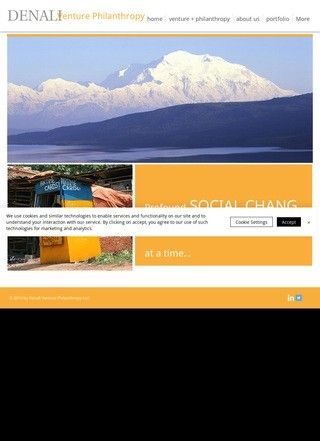
Denali Venture Philanthropy announces a due-diligence-first philosophy, then names none of the companies it has backed. PitchBook records four early-stage portfolio companies; Denali Venture Philanthropy's own Portfolio page offers thematic categories instead of names. For a fund that markets itself on disciplined impact-asset selection, the mismatch between method and disclosure is the first thing a prospective founder or co-investor should notice, and it does not resolve itself the further you read.
Founding structure and investment thesis
Denali Venture Philanthropy was founded by Bo Parfet and Meredith Parfet and operates out of Boulder, Colorado as a hybrid vehicle combining a for-profit investment fund with a charitable structure. Capital flows into early-stage companies, non-profit organizations, and social impact funds under one roof. The organizing thesis is that the hard boundary between investing and giving is itself an obstacle to impact, and Denali Venture Philanthropy is built to work across it. The fund screens candidates using venture-capital due-diligence methods and concentrates that effort on four areas: education, healthcare access, poverty reduction, and environmental protection. The fund also advocates for impact investing as a discipline and supports entrepreneurs pursuing social-change goals. In the fund's own framing, it reorganizes the Parfet family's earlier philanthropic work into a more formal investment structure capable of attracting co-investors who require a structured vehicle.
Leadership experience in finance and health
The leadership credentials are the most independently auditable thing Denali Venture Philanthropy publishes. Bo Parfet holds an economics MA from the University of Michigan and an MBA from Northwestern's Kellogg School of Management, came out of J.P. Morgan investment banking, and currently holds the Chief Growth Officer role at DLP Capital. Meredith Parfet, President of Denali Venture Philanthropy, also holds a Kellogg MBA and worked in global HIV drug management before this role; she simultaneously runs the Ravenyard Group, a crisis-management consultancy. The combination of finance experience and global-health operations is genuinely relevant to the healthcare and poverty themes the fund pursues. That alignment is not window dressing, and it is the strongest case Denali Venture Philanthropy makes for itself.
Limited public track record
Denali Venture Philanthropy carries no consumer ratings. There are no scores on Google, Trustpilot, Yelp, or BBB, and no review counts on any platform. That absence is normal for a private impact fund at this scale; the relevant peer group does not accumulate star ratings either. PitchBook lists a Denali Venture Philanthropy Fund profile. Tracxn records the firm with a single investor noted. The LinkedIn company page shows roughly 70 followers. The four-company figure from PitchBook is the only third-party confirmation of Denali Venture Philanthropy's activity volume, and for a fund positioning itself on due-diligence rigor, four named deals in total is a modest count.
Contact process and information gaps
Reaching Denali Venture Philanthropy means submitting a web form on the Contact page, which handles both general inquiries and media requests. The Boulder, Colorado address is listed. No phone number appears and no direct email is published. For a fund that explicitly positions itself as open to early-stage founders pitching social-impact ideas, a form-only channel creates friction. The explanation is easy enough to guess: public-facing emails invite unfiltered noise, and at this fund's size the principals likely handle their own inbound screening. Even granting that, a founder weighing whether to invest time in an approach has less to work with than most comparable funds provide. The site also lacks any FAQ addressing typical founder questions about check size, typical co-investors, or timeline from first contact to decision, which compounds the information gap.
Portfolio disclosure mismatch
Taken together, Denali Venture Philanthropy has built a coherent thesis and a credentialed founding pair. What it has not built is a public audit trail. Four portfolio companies across early-stage rounds is a limited record by any standard. The unnamed portfolio makes it impossible to evaluate sector distribution, exit history, or co-investor quality from the outside. Denali Venture Philanthropy states that it applies rigorous due diligence to every opportunity it considers; nothing published allows an outsider to verify that claim in any meaningful way. The disclosure standard the fund has set for itself does not match the due-diligence language it uses to describe its process, and that gap is not a minor omission for a fund asking founders to trust it with an approach.
When Denali fits your funding search
A founder working in education, healthcare, poverty reduction, or environmental protection who has already exhausted better-documented impact funds is the narrow audience Denali Venture Philanthropy realistically fits. Check the PitchBook profile for any named co-investors, then reach out through those co-investors for a direct reference before investing time in a formal approach to Denali Venture Philanthropy itself.