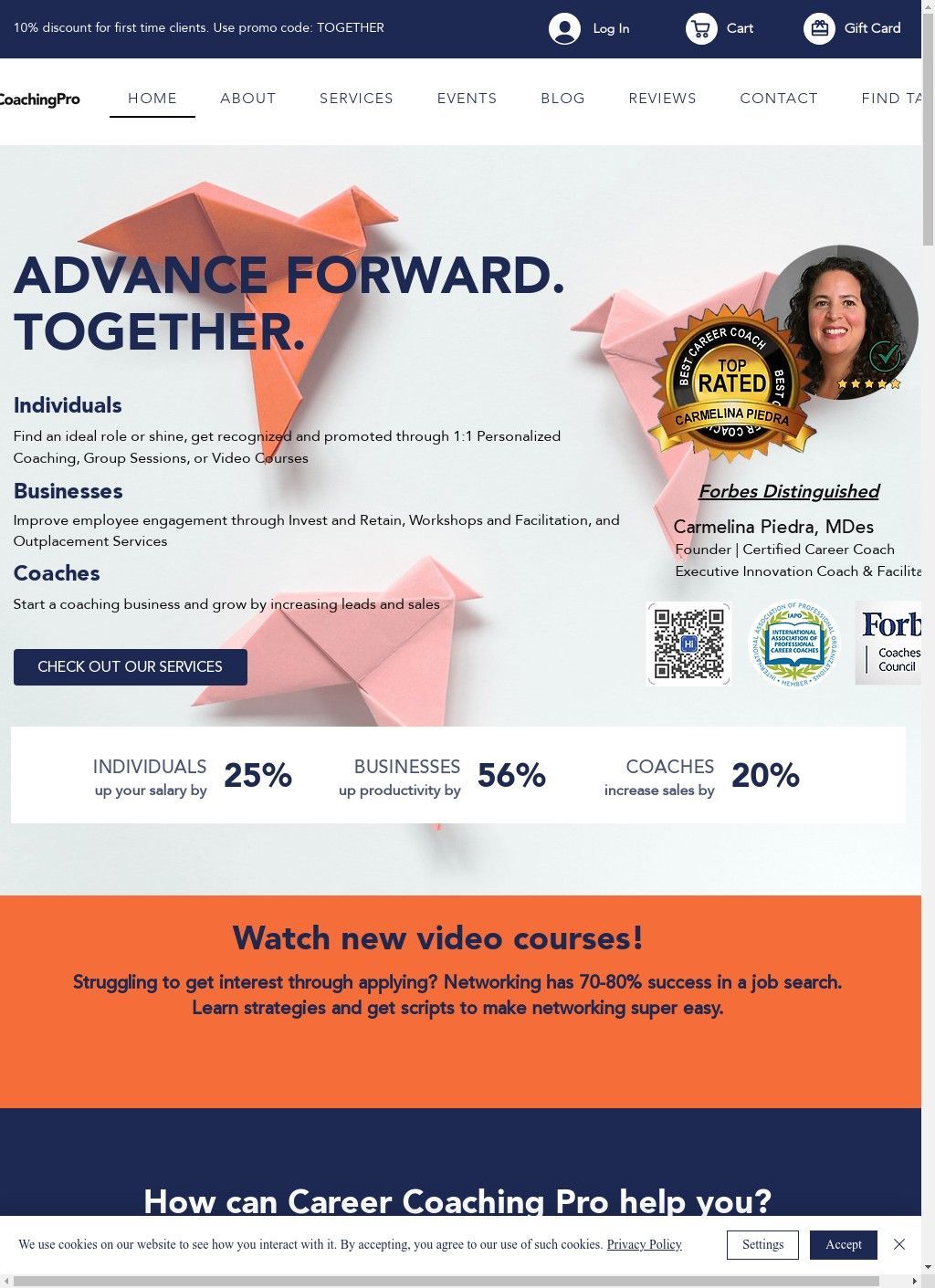
You have just been laid off, or the job you have is going nowhere, and the resume you dust off feels a decade out of date. That is the moment Career Coaching Pro is built for. Career Coaching Pro, founded by Carmelina Piedra during the COVID-19 pandemic specifically to help people knocked sideways by job transitions, sells essentially one thing: a guided way back into the market, whether that means a sharper resume, a rebuilt LinkedIn profile, or the nerve to ask for more money.
Piedra brings a stated fifteen years plus as a certified career coach, and the individual services map closely to the places job seekers get stuck. One-on-one coaching is the headline, the private sessions where a single client gets undivided attention on their own situation. Around it sit video courses for people who would rather work at their own pace and price, and group sessions for those who want company, accountability, and a lower cost of entry. The three formats cover the range from someone who needs a full hand-held rebuild to someone who just wants structured material to follow.
None of the three is a magic fix; each is a way of putting a trained set of eyes on the same problem a job seeker has been staring at alone.
The individual menu is specific, which helps. Resume writing and LinkedIn optimization are the entry points, the pieces most people already suspect are letting them down. Interview preparation and salary negotiation come next, and these are where an outside coach usually earns their fee, because most people are worse at talking about themselves and their pay than they think.
Beyond the immediate job hunt, Career Coaching Pro pushes into career advancement and skill development, naming Agile, general tech skills, and design thinking as areas it will build up. That last cluster is worth noting: it signals an audience aimed at office and knowledge workers moving up a ladder, more than trades or hourly roles, and it turns the service from a one-time job-search fix into something a client might return to as their career shifts.
The skill-development angle in particular aims squarely at people who already have jobs and want the next one, which is a different customer from the freshly laid-off worker the firm was born to help.
Three audiences under one roof
What complicates a quick read of Career Coaching Pro is that it sells to three very different buyers at once. The individual job seeker is only the first, and the other two change how you should see the firm.
Programs for businesses
For companies, Career Coaching Pro offers employee investment and retention programs, workshops and facilitation, and outplacement or redeployment services. The retention and investment programs point at employers trying to keep and develop the staff they already have, while the workshops bring the coaching into a room of people at once. Outplacement is the telling one. It is the service a company buys when it is letting people go and wants them landed somewhere else, and it ties straight back to the firm's origin story of supporting workers through transitions.
A business that runs a workshop through Career Coaching Pro is buying the same expertise the individual clients pay for, packaged for a room instead of one person. Redeployment, the sibling of outplacement, keeps people inside the company by moving them into roles that still exist, the kinder version of the same skill and a sensible thing for an employer to buy before it reaches for layoffs.
Support for other coaches
The third line is the one that gives a careful reader pause. Career Coaching Pro also coaches other coaches: it offers business startup support, lead generation, sales-growth strategy, and digital marketing services to people trying to build their own coaching practice. There is nothing wrong with teaching what you know, and a coach who has built a working practice has real knowledge to sell.
But a business like Career Coaching Pro that both coaches clients and sells the blueprint for running a coaching business is spread across a wide field, and a prospective client is entitled to ask which line has the founder's attention on any given week. The skills that make someone a strong career coach and the skills that fill a sales pipeline are not the same, and doing both well is a tall order.
The reassuring read is that a coach who sells growth to other coaches presumably practices what she teaches; the worrying read is a calendar split too many ways to give any one client full attention.
Everything at Career Coaching Pro runs remotely over Zoom, which fits a business built for remote delivery from the start and makes location irrelevant. A client in a small town gets the same access as one in a major city. For a service that is essentially conversation and feedback, video is a reasonable fit, and it holds costs down on both sides.
There is a live incentive for first-timers. Career Coaching Pro offers a ten percent discount on one-on-one coaching to new clients, applied with the promo code TOGETHER. It is a modest nudge, the kind most service businesses run, and it lowers the cost of trying a first session without committing to a package.
The proof is where the picture gets shakier. Career Coaching Pro leans on a testimonials page that reports striking numbers: clients claiming three times the interest in interviews, twice the job offers, twenty-five percent more salary, and four times the likelihood of promotion. Read those figures with care. They are self-reported and gathered by the business itself, with no methodology and no independent check behind them. Three times the interest compared to what starting point, measured how, over what period? None of that is shown.
Impressive multipliers with no baseline are the easiest kind of proof to produce and the hardest to trust. A prospective client who wants to believe them still has to decide how much weight a company's self-graded scoreboard can carry.
Independent verification is sparse. Third-party listing pages do exist, one on InHerSight and one on Shortlister, but neither shows a numeric star rating or a review count, so there is nothing external to weigh against the in-house testimonials. A Trustpilot page with a four star rating and a solid pile of reviews turns up in searches, but it belongs to a differently named, differently owned company and has no bearing on this one, and counting it here would be an easy mistake for a careless reader to make.
No Google, Yelp, Facebook, or Better Business Bureau rating specific to Career Coaching Pro surfaced at all. For a company built around the pandemic-era job crunch, that absence of independent, numeric feedback is the biggest gap in the file.
Contact is workable but light. An email address and a contact page are there, along with active links to LinkedIn, YouTube, Instagram, and Facebook, so Career Coaching Pro is reachable and visibly present online, and the YouTube and Instagram feeds double as a low-stakes way to sample the coaching voice before booking. What is missing is a phone number or a physical address.
For a coaching relationship, where trust is the whole product, some prospective clients will want a voice on the line before they book, and its absence stands out even though a contact form and social channels partly cover it. The heavy reliance on social platforms also means a slice of the firm's credibility lives on channels it does not fully control, which cuts both ways.
The offering itself is coherent and clearly built by someone who has done the work: the individual services target real pain points, the business and coach programs extend the same skill set logically, and the Zoom-first delivery is sensible. Carmelina Piedra's credentials and the transition-focused origin give Career Coaching Pro a genuine reason to exist, and the range of formats means most budgets have a way in.
The doubt sits squarely on proof. The most persuasive claims on the site, the multipliers on interviews, offers, salary, and promotions, are exactly the ones no independent source confirms, and the wider web offers no rated, countable verdict from real clients to lean on. A first-timer gets the ten percent discount and a low-risk entry, but is still, in the end, taking the results on the word of Career Coaching Pro, and the numbers that would settle that question are the ones the company grades itself on.