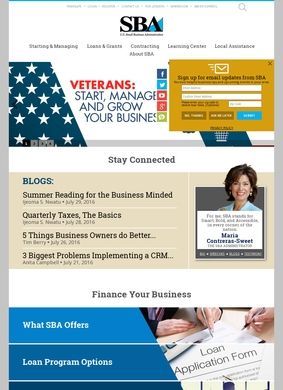
Someone with a sound idea and no clear path to the money usually ends up stuck at the same wall, unsure where a first-time owner goes to find a loan that a bank will honor, which business structure to register, and what taxes will hit once revenue starts. The US Small Business Administration is the federal agency built to answer exactly those questions, and the breadth of what it puts in one place is the main reason to send people here before they pay a consultant for the same information.
Loan programs and financing options
The financing side is the part most visitors come for, and it is concrete. The 7(a) program covers general-purpose borrowing up to $5 million, the 504 program is aimed at fixed assets such as real estate and equipment, and the Microloan program handles smaller needs up to $50,000. None of this is direct lending in the way people sometimes assume. The US Small Business Administration backs loans that approved lenders issue, and the Lender Match tool exists to connect a borrower with those lenders instead of leaving them to cold-call banks one at a time. For a business hit by a declared natural disaster, there is a separate disaster assistance portal, which is one of the few places federal money flows more directly.
Finding lenders through Lender Match
The more substantial contribution, though, is the sheer volume of guidance that has nothing to do with borrowing. Content runs through the whole arc of a company: market research, writing a business plan, choosing a structure, registering, getting licenses, hiring, handling taxes, and then scaling once the thing is actually running. The SBA Learning Center adds free online courses on top of the written material. A reader who has never owned anything before can move from a vague concept to a registered entity using what is published here, without paying for a single piece of it.
Building a business from concept to registration
Federal contracting is the other half of the mission, and the US Small Business Administration lays out the certification programs in plain terms. The 8(a) Business Development program serves socially and economically disadvantaged owners. HUBZone targets firms in historically underutilized business zones. There are dedicated tracks for women-owned small businesses, for veteran-owned and service-disabled veteran-owned firms, each with its own eligibility rules. These certifications are not abstract badges; they determine which set-aside contracts a company can compete for, so getting the designation right has direct financial consequences.
Federal contracting and certifications
To support that side, the site carries a size-standards lookup so an owner can check whether the government even counts them as small in their industry, plus contracting opportunity guides and procurement scorecards that track how agencies are doing against their small-business targets. It is detailed material, and it rewards the patience to read closely. The US Small Business Administration does not water it down, which is appropriate given that a wrong assumption about eligibility can sink a bid.
Checking size standards and procurement rules
Beyond loans and contracts, the reach of the US Small Business Administration keeps widening. There is an Onshoring portal that connects businesses with U.S. manufacturers, export and trade assistance for companies looking past the domestic market, and a specific strand of support for child care businesses. Surety bond help and a directory of SBIC investment capital sit alongside the rest, which means equity-seeking firms are covered as well as debt-seeking ones.
Accessing capital beyond traditional loans
One thing worth flagging is that the US Small Business Administration does not try to do everything from a screen. It maintains a nationwide network of local partners: Small Business Development Centers, SCORE mentoring chapters, Women's Business Centers, and Veterans Business Outreach Centers. A lot of early-stage trouble is specific to a person and a place, the kind of thing a web page cannot diagnose. The US Small Business Administration points people toward an actual advisor in their region, which is a more honest answer than pretending a checklist solves everything.
Connecting with local advisors in your region
The trade-off in all this breadth is that the site can overwhelm. The sheer number of programs, acronyms, and eligibility thresholds means a newcomer can spend real time just orienting before any of it pays off. The 8(a) and HUBZone rules in particular take effort to parse, and someone hoping for a quick answer about whether they qualify will not always get one in a single visit. This is a reference built for following carefully, not skimming.
Navigate the programs with patience and care
The verdict is favorable but measured. As the definitive source on federal small-business loan programs, certification paths, and government contracting, the US Small Business Administration has no real substitute. The information is authoritative and free, which puts it well ahead of the paid guides that mostly repackage the same rules. The catch is that it rewards patience rather than rewarding speed. A newcomer who treats it as a working reference, reading carefully and using the local partner network when the published material runs short, will get real value from it. Someone who arrives hoping for a one-page summary will likely leave confused.