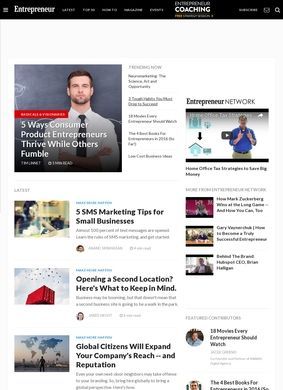
Entrepreneur is a business-media website published by Entrepreneur Media, LLC, and it covers how to start, run, and grow a company from the first idea to a scaled operation. The homepage sorts everything into a handful of broad tracks, each deep enough to hold a founder for an afternoon, and the whole thing reads like a working reference library for small business rather than a daily news feed. The content is free to read, and the paid products sit off to the side.
What the site publishes and sells
The bulk of the value sits in the free editorial, organized by the stage a business has reached. Someone still testing an idea, someone hiring a first employee, and someone trying to push past a growth plateau each land in a different corner of the site, and the practical guidance is written to be used, not admired.
Below the articles, the company runs a set of tools and services that turn Entrepreneur from a magazine into something closer to a small-business marketplace, which is worth understanding before a reader clicks anything that costs money. The mix of free reading and paid service is the whole model, and it is fairly transparent once you see the shape of it.
Build your business
The Build Your Business track is the backbone of the site. It opens on market research, planning, funding, and launching operations, then moves through branding, team building, online presence, and the daily grind of running a company, before finishing on finances, HR, customer service, and the sales, marketing, and leadership demands of growth. That is a complete lifecycle laid out in one section.
A reader can follow it in order, the way you would work through a course, or drop straight into a single stage when a specific problem lands on the desk that week. Entrepreneur keeps this section stocked with practical how-to pieces and founder interviews, and the depth here is the strongest single argument for bookmarking the site.
It is the part that rewards a return visit, because there is always another sub-topic under the one you just read.
Side hustles and passive income
The Side Hustles and Passive Income area is where the site leans hardest into its most-searched territory. It carries hundreds of side-hustle ideas, first-person success stories, passive-income guides, and gig-economy resources, and the volume is genuine rather than padded out to look impressive. For a reader holding down a day job with a spare evening or two, this is the practical heart of Entrepreneur, and it is probably the section that pulls the most traffic through search.
A word of caution belongs here: the success stories can tip into hype, and the headline earnings figures read like marketing. A sceptical reader should treat those numbers with suspicion and mine the underlying idea lists instead, which are solid starting points on their own.
Franchise opportunities
Franchise coverage works more like a tool than a reading section. There is a franchise directory with a matching feature, the annual Franchise 500 rankings, and a filter that sorts opportunities by investment level, from under 25,000 dollars to more than 150,000, with guidance on multi-unit ownership layered on top.
A would-be buyer can move from browsing concepts to comparing capital requirements in a few clicks, which turns a vague ambition into a shortlist. That is a concrete, usable service, and it is the kind of resource most general business sites never bother to build, which is part of why Entrepreneur is known in franchise circles at all.
The Franchise 500 in particular gives the section a recognizable annual anchor that pulls repeat visits each year, and it is genuinely handy for a first-time buyer with no idea where to begin. The filter by investment level is the practical core of it, since it lets someone with a fixed budget rule out concepts they could never afford before wasting an afternoon reading about them.
Tools, help, and how it checks out
The reading is the draw, but the site also runs on paid products and leans on reader trust, so both deserve a look. Here the picture turns a little less flattering than the polished editorial suggests, and a fair review has to say so.
Start Your LLC and the paid extras
Beyond the articles, the company sells a broad shelf of services. A Start Your LLC formation service handles company registration, and alongside it sit magazine subscriptions, daily and topic-specific newsletters, webinars and white papers, video content and podcasts, and a press-release publishing platform. It is a wide catalogue, and it explains how a free-to-read publication funds itself without a hard paywall.
A reader should know going in that some prominent links lead to paid Entrepreneur products and not free advice, and the site does blur that line in places, so it pays to notice which Entrepreneur buttons carry a price tag before clicking. None of it is buried or dishonest, but the commercial layer is substantial, and a visitor gets more out of the site by reading it with open eyes than by treating every recommendation as neutral guidance.
Outside reputation for Entrepreneur is sparse and a little muddled, which is worth flagging for a site this large and this old. Trustpilot has a page for it but shows very low engagement, only about seven contributed reviews, with no aggregate star rating visible. SmartCustomer lists it at 2.1 out of 5 from 28 reviews, and one visible complaint calls it a bunch of thrown-together websites while disputing vendor legitimacy, though it is genuinely unclear whether that reviewer is describing this publication or a similarly named business.
Two automated scanners, ScamAdviser and Scam Detector, both assess the domain as legitimate and high-trust, but those are safety and security checks, not human review platforms, and they say nothing about editorial quality. No Yelp, Google, BBB, or customer-facing Glassdoor rating for the publication itself turned up; the Glassdoor entries that surfaced belonged to unrelated organizations.
Contact is where the site is weakest. The main pages list no phone number and no physical address, and support runs through a separate help portal instead of a general contact page or email. A visitor can reach the company by signing up for a newsletter, but anyone wanting a direct line has to go hunting for that help portal.
For a publisher of this size the gap reads as a deliberate choice to push everything through self-service, and it works well enough for account and billing questions, yet it leaves a first-time reader with nowhere obvious to write when something goes wrong.
The balance at Entrepreneur comes down to two different piles: deep, genuinely useful content on one side, a muddled contact setup and a barely-there outside reputation on the other. Which pile counts for more depends on why someone showed up in the first place. A founder working through the Build Your Business track gets one of the better-stocked libraries on the web at no cost. A buyer about to pay for the LLC service or another paid product is doing business with a publisher whose own review trail is almost empty.