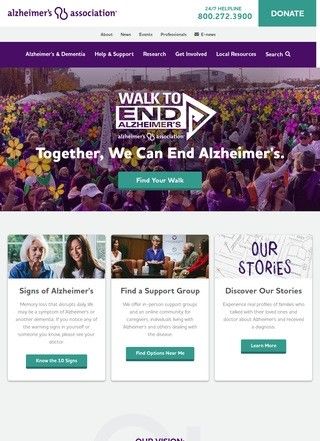
At the front of alz.org sits the 24/7 Helpline at 800.272.3900, available in more than 200 languages, and that placement tells you a lot about how the Alzheimer's Association sees its job. This is not a site built to impress. It is built for people in the middle of a crisis: a new diagnosis, a parent who has started wandering, a spouse who no longer recognizes the house. The phone number is treated as the main product, and everything else on the site backs it up with care consultations, support groups, and explanations a frightened family can read at two in the morning.
24/7 helpline for people in crisis
The numbers behind the work are not abstractions. The Alzheimer's Association puts the population it serves at over 7 million Americans living with Alzheimer's disease and related dementias, alongside an estimated 13 million caregivers. The caregiving section is written for someone who has to figure out, this week, how to handle a relative who keeps asking the same question or refuses to bathe. Care consultations and both local and online support groups are offered as concrete next steps, which is more useful than a wall of definitions.
Caregiving strategies for daily problems
The educational material is where the Alzheimer's Association earns serious credibility. It walks through early warning signs, what a diagnosis actually involves, and the treatment options currently on the table, without simplifying to the point of uselessness. There is an interactive brain tour that shows how the disease moves through different regions, and it is a genuinely good teaching tool for a topic most people only half understand. Brain health gets its own thread, framed around what someone can do now rather than vague reassurance.
Interactive brain tour and disease stages
The proportion is right. The content does not promise cures or hide the grim parts. It explains stages, it explains what to expect, and it points caregivers toward strategies for the daily problems that wear families down. For a condition where false hope is everywhere online, the Alzheimer's Association keeps its footing and stays honest about what is known and what is not. That discipline is rarer than it should be.
Research funding and policy advocacy
The research mission runs in parallel to all of this. The organization funds dementia research projects around the world and pushes hard on policy, advocating for larger federal research budgets and legislative change. That dual role, funding science while running a helpline, is unusual, and the site makes the connection plain: money raised by ordinary supporters flows into both the lab and the living room.
Walk to End Alzheimer's and community events
Community engagement is where the Alzheimer's Association turns sympathy into activity. The Walk to End Alzheimer's and The Longest Day are the headline fundraising events, and the site folds in volunteer opportunities and tribute pages for people who want to honor someone they have lost. None of it feels bolted on. The events feed the research and support work already described, so a person who signs up for a walk can see, on the same site, where that effort goes.
For people who want to learn without leaving home, ALZ Talks webinars cover specific topics in a format that suits caregivers short on time. The Alzheimer's Association also connects users into a wide network: more than 30 national partnerships and over 900 local community partnerships, with chapters operating in all 50 states. Dementia care is intensely local. A caregiver in rural Montana needs a different set of contacts than one in Chicago, and a chapter system is the structure that makes that possible. This entry sits in a business directory under finance, but the substance is squarely a national health and social-services operation.
One thing worth naming plainly: the breadth that makes the Alzheimer's Association so capable can also make the site feel like a lot at once. A caregiver arriving in a panic faces helpline, support groups, education, brain health, research, advocacy, walks, webinars, and chapters, all presented as roughly equal doors. The helpline number cuts through that, and it should, but the sheer volume of paths is a real consideration for someone with no patience left.
How does the organization split its funding?
The funding model deserves a clear-eyed look too. Because the Alzheimer's Association raises through events and donations and channels money into both research grants and direct support, a visitor cannot tell from the public pages how the split actually lands. The site explains the mission well. It is less forthcoming about how a given dollar divides between a research project overseas and a support group down the street, and for a donor that distinction is not trivial.
A search for independent ratings or aggregated user reviews of alz.org turns up very little; the organization is too established and too non-commercial for that kind of profile to accumulate. What exists instead is decades of media coverage and peer-reviewed citations. That record is consistent with everything the site presents about itself.
Taken together, the Alzheimer's Association is the most complete starting point available for a worried family. The helpline alone justifies a visit, the education is sober and well made, and the research funding gives the whole thing a purpose larger than comfort. The Alzheimer's Association is doing serious work on a disease that is still winning, and the site reflects that seriousness without dressing it up. Given the scale of what the Alzheimer's Association is trying to do, that honesty counts for something.