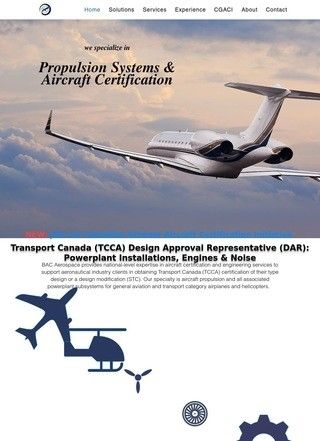
BAC Aerospace Electric Aircraft Propulsion is a Canadian engineering consultancy that helps aircraft programs through certification, with a particular focus on propulsion systems. The service it sells is fundamentally regulatory: aircraft type certification, Supplemental Type Certificate (STC) support, compliance findings, and design analysis built to satisfy the people who sign off on whether an aircraft may fly. The principal, Chris Baczynski, holds a Design Approval Representative delegation under Transport Canada authority for powerplant installations. That delegation reflects a working relationship with the regulator, and it is what lets BAC Aerospace Electric Aircraft Propulsion make compliance findings on behalf of the certifying body for the systems it covers.
Propulsion systems certification at the aircraft level
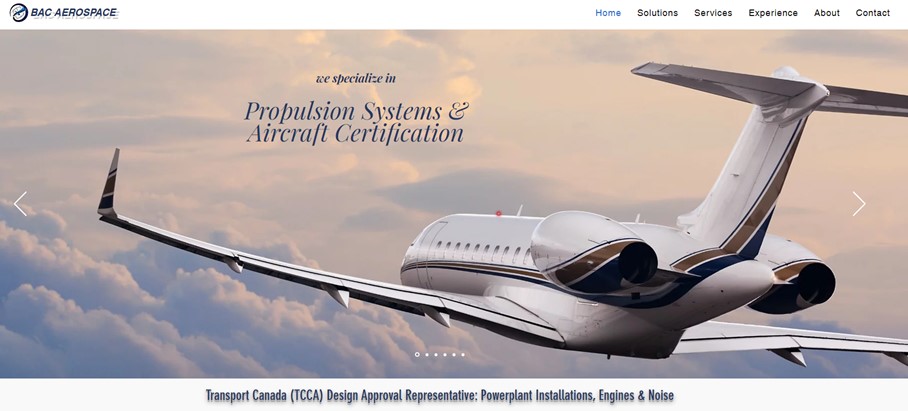
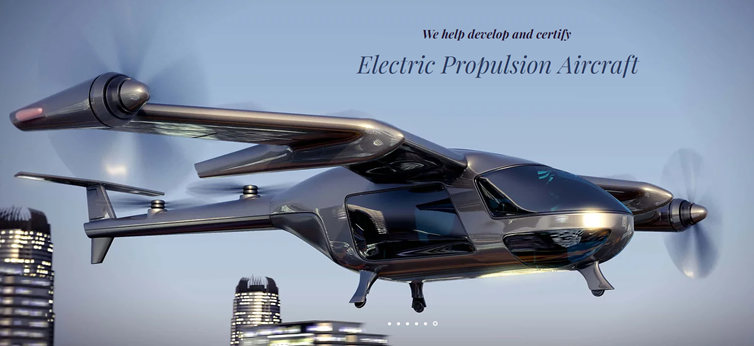
The technical specialty is narrow on purpose. Plenty of shops help certify an airframe or an avionics change. BAC Aerospace Electric Aircraft Propulsion concentrates on propulsion at the aircraft level, meaning the entire powerplant installation rather than the engine or motor in isolation. That distinction is where most of the difficulty lives in practice. A new motor on a test stand is one problem; the same motor mounted, cooled, fed, wired, and integrated into a real aircraft that has to survive a full certification campaign is a much larger one. The site positions the firm squarely in that second space. The scope listed covers fixed-wing aircraft, helicopters and other rotorcraft, electric and hybrid-electric propulsion, and eVTOL designs, which together sketch the range of programs where this kind of help is actually needed.
From startup electric aircraft to established OEMs
That spread of aircraft types tells you who is meant to walk through the door. Established OEMs with existing programs are one audience. The more interesting one is the wave of startup electric aircraft companies with promising powertrains and very little experience in what Transport Canada or the FAA will demand before anything carries a passenger. Certification is the wall those startups hit, and learning by trial is expensive. A consultant who has already done the regulatory groundwork is, for that kind of client, less a convenience than a prerequisite.
Investment connections through CGACI membership
One claim on the site goes beyond ordinary consulting work. BAC Aerospace Electric Aircraft Propulsion is described as the founding member of the Canadian Greener Aircraft Certification Initiative, or CGACI, an effort that connects early-stage electric propulsion companies with technical expertise and, notably, with investment connections. Pairing a certification path with access to funding addresses the two things a young aerospace startup tends to lack simultaneously, and most engineering consultancies offer only the first. Whether the investment side is a formal network or a looser set of introductions is not spelled out in the available material, so a prospective client would want to ask exactly how that pipeline works before counting on it.
The compliance side rounds out with what a real certification project needs along the way: engineering design, analysis, and testing aimed at producing the evidence regulators require, plus assistance with international import and export certification. For a company trying to sell an aircraft across borders, that last piece has direct practical consequence, since a certificate valid in one jurisdiction does not automatically travel to another.
Verifying credentials without public reviews
The public record is limited. No notable third-party reviews turned up in a search. BAC Aerospace Electric Aircraft Propulsion appears on AZoM supplier listings, but those carry no ratings or review counts, and no Google, Trustpilot, Yelp, or BBB presence surfaced. For a consumer-facing operation that absence would be a real strike. For a specialized aerospace consultancy whose clients are OEMs, certification authorities, and funded startups, the picture is different. Work of this kind is won through reputation inside a small professional circle and through the delegation credential itself, not through accumulated star ratings from the general public. The absence of public reviews is a genuine limit on what an outsider can independently verify, and it would be dishonest to pretend otherwise, but it does not by itself point to a problem.
The way to reach the firm is minimal. There is a form-based contact page and the principal points people toward LinkedIn outreach, which fits a one-person delegate practice reasonably well. Even so, the site lists no phone number and no physical address. A buyer about to engage a long, costly certification program generally wants to know who they are dealing with and where. A form-only front door asks them to take a first step on faith, and adding a phone number and a stated location would close that gap at no real cost.
BAC Aerospace Electric Aircraft Propulsion is a credible, tightly focused specialist whose value sits almost entirely in the Transport Canada delegation and the propulsion expertise behind it. Polished presentation and a long list of testimonials are not part of the picture, and the firm does not lean on them. The CGACI founding role and the explicit interest in electric, hybrid, and eVTOL work place BAC Aerospace Electric Aircraft Propulsion where a meaningful slice of new aviation is heading. The limited public footprint and form-only contact both give pause. What the published record shows is a regulator-recognized delegate who lives inside the exact certification problem this class of client is facing; what it does not show is the kind of verifiable track record a buyer can look up independently when deciding where to place serious program budget.
Business address
BAC Aerospace Inc
634 Landry St,
Rockland,
ON
K4K 1K7
Canada
Contact details
Phone: 613-909-8747