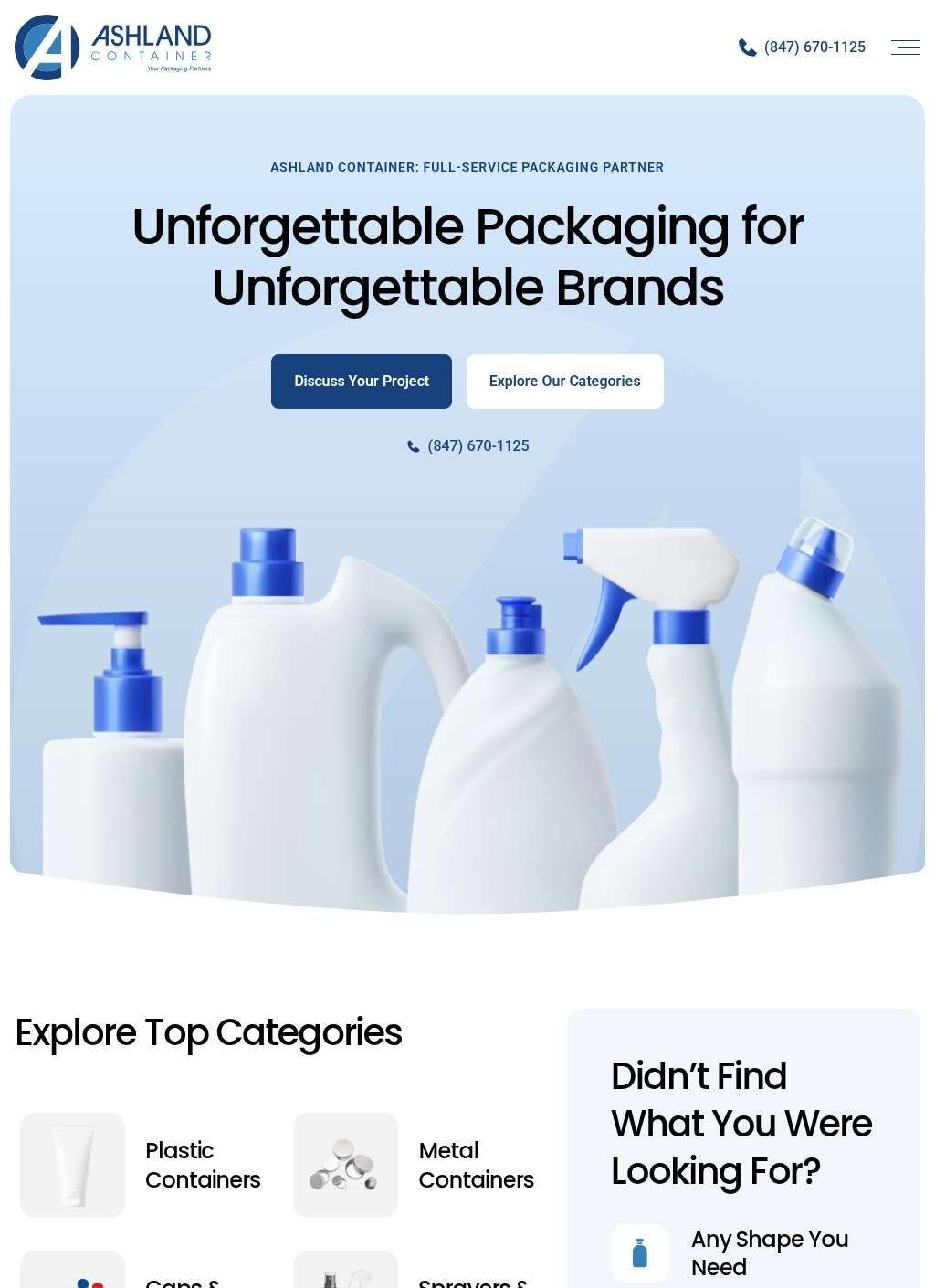
A cosmetics brand getting ready to launch a new face serum hits the same wall every product team hits: the formula is finished, but the bottle, the pump, the cap, and the secondary packaging all have to be sourced, tested, and ordered in volume before anything ships. That sourcing job, across glass, plastic, and metal, is what Ashland Container Corp. has built its trade on out of the Chicago area for more than fifty years. The Ashland Container site reads like a supplier that already knows the questions an inbound buyer will ask, because it answers them before you have to dig.
Wholesale distribution across containers and closures
The core of the operation is wholesale distribution. The Ashland Container catalog runs across glass jars, bottles in plastic and metal, plus the closures and dispensing hardware that turn a container into a finished package: caps, sprayers, pumps, measuring devices, and a range of flexible packaging. That breadth matters for a buyer who would rather place one coordinated order than chase a bottle from one vendor and a matching pump from another. A company sourcing a lotion package, for instance, can line up the jar, the closure, and the applicator from a single point of contact, which cuts down on the fit-and-compatibility headaches that come from mixing suppliers. The depth of the closure and dispenser range is the detail a packaging buyer tends to notice first, since a perfect bottle with the wrong pump thread is no use to anyone.
Custom packaging design with in-house engineering
Beyond stock items, Ashland Container leans on an in-house engineering and design team for clients who want something distinctive on the shelf. The site frames this as custom packaging design instead of off-the-rack selection, and it pairs that with practical add-on services: container decorating, warehousing, and packaging billed as more eco-friendly. Warehousing is the quietly useful one here. A brand that orders in bulk to hit a price break still has to put those units somewhere, and a distributor that holds inventory takes a real logistics problem off the customer's plate.
Decorating, warehousing, eco-friendly packaging
The decorating service is the piece that turns a plain container into branded product, so a buyer who wants printing or labeling handled upstream does not have to route bare bottles through a separate converter. Custom work and stock supply sitting under one roof is a sensible structure for the kind of mid-volume brand that needs more than a generic bottle yet has no reason to tool an entirely bespoke mold from scratch. The Ashland Container design team is the bridge between those two extremes, and pairing it with the company's own warehousing means a custom run can be produced, decorated, and held in one place. That continuity is harder to get when design, printing, and storage are split across three vendors who each blame the others when a tolerance slips.
Industry focus on regulated sectors
Who all this is built for becomes clear from the industry pages. The catalog is pointed at Health and Beauty, Pharmaceutical, Household and Industrial chemicals, Pet Care, Food, and Beverages. That spread is coherent. These are the sectors where the container is regulated, where chemical compatibility between product and packaging is a genuine engineering concern, and where a buyer benefits from a distributor that has handled a child-resistant closure or a chemical-grade bottle before. A pharmaceutical packaging requirement and a household cleaner package are very different problems, and Ashland Container addresses them as such with dedicated pages rather than lumping them under one generic catalog entry.
Who qualifies as a customer here?
The order thresholds settle any ambiguity about who the customer is. Stock items carry a minimum of 5,000 units, and custom products start at 100,000. These are wholesale numbers, full stop. A craft maker filling a few hundred jars a month is not the audience, and Ashland Container does not pretend otherwise. That honesty is worth something. A buyer learns within a few clicks whether they are in the right place, and a procurement manager at a brand doing real production volume will read those minimums as a sign they are talking to a peer instead of a hobby supplier. Ashland Container is plainly set up for accounts that reorder, not for one-time curiosity buyers.
B2B structure without consumer clutter
It also reframes how to read the rest of the Ashland Container site. The sourcing-expertise and custom-solutions sections are pitched at someone who buys packaging as a job, not a one-off, and the tone follows suit. There is no consumer-store clutter, no cart for a single bottle, just the structure a B2B account expects. For the right reader that focus is a feature, and for the wrong one it is a clear sign to look elsewhere.
Direct phone lines and physical locations
On reachability, Ashland Container does well by buyers who want to talk to a person. Two physical locations are published, one in Chicago Heights and one in Palatine, along with a direct phone line and stated business hours running weekday mornings into mid-afternoon Central time. For a wholesale relationship that often opens with a quote request and a conversation about specs, having addresses and a phone number in plain view is exactly the right call. Nothing about contact is hidden behind a single form, and the published hours set a fair expectation of when a call will be answered.
Limited public reviews for B2B operations
Outside validation is where the picture gets sparse. The company has a Better Business Bureau profile tied to the Chicago Heights location, but it sits at "Not Rated" with no accreditation confirmed, so it offers presence without a verdict. Across the consumer platforms where a buyer might go hunting for star ratings, Google, Yelp, Trustpilot, there are no review counts or scores to report for Ashland Container. That is not unusual for a strictly B2B distributor, where reputation tends to travel through procurement networks and repeat accounts instead of public five-star tallies, but it does mean a first-time buyer cannot lean on crowd feedback and will have to qualify the supplier the old-fashioned way: references, a sample order, a direct conversation.
Inside the Ashland Inc. name confusion
One trap deserves a flag. A search for the name surfaces a Glassdoor page with hundreds of reviews and a middling score, but that profile belongs to Ashland Inc., the chemical company, an entirely separate business. A buyer doing due diligence should not let those numbers attach to Ashland Container; they describe a different organization entirely. The shared word in the name is the only connection.
Regional alternative to national distributors
Weighed against a national packaging distributor like Berlin Packaging, which carries deep inventory and a polished web storefront but can feel like one account among thousands, Ashland Container reads as the more hands-on regional option, the kind of supplier where the design team, the warehouse, and the person answering the phone are all close to your order. The trade-off is the thinner public track record.
For a brand near the Chicago area that values a real local relationship and meets the volume minimums, this is a supplier worth requesting a quote and running a sample order; the in-house design capability and the fifty-year tenure are not cancelled out by a "Not Rated" BBB line. A buyer wanting the reassurance of a long public review history should put it beside a larger name, but the published evidence is enough to open a conversation.
Important pages
Business address
Ashland Container
475 E Joe Orr Road,
Chicago Heights,
IL
60411
United States
Contact details
Phone: 708-758-8800