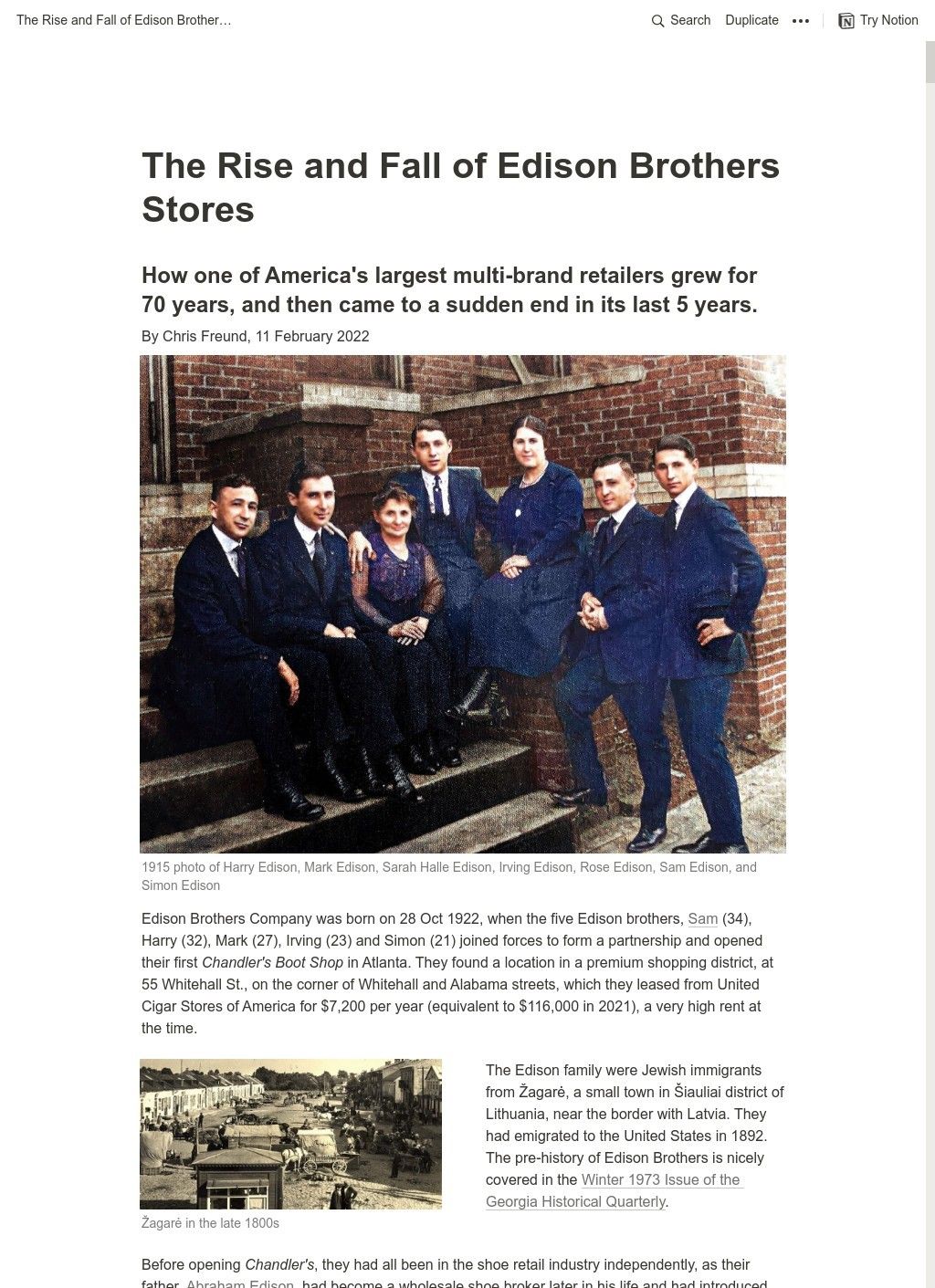
Shoe companies do not usually attract long-form histories, but Edison Brothers Stores is not a typical case. The Rise and Fall of Edison Brothers Stores is a written account of a footwear retailer that held, for over four decades, the distinction of being the largest of its kind in the United States, and it follows the company from its 1922 founding to two Chapter 11 filings and eventual liquidation. The page lives on Notion, written by Chris Freund, great-grandson of co-founder Sam Edison. That family connection runs through everything here, and it is better to know it upfront than to discover it halfway through.
From founding to multi-brand expansion
The article opens at the beginning. Sam Edison and his brothers incorporated on October 28, 1922, and the narrative follows the business outward from there through decades of expansion. What the page does well is name names. Edison Brothers did not operate under a single banner; it launched or acquired a long string of brands over the years, and The Rise and Fall of Edison Brothers Stores walks through them: Chandlers, Bakers, Leeds, Burts, Oaktree, Jeans West, the 5-7-9 Shops, Joan Bari, Wild Pair, Fashion Conspiracy, Repp Big and Tall, Handyman Hardware, United Sporting Goods, and Dave's. For anyone who grew up walking past those signs in American malls, that list lands as a jolt of recognition. It also shows a reader unfamiliar with the company just how far the operation spread, well past footwear into hardware and sporting goods.
Tracking the portfolio of acquired brands
The scale comes with concrete figures. By the late 1990s the company employed nearly 18,000 people. The Rise and Fall of Edison Brothers Stores does not stop at the peak, though. The mid-1990s market troubles arrive, then the first bankruptcy filing, then a second Chapter 11 by March 1999. At that second filing the company listed 346.8 million dollars in assets against 295.1 million in liabilities, and liquidation followed. Numbers that specific separate a researched account from a vague reminiscence; their presence here means the author went and found the record rather than writing from family memory alone. The financial spine of The Rise and Fall of Edison Brothers Stores lines up with how the company's collapse is generally documented elsewhere, which gives a reader some purchase on the reliability of the rest.
Financial scale at peak growth
Structurally, this is a single long-form editorial piece, which Notion handles fine. There are no menus, no product catalog, no booking forms, because none of that applies. One person published one article. Freund shared it on LinkedIn to mark the 100th anniversary of the founding, which makes the audience and the spirit of the thing clear. This is a centenary tribute as much as a business autopsy, written by someone with a personal stake in getting the story down before it faded.
Bankruptcy filings through liquidation
That personal angle cuts two ways, and a fair reader should hold both sides at once. The affection for the subject is clear throughout The Rise and Fall of Edison Brothers Stores, and it gives the piece a voice that an encyclopedia stub does not have. A descendant of the founder brings context, family memory, and motivation that an outside researcher would have to work hard to reconstruct. The cautious side is that the same closeness means this is one family member's telling, not an arms-length, independently verified account. The bankruptcy figures are checkable against the public record and they match; the overall timeline is sound.
Family perspective on company history
But a reader who wants critical analysis of management decisions, or a balanced post-mortem on why a retailer that size failed, may find the piece warmer toward the company than a neutral case study would be. That is a feature of who wrote it, not a flaw, and knowing the authorship lets you read it correctly.
Weighing affection against objectivity
Where does The Rise and Fall of Edison Brothers Stores fit as a resource? It is aimed at a fairly specific reader: someone interested in American retail history, in the mall economy of the late twentieth century, or in how large companies unravel. For a student or a writer working on Edison Brothers, this page is a useful starting point because it gathers the brand portfolio, the employment peak, and the bankruptcy figures in one place, under a named author who can be traced back to the source. A lot of what circulates online about defunct companies is recycled and unattributed; here you know exactly who wrote it and what their relationship to the subject is.
Using this resource for retail research
The format has real limits. Notion renders cleanly for a piece of this length, but The Rise and Fall of Edison Brothers Stores does not come with the apparatus of a formal reference. There is no citation list, no footnotes pointing to the court filings or trade-press coverage that would let a researcher verify each claim independently. The numbers are specific and credible, but anyone needing to cite The Rise and Fall of Edison Brothers Stores in serious work would still want to confirm the figures against primary sources such as the actual bankruptcy court records. Treat the page as a well-organized overview and a lead, not a final authority.
Limitations of format and sourcing
A search for outside discussion of the page turns up encyclopedia entries, an AI-generated blog write-up, a Grokipedia entry, and Freund's LinkedIn post announcing The Rise and Fall of Edison Brothers Stores on the centenary. None of those are reviews of the article itself; they are simply other places where Edison Brothers comes up as a historical subject. There is no independent commentary on this particular article, which is unsurprising for a personal Notion page. The absence does not diminish it.
The Rise and Fall of Edison Brothers Stores is a solid, genuinely informative piece of retail history, built around real brands, real employment numbers, and real bankruptcy figures, with extra credibility from an author who has a direct family line to the company. It delivers more substance than a quick web summary and more texture than a bare encyclopedia entry. The reservations are mild but honest: one person's account, affectionate toward its subject, on a platform with no formal sourcing, and with no independent commentary behind it. Read The Rise and Fall of Edison Brothers Stores for the story and the names; verify the figures elsewhere if they need to hold weight in further research. On those terms it is a worthwhile read, with clear eyes about what it is.
Business address
St. Louis,
MO
United States