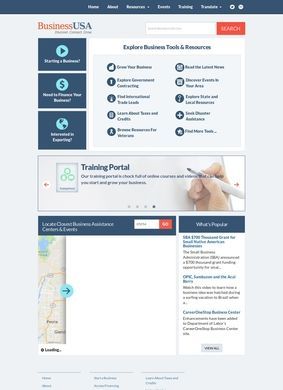
Where does a person actually start when they need to renew a passport, check a tax refund, register to vote, or find out which federal benefits they qualify for? Business USA, the official portal run by the General Services Administration at usa.gov, answers that by gathering a wide spread of federal information under one roof and sorting it by what people are trying to do, not by which agency happens to own the answer.
How the site organizes federal information
The site is organized around topics, and the list is long. Government benefits cover food assistance, housing, health care, and financial aid. Money and Credit pulls together grants, loans, unclaimed money, credit reports, and tax information. There are dedicated sections for taxes, immigration and U.S. citizenship, travel and passports, jobs and unemployment insurance, small business funding and licensing, military and veterans support, health insurance and mental health, housing help, education and Federal Student Aid, disabilities, disasters and emergencies, scams and fraud, voting and elections, complaints against agencies or companies, and legal issues. There is even an Innovation section pointing to citizen science and government competitions. That breadth is the point. Most people arrive with one narrow question, and the structure lets them ignore everything except the section that applies to them.
Finding benefits through guided questions
What keeps the volume from becoming a maze is the way Business USA leans on tools and guided paths instead of asking people to already know which agency handles their problem. A benefits finder asks a series of questions and matches the individual to programs they may be eligible for, which spares users from reading through dozens of pages to learn that a particular program does not apply to them.
Life events navigator for multiple agencies
There is also a life-events navigator built around situations rather than departments: having a child, retiring, or handling matters after a death. This framing is genuinely useful, because those moments tend to trigger paperwork across several agencies at once, and a person in the middle of them rarely knows the full list. Grouping the steps by the event answers the question someone is really asking, and it answers it faster than any alphabetical agency index could.
Reporting scams, fraud, complaints
The Scams and Fraud and Complaints sections deserve a specific mention. They walk through reporting identity theft, Social Security scams, and grievances against telemarketers, banks, housing providers, and travel companies. These are exactly the cases where people get lost between jurisdictions, and having a single starting point that routes them correctly is worth more than it might appear at first glance. Business USA does not resolve the complaint itself, but it sends you to the right door, which is the part most people cannot figure out on their own.
Spanish language access for all users
Business USA serves residents, citizens, and visitors, and it does not assume everyone reads English. A full Spanish-language version lives at usa.gov/es, which matters for a portal whose whole purpose is reaching the broadest possible public. A government site that only worked in one language would quietly exclude a large share of the people it exists to help.
Plain language guidance for federal processes
The plain-language approach runs through the topic pages too. Information about naturalization requirements, Green Cards, voter registration, polling locations, or replacing vital records is written to be understood by someone with no background in how the relevant agency operates. For small business owners, the guidance on starting, funding, and managing a company, plus import and export licensing, sits alongside the consumer-facing material, so an entrepreneur and a first-time voter can both find their footing on the same site.
From guide to transaction completion
One reasonable expectation to set: Business USA is a guide to federal services, not the place where most transactions are completed. It points to the agencies that actually process passports, file taxes, or pay out unemployment, and then hands the user off. Used that way, as the map rather than the destination, Business USA does its job well.
Consolidation removes friction from federal search
The value here comes from consolidation. Anyone who has tried to find the correct federal program by guessing at agency names knows how much friction that involves, and Business USA removes a good deal of it by working backward from the question a person has, not from the organizational chart of the federal government. The topic coverage is comprehensive, the guided tools are practical, and the Spanish version widens the reach in a way that fits a public service. Whether you are a new parent sorting out benefit eligibility or a veteran checking health and housing support, the sensible move is to open the relevant topic section or run the benefits finder first. Business USA tends to shorten the path considerably.