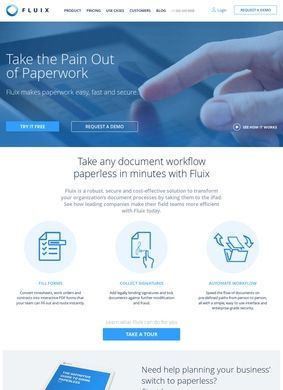
Fluix is a no-code platform for inspection management and document workflows, built for teams that do their work in the field and not at a desk. The product centres on a mobile app for iOS and Android that runs fully offline, and that detail is what separates Fluix from a lot of clipboard-replacement software. A technician on a wind turbine, an oil rig, or a remote construction site does not always have a signal, and the app is designed so that inspections, checklists, photos, GPS coordinates, timestamps, and electronic signatures all get captured locally and sync once a connection comes back. That single design choice defines the audience more clearly than any marketing copy could.
Offline-first mobile inspection
The form side is handled by a drag-and-drop builder, with pre-built templates available if a team does not want to start from scratch. Fluix also handles corrective action tracking once findings come in: a problem spotted during an inspection can be assigned to someone, given a deadline, and followed until it is resolved. That closes the loop between spotting an issue and fixing it, which is where paper-based or PDF-based systems quietly fall apart. The inspection types Fluix covers are broad, spanning safety, vehicle, equipment, facility, field, and incident reporting. Building the workflow is fairly self-contained within the platform itself, so teams do not need developer involvement to get a form deployed and routing to the right people.
Data routing and integrations
A second layer worth understanding is how Fluix handles reporting. Rather than building its own analytics engine, Fluix pushes operational data out to tools the customer already runs. The connector list is long: Salesforce, Power BI, Zapier, Procore, HubSpot, Airtable, Microsoft Teams, Google Drive, Excel, and Azure. For a construction firm already living inside Procore, or an enterprise standardised on Power BI, that approach is sensible. It means the captured field data lands where the rest of the business can act on it, instead of trapping it in yet another dashboard nobody logs into.
Native analytics trade-off
The trade-off is honest and worth naming: if you want deep native analytics inside the same product, Fluix is not the answer, and you will need to maintain one of those external connections to get the operational picture. For teams that already have a BI stack, that integration model is a feature. For a smaller operation without those tools, it is an extra dependency to set up and keep running.
Industry focus and customer base
The industry list is clearly deliberate, not a catch-all: wind and renewable energy, construction, aviation, oil and gas, HVAC, manufacturing, utilities, and pest control. These are sectors where inspections are frequent, regulated, and often carried out somewhere with poor connectivity. The offline-first pitch and the industry focus line up cleanly, which is more than many horizontal tools claiming to serve everyone can say.
Fluix states a customer base of around 12,000 field service teams, and names Siemens Gamesa, DRAX Power, and CPP Australia among them. Those are recognisable industrial names, particularly in the energy space, and they fit the renewable and utilities focus the platform leans on. Named enterprise customers are not proof of quality on their own, but they do point to deployments that went through real procurement scrutiny before Fluix got signed off.
Review coverage across platforms
The independent review trail backs that up reasonably well. Fluix carries 21 reviews on G2, 69 verified user reviews on GetApp, plus listings on Capterra, TrustRadius, and Software Advice, and an editorial review from PCMag. That is a healthy spread across the software-comparison sites buyers tend to check, and the editorial coverage adds a layer of scrutiny beyond user-submitted ratings. The volume is moderate, not enormous, which is about what you would expect for a focused B2B tool serving a defined set of industries. One caution worth flagging: a Trustpilot entry with a couple of reviews and a four-star score appears to belong to fluix.store, a separate entity, not the inspection platform at fluix.io. Anyone researching Fluix should not count that toward this product, as the confusion is easy to make and it skews the credibility picture.
Contact and trial options
On the contact side, the Fluix landing page keeps things lean. There is no phone number or physical address shown up front, which some buyers will read as a gap, though it is common for self-serve B2B software that funnels prospects toward a demo. Email routes do exist, including a sales address and a data protection contact, and there are demo booking and trial sign-up forms. A self-service trial and a booked demo are the two paths most teams evaluating inspection software would want anyway, so the absent phone line is a minor mark against rather than a blocker. Teams already familiar with demo-led SaaS sales will not blink at it.
Taken together, Fluix is a focused, credible product that knows exactly who it is building for. The offline-first capability is the real differentiator; the rest of the Fluix feature set flows logically from the assumption that field workers lose connectivity and cannot wait. The reliance on third-party integrations for reporting depth suits organisations with an existing data stack more than lean teams starting cold. For a regulated field operation in renewables, construction, aviation, or any of the other named sectors, Fluix is worth putting on the shortlist and running through a trial. The published evidence is solid enough to justify that step without needing more.
Business address
Fluix
795 Folsom St.,
San Francisco,
California
94107
United States
Contact details
Phone: +1 650-433-9008