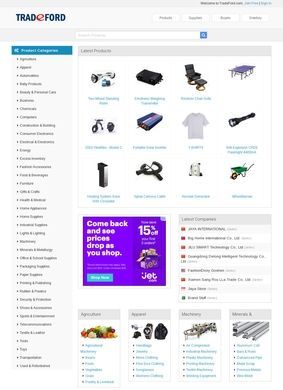
TradeFord splits its marketplace into two halves that rarely sit together on the same site: a supplier directory where manufacturers list products for sale at wholesale prices, and a separate importer directory where buyers post what they are trying to source. Timber is one of the verticals a visitor can browse, which gives some sense of the goods changing hands here. The pitch is global trade matchmaking, and the structure follows the two sides of any deal.
Put plainly, TradeFord is a B2B marketplace and import/export directory that connects buyers, suppliers, manufacturers, importers, and exporters, and hosts trade leads between them. Companies join, list what they make or what they need, and wait for the other side to find them. That is the whole model, and it is a sound one when the listings run deep and stay current.
The appeal for a smaller player is reach. A timber supplier in one country and a furniture maker in another are unlikely to meet through local channels, and a global index both can list on is the kind of bridge international trade actually runs on. TradeFord aims squarely at that gap, positioning itself as neutral ground where a manufacturer, a trader, and an importer all show up under the same categories.
One caveat has to come early, because it colours how much of the rest can be trusted. On repeated attempts the TradeFord homepage would not load at all; the server turned visitors away instead of serving the page. For a platform whose entire value is being reachable by strangers doing business across borders, that is not a small thing. Much of what can be said here therefore comes from how TradeFord appears in other listings and in third-party reviews, not from a clean walk through the live site.
That access problem bleeds straight into the contact question. With the landing page refusing to open, there was no way to confirm whether a phone number, a street address, or a contact form sits where a cautious trader would want to find them. For a marketplace that asks companies to transact with strangers, unverified contact details are a fair reservation, and it seems more honest to flag the gap than to paper over it.
What the platform puts in front of buyers and suppliers
Set the access trouble aside for a moment and the concept behind TradeFord is a familiar, useful one. Two audiences, buyers and sellers, need a neutral place to find each other, and a directory that indexes both by category and geography saves a great deal of cold emailing. TradeFord organizes itself entirely around that matchmaking, and its layout mirrors the two-sided trade it wants to carry.
How much any of it delivers comes down to the depth of listings on each side, which is exactly what a locked homepage makes impossible to verify. The shape of the service is still clear from how TradeFord presents itself across the wider web, and it divides cleanly along the lines a working trader would expect. Three pieces do most of the work.
The supplier and importer directories
The two directories are the backbone. On the supplier side, manufacturers and traders list products for sale at wholesale prices, tagged by category so a buyer can drill into a vertical like timber and see who is offering what. On the importer side, buyers and importers post what they need, which lets suppliers approach them directly.
That two-way arrangement is the part of TradeFord that does the real work, since a directory that only listed sellers would leave every buyer doing all the searching alone. A supplier scanning importer posts can chase demand that already exists instead of guessing at it.
The trade-off is that a directory is only as valuable as it is populated, and from the outside there is no reliable way to gauge how many live sellers and buyers TradeFord currently carries. A directory with few live listings looks identical to a crowded one until you go hunting for a specific product and either find ten suppliers or none.
The B2B marketplace and trade leads
Wrapped around the directories is what TradeFord calls its B2B marketplace, a browsable index by product category, plus a stream of trade leads that flag active buying and selling intent. For a company trying to break into export markets, leads are the currency that matters most, and one reviewer described the site as a useful trade forum for exporters growing from zero.
TradeFord positions itself as a common platform for that kind of matchmaking. The trade-lead feature is where the promise either pays off or falls flat, and it hinges entirely on how fresh the postings are, because a lead board full of stale requests is worse than none.
This is the feature a prospective member should test first, since it is the clearest measure of whether TradeFord is a living market or a parked directory. There is a well-worn pattern with platforms like this: the value compounds as more real businesses list and message each other, and it drains away when the pages fill with abandoned accounts.
What the outside ratings say
Third-party opinion on TradeFord is mixed but leans positive, and it is worth laying out plainly. SmartCustomer lists a four-star rating from five customer reviews, a sample small enough that I would read the average as a hint and not a verdict. Trustpilot hosts customer reviews of the site too, with one snippet pointing to 73 reviews in total and comments running both ways, including a reviewer who called it a helpful B2B trade forum for exporters.
On the safety and legitimacy front the signals are steadier. Scamadviser concluded the domain is legit and safe with a relatively high trust score, Scam-detector assigned it a medium trust score, and MyWOT carries a safety scorecard, though no specific number surfaced in what was visible.
A favorable review on servicerate called the experience fantastic and recommended TradeFord for expanding a business globally. None of that is overwhelming, the review counts stay modest across the board, and yet nothing in the record points to a scam either. The reasonable read is a functioning marketplace with a modest, generally satisfied user base rather than a polished, heavily reviewed giant.
One detail cuts against the platform and deserves stating plainly. A B2B marketplace lives or dies on whether the counterparties are genuine, and none of the safety scores speak to that directly, because a domain can be judged safe to visit while still hosting listings that lead nowhere.
The sensible posture, then, is to read the trust scores as saying the site itself is not a trap, and to treat the businesses on the other end of a lead, the supplier quoting a price or the buyer posting a request, as parties to verify one deal at a time. That is ordinary caution for cross-border trade, where a first shipment to an unknown partner is always a leap, and no directory can remove the risk of dealing with a stranger abroad even when it is the thing that introduced you.
Weigh the two halves together and TradeFord comes out as plausible but unproven: a coherent directory model and clean safety scores on one hand, a homepage that would not load and a shallow pool of public reviews on the other. Both facts are true at once, and a sensible trader holds them together instead of picking the flattering one.
A small manufacturer or a first-time exporter trying to get product in front of overseas buyers is the natural fit here, especially given the trade-lead feature and the low barrier to listing a few items. The sensible move is to build a free listing, post one product with real wholesale pricing, and watch for a week or two whether any leads actually come back before putting more inventory or money behind it. The buyers TradeFord actually delivers matter more than any safety score, and those scores are worth treating as a starting point rather than a verdict.