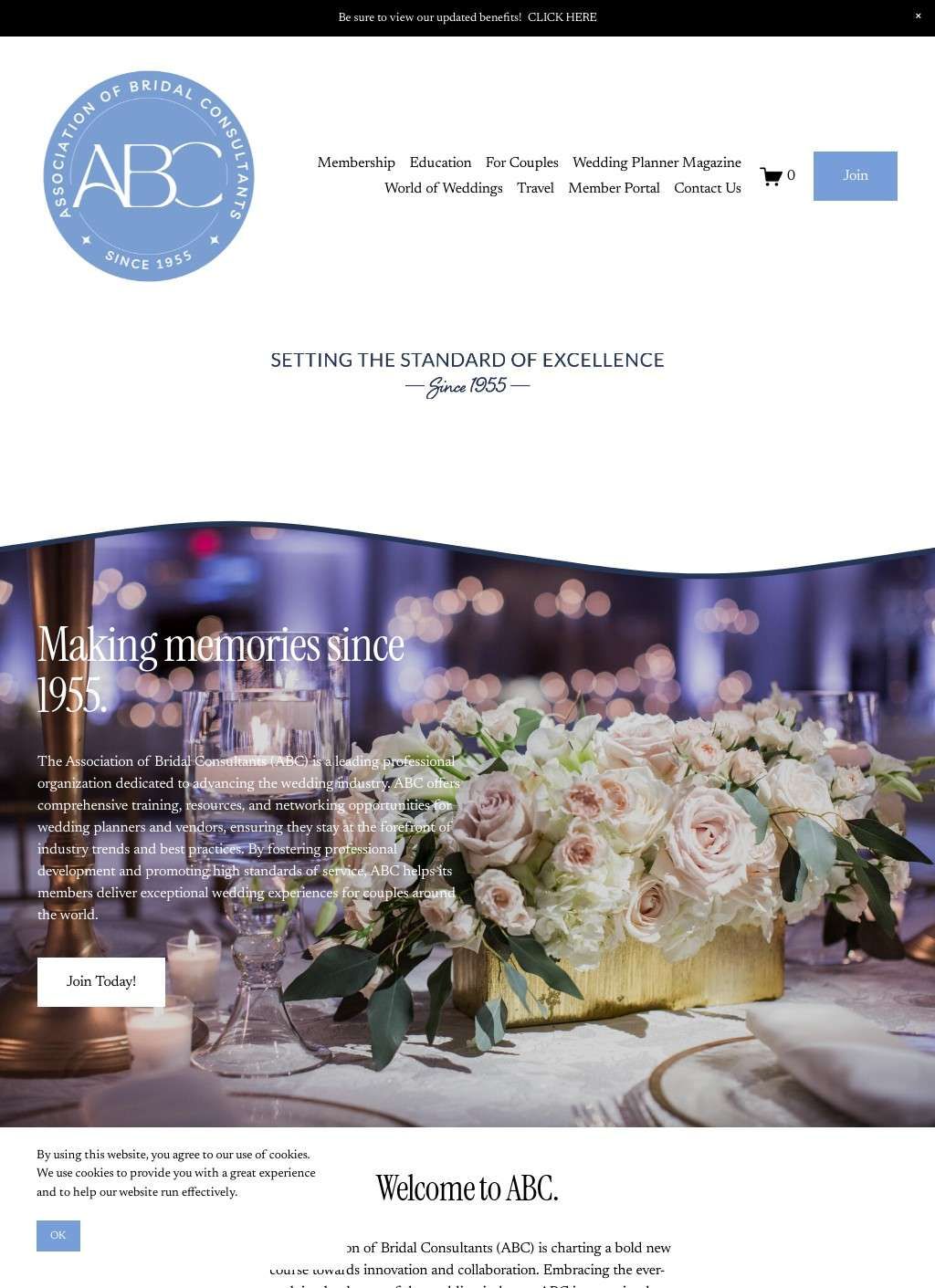
Most trade groups hand out a single credential. The Association of Bridal Consultants runs a whole ladder of them: Registered, Certified, Professional, and Accredited, climbing toward Master Wedding Planner and Master Wedding Vendor at the top. That structure is the clearest signal of what this organization is about. It treats wedding planning as a career with rungs to climb, not a hobby you either have or you don't, and the site is built around helping members move up that ladder.
Four audiences under one roof
The audience of the Association of Bridal Consultants is wider than you might guess from the name. Yes, it speaks to wedding planners and vendors chasing professional development and a recognized designation. But it also points couples toward certified professionals, courts corporate sponsors and partners across the wedding trade, and even offers a certification track aimed at hotels that want to prove their wedding credentials. Four fairly different groups, one association, and the material is organized so each of them can find the door meant for them.
Courses from beginner to expert
The education side of the Association of Bridal Consultants is where the organization has invested most heavily. Alongside the tiered designations, there are Wedding Industry Career Courses, an Instructor Program for people who want to teach, and continuing education to keep an existing credential current. I found the layered approach genuinely sensible, since it lets a newcomer start with foundational coursework and a seasoned planner keep sharpening without repeating the basics.
Turning training into shared standards
What the Association of Bridal Consultants is really selling on this front is a shared standard. A couple hiring someone with an ABC designation, or a hotel that has earned its certification, gets a shorthand for a level of training that would otherwise be hard to compare across a fragmented field. That is the quiet value of a trade body: it turns scattered experience into something a client can read at a glance.
Training tomorrow's instructors
The Instructor Program deserves a specific note, because it shows the association thinking a generation ahead. Rather than only certifying practitioners, it certifies the people who will train the next wave of them. That is how a standard actually propagates instead of fading, and it is a level of infrastructure that a looser network of planners would rarely bother to build.
Events keep members connected
Beyond credentials, the calendar is busy. The flagship event of the Association of Bridal Consultants is the annual "World of Weddings" conference, backed through the year by "Wednesday Webinars" and by state and local networking meetings that keep members connected between the big gatherings. For a business built on relationships and referrals, that steady drumbeat of in-person and online contact is arguably as valuable as the certificates themselves.
Publishing arm and directory
The Association of Bridal Consultants also runs a publishing arm of sorts. There is Wedding Planner Magazine, the "ABC Weddings Unveiled" podcast, and the Trendsetter Awards, which recognize standout work in the field. Add the membership directory of planners and vendors, and the picture is of an organization that trains its people and then gives them somewhere to be found.
How the directory closes the loop
That directory is worth pausing on. It is the point where the association turns outward to couples, functioning as a vetted list of professionals who have signed on to a common set of standards. A planner earns a designation, appears in the directory, and the couple browsing it gets a filtered pool instead of an open search. The Association of Bridal Consultants effectively closes its own loop, from training to recognition to booking.
Awards and podcast build reputation
The awards and the podcast round out the media presence, and they serve a purpose past marketing. A field like wedding planning runs on reputation and visible proof of quality, and the Trendsetter Awards give members a concrete accolade to point to. The magazine and the podcast, meanwhile, keep the association's voice in front of the whole industry, beyond its own membership. That reach fits an organization trying to define what "professional" means in this trade.
If there is a limitation, it is that so much of the value lives behind membership. The public-facing pages describe the programs well, but the coursework, the deeper directory, and the ongoing education are meant for people who join and pay. That is entirely normal for a trade association, and it is not a knock so much as a clarification: this is a members' institution first, and a public resource second.
Taken together, the Association of Bridal Consultants reads as a serious backbone for a business that outsiders often assume runs on flowers and improvisation alone. The designations, the coursework, the conference and webinar schedule, the media output, and the directory add up to a coherent system for turning wedding planning into a credentialed profession. A planner weighing where to spend professional dues, a hotel considering certification, and a couple trying to sort one self-declared "wedding coordinator" from another all get the same thing from it: a standard that was set on purpose, rather than assumed.
What the site does not do is pretend the standard is free. Judging any individual planner or vendor still comes down to the credential they hold and the work they show, and the role of the Association of Bridal Consultants is to make that credential mean something consistent. On that narrower promise, it delivers.