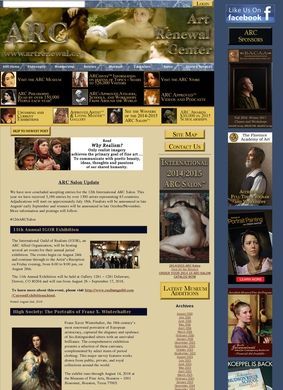
Someone trying to teach themselves to draw or paint the way the old masters did runs into a wall fast: most of what shows up online is contemporary, abstract, or simply not the kind of work they want to study. The Art Renewal Center exists for exactly that frustration. It is a nonprofit educational foundation built around the revival of realism, and its core claim is that it runs the largest online museum devoted to representational art, pulling together old masters, the 19th-century painters, and living realist artists in one searchable place.
Museum and artist directory
The museum side is the heart of it. Thousands of works sit in a browsable collection alongside an artist directory, so someone hunting for a particular Bouguereau or trying to find a present-day painter working in a classical mode has a real archive to dig through. For a student of technique, having that volume in one collection is worth more than any single image, because the value is in comparison across hundreds of hands.
Atelier accreditation for realist schools
Beyond looking at pictures, the Art Renewal Center does work that touches the careers of artists directly. It vets and lists art schools through an ARC-approved atelier program, applying a defined curriculum standard before an institution makes the list. That accreditation function matters to a would-be student choosing where to train, since the Art Renewal Center is staking its name on which schools genuinely teach representational drawing and painting. There is also the ARC Salon, an annual international juried competition for realist artists, with scholarships attached, which gives the whole project a competitive spine and a reason for working painters to keep coming back.
Annual salon with scholarships
The educational library is the part that rewards a slow reader. It collects articles, essays, and video resources, and given that the Art Renewal Center has strong opinions about the direction art took in the last century, that reading leans toward argument as much as instruction. A visitor will find history and theory written from a clear point of view, not a neutral survey, which is worth knowing going in.
Educational resources from a stated perspective
Around that sit the practical pieces: a membership program, a donation platform that fits its nonprofit status, a store, and painting appraisal services. The appraisal offering is an unusual touch for what is mostly a museum-and-education site, and it signals that the people behind it are treating the realist field as a working market rather than a gallery to admire from a distance. Multilingual interface options round things out, which tracks with an organization that frames itself as a global hub connecting artists, schools, and allied groups.
Membership, donations, appraisals
On the practical question of reaching them, the Art Renewal Center makes it simple. A street address in Port Reading, New Jersey, a phone number with an extension, and an email all sit on the main site without any hunting. For a 501(c)(3) handling donations, memberships, and appraisal work, that openness about where it is and how to call matters, and the foundation clears the bar comfortably.
Contact information and nonprofit transparency
Reputation is where the picture gets more interesting, and more contested. There is a BBB profile, though the organization is not accredited there and no rating or review count surfaces with it. The usual consumer platforms, Trustpilot, Google, Yelp, turn up nothing in the way of stars, so anyone wanting a tidy numerical score will not find one. What does exist is professional conversation, and it is split. Threads on Quora show working artists divided: some genuinely value the realist focus and the resource the museum provides, while others push back hard on what they see as an anti-modernist crusade. A DeviantArt discussion lands in similar territory, describing the Art Renewal Center as polemical in its opposition to modern art. The testimonials the Salon publishes come from its own sponsors, so they read as exactly that.
Professional opinion remains divided
That division is not a small footnote. The Art Renewal Center is plainly useful as an archive and as a credential-checker for schools, and for a realist painter or a student of the genre the resource is hard to match in scope. But the same conviction that makes it valuable also makes it a partisan in a long-running argument about what art should be. The museum is real and the school vetting is concrete, yet the foundation's voice carries an agenda, and a visitor relying on its library for an even-handed account of art history may not get one. Whether the strength of the collection is enough to outweigh the slant of the editorial line is a question each user will answer differently, and the Art Renewal Center does little to soften the edge of its own position.