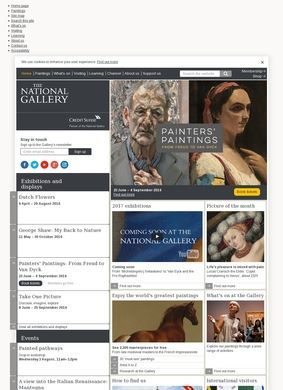
What you can actually see at The National Gallery without paying anything is the whole permanent collection, which is the headline fact worth grasping before any of the rest. Over 2,300 Western European paintings, from the mid-13th century through to 1900, sit on the walls in Trafalgar Square and cost nothing to walk in and study. That single decision shapes the entire character of the place: it is built for repeat visits and short ones, for the person who has twenty minutes between trains as much as for the scholar who comes back across a year. Free entry to the core holdings is the operating principle here, and almost everything else on the website flows from it.
Masterpieces from Leonardo to Monet
The collection itself is the reason The National Gallery has the standing it does. Leonardo da Vinci and Michelangelo are here, alongside Raphael, Rembrandt, Vermeer, Caravaggio. The British side is strong too, with Turner and Constable, and the later rooms move into Van Gogh and Monet. This is a tight, deliberately edited survey of European painting, and one of the quiet pleasures of the website is that you do not have to be standing in London to start working through it.
Searching the online collection database
The online collection database lets you search every work in the holdings, which turns a planning tool into something closer to a study resource. I have lost more time than I meant to clicking from one attribution to the next, reading the catalogue notes that sit behind each picture. The names above are only a sample. The point is the consistency: instead of padding the rooms out with minor works, the Gallery hangs a run of paintings most people will recognise on sight.
Virtual tours and online learning tools
The digital side of The National Gallery is more substantial than a typical museum landing page. Past the searchable database, there are virtual tours and a body of online learning content, so a teacher in another country or a curious visitor at home can get real value without a ticket or a flight. The web presence is treated as a genuine arm of the institution, useful in its own right and able to stand apart from the building.
Education programs for schools and families
Education is where the breadth shows. The programme reaches schools, teachers, families and adults separately, with tours, workshops and talks pitched at each group instead of one generic offering covering all of them at once. For people doing serious work, there is a research library and an archive, which puts The National Gallery in a different bracket from a venue that simply hangs art and opens the doors. The site also handles the practical layer cleanly: information on the temporary and special exhibitions, which are ticketed and rotate, and on the shop, which sells prints, books and gifts both in person and through the online store.
Food and events round it out. There are restaurant and cafe facilities on site, and the spaces can be hired for private functions, so anyone organising a group day out or a corporate evening can settle those plans from the same pages. None of this is unusual for an institution of this scale, but it is all documented properly, and a visitor can plan a full day at The National Gallery without guessing at any part of it. Selling the prints and books through the online store as well as in person keeps a piece of the place reachable for people who cannot get to London.
Free collection versus ticketed exhibitions
Worth being honest about what the ticketed exhibitions mean in practice: the free permanent collection is the constant, and the special shows are the part you budget for. That split is sensible. It keeps the masterpieces open to everyone while letting the bigger, loan-heavy exhibitions pay their way. A first-time visitor can spend a whole afternoon with the permanent rooms at The National Gallery and never reach for a wallet, then decide separately whether a particular exhibition is worth the price. That is a fairer arrangement than charging a single blanket admission, and it lets a casual visit and a deliberate one coexist under the same roof.
Public body status and funding
The structure of the institution is part of why the offering stays coherent. The National Gallery is a non-departmental public body sponsored by the UK Department for Culture, Media and Sport, which is the formal way of saying it is a public museum answerable to the public purse. That status is the reason free admission to the permanent collection is a standing commitment, not a promotion that might quietly disappear. It also explains the seriousness of the research and education arms, which serve a remit broader than ticket sales.
What general visitors experience
For the general visitor, the appeal is direct. You arrive at one of the most central addresses in London, you walk in, and you are in front of paintings that anchor the history of European art. The collection is dense enough that you can return many times and find new things, and edited tightly enough that a single visit does not leave you exhausted or lost. School groups get structured support, families get programming built for children instead of tacked on as an afterthought, and international visitors get a clear path through both the building and the website before they travel.
Deep research tools for scholars
The researcher gets the deepest end of it. Between the online database, the physical library and the archive, The National Gallery functions as a working reference point well beyond a single visit, which is the test of whether an art institution takes its scholarly role seriously. Plenty of museums put a fraction of their holdings online and call it a digital collection. At The National Gallery the database covers everything, and that completeness changes how useful it is. For an art historian checking provenance or a student building a reading list, a partial catalogue is a frustration. A full one is a tool you can rely on, and that is the standard The National Gallery has set for itself.
Comparing the National Gallery and Tate
If there is a fair point of comparison, it is the Tate, which sits a short distance away and pulls toward British and modern and contemporary work. Someone deciding between the two is really choosing a period and a temperament. Tate Modern is the place for the twentieth century onward and for art that argues with you. The National Gallery is the place for the long arc of Western painting up to 1900, hung with restraint and weighted toward looking rather than provocation. A visitor with one day in London and an interest in the old masters should start at The National Gallery without much hesitation, and treat Tate as the natural second stop instead of a substitute. The two cover different ground, and The National Gallery owns its half of it about as completely as any single museum can.