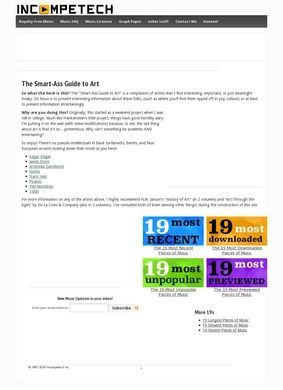
A student stuck on a paper about Mondrian, or someone who just clicked away from a museum wall card written in dense curatorial jargon, tends to want the same thing: a plain explanation of who the artist was and why their work looks the way it does, without the lecture-hall posturing. The art section of Incompetech aims squarely at that reader. Sitting at incompetech.com/art under the title "The Smart-Ass Guide to Art," it profiles eight figures from the Western canon and writes about them the way a knowledgeable friend might, dropping the academic register while keeping the academic content.
Eight artists from Giotto to Picasso
The eight covered are Picasso, Degas, Gentileschi, Mondrian, Titian, Hals, Ensor, and Giotto. That is a deliberate spread. Giotto sits near the start of the Renaissance shift, Titian and Hals carry the portrait tradition forward in different centuries, Gentileschi brings a Baroque name that older surveys often skipped over, and the run on to Mondrian and Picasso lands on the people who took the whole representational project apart. Ensor is the wild card in the set, a name a casual reader is less likely to have met, which points to genuine enthusiasm rather than a checklist of the most famous. Each profile in Incompetech's guide gives biographical context alongside a description of the artist's stylistic traits, so a reader leaves with both the life and the look together.
Why informal writing matters in art history
The conceit in the title is the whole pitch. Art history has a reputation for being written by and for people who already know it, and the section pushes against that by being informal on purpose. The prose blends real information with a loose, conversational voice, which is a harder trick to pull off than it sounds, because the joke has to carry the fact and not bury it. A reader who only wanted a Wikipedia paragraph would not need Incompetech for that. The draw here is the register: a writer willing to be funny about Titian's color or blunt about what made Mondrian's grids tick, while still telling you the actual thing. For students, casual learners, anyone after an introduction that does not assume a degree, that approach works.
Honest scope and free access
It helps that the scope is honest. Eight artists is not a survey of art history and the section does not pretend otherwise. It is a sampler, a set of entry points a curious person can read in an afternoon. The framing as a free public resource matches that ambition. Nothing is sold on the art pages, no course is upsold, no membership gate appears between the reader and the writeups. What is there is there to read.
The origin story fits the result. The art guide began as a college project and has been kept online and maintained as a free resource ever since. That history shows in the shape of it: a focused piece of work by one person who found it worth keeping public, not a content farm padding out a topic for traffic. There is no churn of fresh posts, no comment section to moderate, no sense that the page exists to feed an algorithm. It is a small thing that someone at Incompetech decided to leave standing. Whether eight profiles is enough depends entirely on what the reader came for, and the section is upfront enough about its own scope that nobody should arrive at Incompetech expecting an encyclopedia.
Incompetech's music library and other tools
Context matters here, because the art guide is a small room in a much bigger building. Incompetech is the personal site of Kevin MacLeod, running under Incompetech Inc. and online since 1997, and the domain is far better known for something else entirely: a large library of royalty-free music, licensed through filmmusic.io, that has scored a staggering number of videos, games, and student films over the years. The same domain also hosts a graph paper generator and printable calendars. Unlike a business directory or a content hub with dozens of contributors, Incompetech is one person's accumulation of free tools and resources parked under one roof.
How the art section fits within a larger site
That background cuts two ways for a reader weighing this entry. On one hand, it explains the generosity of the art pages: this is a creator who has spent decades giving things away and clearly enjoys it, so a free art guide from Incompetech is entirely in character. On the other hand, it means the art corner gets a fraction of the attention the music library commands, and a visitor arriving specifically for visual arts should understand they are looking at a side project of a music site, not a dedicated art platform. The pages have the slightly homemade feel of a personal site that grew by accretion over many years, which some readers will find charming and others dated. The substance, though, is in the writing, and that does not age the way a layout does.
What third-party sources say about Incompetech?
Outside opinion follows that imbalance almost exactly. The domain is rated safe and legitimate by both WOT and Scamadviser, which settles the basic trust question and is no small thing for a site asking nothing of a visitor but their attention. Beyond that, listings on SourceForge, SaaSHub, and TopBusinessSoftware carry user reviews and discussion, but they all treat Incompetech as a stock music product. The commentary is about the audio library, the licensing terms, the sheer volume of tracks, and none of it touches the art writeups.
No Google, Trustpilot, Yelp, or BBB presence turned up at all. So the art section of Incompetech has essentially no third-party feedback of its own to point to; the goodwill attached to the name was earned by the music, and a reader judging the art guide is judging it on the page in front of them and little else.
On reaching anyone behind it, the site keeps things minimal. A Contact link sits in the navigation and leads to an email page one click away. The art landing page shows no phone number and no physical address, which is unremarkable for a personal creative site run by one person. Nobody arriving to read about Giotto needs a switchboard, and a single click to an email route is enough for the questions this kind of resource attracts.
Worth saying plainly: the value depends on how niche the need is. As a quick, readable, jargon-light introduction to eight specific artists from a creator with a long record of keeping free resources online, the art section of Incompetech does a tidy, honest job, and the lack of a paywall or a hard sell is genuinely refreshing. As a broad art-history reference, eight profiles is nowhere near enough, and the absence of any reviews aimed at the art content means a reader is taking the writing on its own merits with nothing external to lean on. For its narrow brief it works. Expecting an encyclopedia from Incompetech would be misreading what it is; the site has always been a collection of focused, freely given things, and this corner of it is no different.