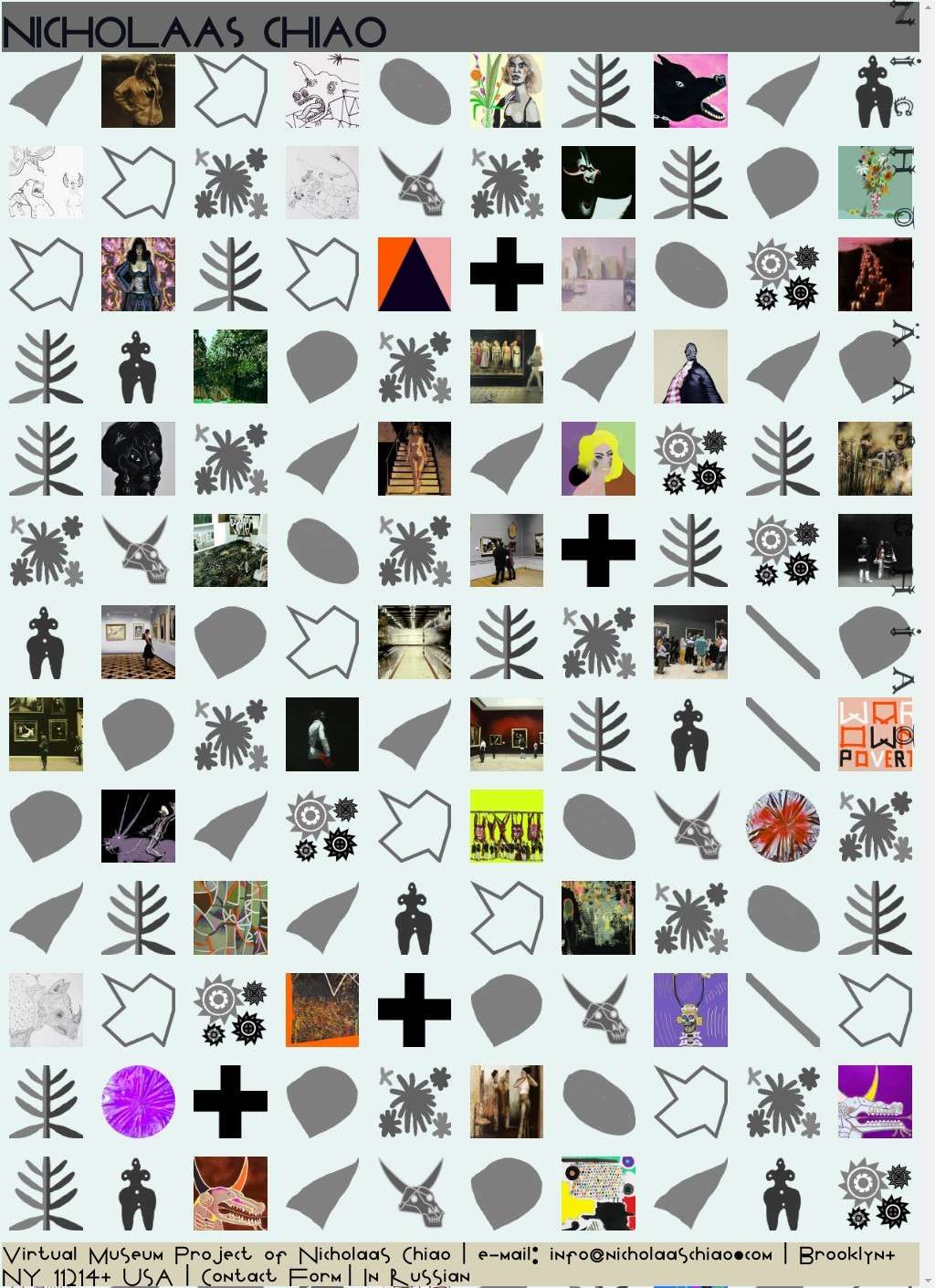
What does a one-man online museum actually contain when the artist curates himself? In the case of the Virtual Museum Project of Nicholaas Chiao, quite a lot, and it is sorted with more care than a typical personal art site manages. Chiao, born in Minsk in 1981 and in the United States since 2003, works out of Bensonhurst in Brooklyn, and he has arranged his output into more than ten thematic exhibitions grouped by style. A visitor can move through Neo-Expressionism, Photorealism, Conceptual Art, Political Art, Drawings, Erotic Art, Sports Art, Design, Neo-Cubism, Neo-Impressionism, and Postmodern Art, each treated as its own room. That is a wide stylistic spread for a single painter, and it tells you something about how restless the practice is.
Exhibition rooms by movement
The grouping by movement is the smartest decision the Virtual Museum Project of Nicholaas Chiao makes. Instead of dumping everything into one gallery and letting the viewer sort it out, it asks you to enter through a door labelled with a recognizable art-historical term. Someone who came for the photorealist work does not have to wade through the erotic pieces to find it, and someone curious about the cubist experiments knows exactly where to go. There is also a "Masterworks" section that pulls out pieces the artist considers significant, dating from 2007 forward, which works as a highlight reel for anyone who does not want to walk every room.
Recurring themes across styles
Themes recur across these categories whether or not the style changes. Mortality, psychosis, love, global threats, and the future of humanity keep surfacing, which gives the body of work a through-line even when the surface technique jumps from impressionist brushwork to hard-edged conceptual statements. That consistency of preoccupation is what separates a serious practice from a sampler, and on the evidence presented in the Virtual Museum Project of Nicholaas Chiao the work reads as the former.
Inside the Niertismus philosophy
Beyond the paintings, the site promotes a framework the artist calls "Niertismus," described as a philosophical and religious system that blends art and science around immortality, technological advancement, and ethical evolution. The principal work under that banner is "The Idols of Niertismus." This is the part of the Virtual Museum Project of Nicholaas Chiao most likely to divide visitors. Some will find the ambition compelling, a painter trying to build a coherent worldview instead of merely hanging pictures; others will find the metaphysics a stretch. Either way it is sincere, and it is laid out plainly enough that you can read it and decide for yourself.
Poetry, design and forum access
There is more than visual art on offer. Chiao includes poetry and design work alongside the paintings, and these additions confirm that the Virtual Museum Project of Nicholaas Chiao operates as a broader creative archive than its name implies. An art forum is built in for community dialogue, which is an unusual touch for a personal artist site and points to a preference for conversation over a silent scroll. A Patreon link is present for anyone who wants to support the work financially, positioned as a donation route rather than a paywall, so the galleries themselves stay open.
External profiles and cross-references
The artist does not exist only inside this one domain, which helps when you want to check the work against an outside frame. A parallel site sits at chystiakov.com, and profiles appear on ArtMajeur and on WikiArt, where 52 artworks are catalogued. That WikiArt presence is useful: the paintings are logged on an independent reference that anyone can browse, so the Virtual Museum Project of Nicholaas Chiao is not the sole record of its own existence. Knowing the Virtual Museum Project of Nicholaas Chiao has a parallel catalogue on WikiArt gives an outside reader a fixed cross-reference point. The catalogue there gives an outside reader a fixed point of comparison.
Reputation and online reviews
On reputation, the picture is quiet. A search turns up the artist profile pages on ArtMajeur and WikiArt, but no Google, Yelp, Trustpilot, or comparable platform carries ratings or written reviews of the Virtual Museum Project of Nicholaas Chiao. There is no chorus of outside voices weighing in, positive or negative. For a contemporary artist operating largely through his own channels that is not surprising, and it is worth stating plainly so nobody arrives expecting a wall of star ratings that does not exist. The WikiArt and ArtMajeur listings give the work a measure of third-party visibility even without scores attached.
Contact channels without a phone line
Contact in the Virtual Museum Project of Nicholaas Chiao sits in a middle zone. An email address and a contact form are both available, so a visitor who wants to reach the artist about a piece, a commission, or the Niertismus material has a clear path. The catch is placement: neither is pushed to the front, and the landing page does not foreground how to get in touch, so you have to look. There is no phone number and no physical street address, which is a real limitation if you prefer to call or want to know where a studio actually is. For an online museum built around viewing rather than transacting, the form covers the practical need, but anyone hoping to verify a bricks-and-mortar presence will not find one here.
A curated institution takes shape
Taken together, the Virtual Museum Project of Nicholaas Chiao reads closer to a small curated institution than to a portfolio page. Each style gets its own space, the strongest pieces are flagged in the Masterworks room, and the site folds in poetry, design, a philosophical framework, and a forum alongside the paintings. Independent listings on WikiArt and ArtMajeur back the visual record. The reach exceeds what one person usually attempts under a single roof, and that scope is both the appeal and the risk: a visitor either buys into the breadth or finds it scattered.
A buyer looking for gallery provenance, pricing transparency, or a phone line will need to dig through the Virtual Museum Project of Nicholaas Chiao carefully, and may come up short on the last point. The Virtual Museum Project of Nicholaas Chiao is plainly the work of someone treating his own catalogue as a lifelong undertaking, and the site is organized to be walked through, not skimmed. One detail lingers after a full look: the same set of concerns, death and love and the fate of humanity, shows up whether the canvas is impressionist or postmodern, and the eleven-plus style rooms are really eleven angles on one preoccupation. The Masterworks section dates back to 2007, the WikiArt count stands at 52, and the forum sits there waiting for replies that the search did not surface.