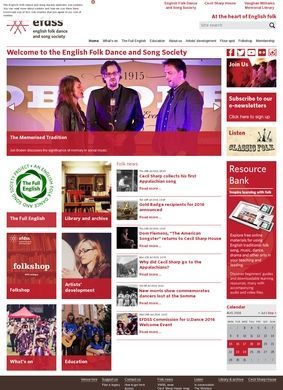
Someone learns a tune at a session, wants to know where it came from, and finds the printed and recorded trail has gone cold. That is the gap the English Folk Dance and Song Society (EFDSS) was built to close. As the national development organisation for English folk music and dance, working out of Cecil Sharp House in London, it holds the threads together: the archive, the teaching, the funding for new work, and the slow business of passing songs and steps from one generation to the next. A person who arrives wanting either to dig into the source material or to start playing themselves will find both routes open here, which is unusual for a single organisation.
Tracing tunes at the Vaughan Williams library
The single most useful thing on the site, for anyone chasing provenance, is the Vaughan Williams Memorial Library. This is the national archive and library for folk music and dance, and the English Folk Dance and Song Society (EFDSS) runs it as a working resource, not a sealed collection. If you want to trace a ballad, check a variant, or read what collectors wrote down a century ago, this is the front door. The library sits at the centre of what the organisation does, and a lot of the rest of the programme fans out from it.
Youth ensembles and disability inclusion
The work with young performers is substantial and clearly separated by purpose. The National Youth Folk Ensemble and the London Youth Folk Ensemble give young musicians a structured route into ensemble playing, and Folk Unlimited extends that to disabled young people, pointing to a deliberate effort to widen who gets to take part. These read as ongoing programmes with their own identities, not token gestures.
Weekly classes and social dances for adults
Adults get a full slate too. The Cecil Sharp House Choir, the Monday Folk Singers, Sunday Folk Music Workshops, dance classes, lectures and talks, and family barn dances cover a wide span of commitment, from a one-off evening to a regular weekly habit. I appreciate that the family barn dance sits in the same listing as the lectures, because it tells you the English Folk Dance and Song Society (EFDSS) is trying to serve the casual visitor and the serious student under one roof. The barn dance is the easy on-ramp; the lecture series is for people who already know they want more.
Training for folk practitioners
There is a whole layer aimed at practitioners, and it is where the organisation shows its national role most plainly. CPD, the Folk Education Network, and the FolkSafe safeguarding programme exist for the people who teach, organise and run folk activity elsewhere. The English Folk Dance and Song Society (EFDSS) is effectively supporting the wider ecosystem, training and protecting the people who do the work in schools, clubs and community halls across the country. FolkSafe in particular does unglamorous infrastructure work that a national body is well placed to standardise, and the folk community benefits from having it done consistently.
Funding routes for working artists
The artist-development strand is more generous than I expected from an organisation of this type. Bursaries, micro grants, commissions, artist presentations, and a Dance Development programme with its own dance mini grants add up to real money and real opportunity moving toward working artists. For a musician or dancer trying to make a living in a field that does not throw cash around, knowing where the bursaries and commissions sit is genuinely worth the visit. The English Folk Dance and Song Society (EFDSS) is acting as funder and platform at once, which is a useful combination for someone early in a career.
Publishing formats for every audience
On the publishing side, the output is steady and varied. The Folk Music Journal and the English Dance and Song magazine are the scholarly and the popular faces of the same interest, and the podcasts, the Old Songs Podcast and Folk Folk, pull the same material toward listeners who would never pick up a journal. Online learning through People Dancing rounds this out for those who want to learn at home. Taken together, the English Folk Dance and Song Society (EFDSS) is publishing across the full range of how people consume this stuff, from a peer-reviewed article to a half-hour episode on a commute.
Cecil Sharp House venue and shop
Cecil Sharp House itself does double duty. It programmes live gigs, dances, exhibitions and conferences, and it tours productions such as Rooted and Rising, so the building is a venue with a real artistic output, well beyond a passive office. The house is also available for hire, weddings included, which is a sensible way for a charity to put its space to work between events. The Folk Shop sits alongside all this, selling CDs, publications, book-and-CD sets and merchandise, so a visitor can leave with the recording or the book that prompted the trip in the first place.
Membership tiers with insurance cover
Membership is structured for the spread of people who care about this field, and the range goes well beyond what a business directory entry can convey. Categories cover individuals, groups, libraries and institutions, and they include public liability insurance, which is the detail a folk club organiser or dance caller will notice immediately. That insurance line is a quiet sign that the English Folk Dance and Song Society (EFDSS) understands its members are often running their own small events and need cover to do it. A library or an institution joining for collection access is a different proposition from an individual joining to support the cause, and the tiering reflects that.
National advocacy through parliamentary work
The English Folk Dance and Song Society (EFDSS) also operates at a level above its own programmes. It runs the English Folk Expo partnership and the All-Party Parliamentary Group for Folk Arts, and it offers US tax-efficient donation mechanisms for supporters overseas. The parliamentary group is the kind of advocacy work that only a national body tends to take on, and it puts the English Folk Dance and Song Society (EFDSS) in the room where arts policy gets discussed. Both point to an outfit thinking beyond a single building in London.
Checking reputation without review scores
Outside reputation is limited in the way you would expect for a specialist body. A search turns up no aggregated ratings on general review platforms; the English Folk Dance and Song Society (EFDSS) has no Trustpilot or Google review count to quote. For the English Folk Dance and Song Society (EFDSS), whose audience runs to practitioners and researchers, that absence reflects who it serves. What exists instead is decades of published scholarship, listed partnerships with arts funders, and the parliamentary group, all on public record and more useful than a star average for anyone assessing the organisation seriously.
What holds all of this together is a clear sense of who the English Folk Dance and Song Society (EFDSS) is for, and the site does not pretend otherwise. The performer, the teacher, the researcher, the dancer and the funding-seeking artist each have a defined path through it. Few resources anywhere can claim the same reach across English folk tradition. The one weak spot is that the sheer breadth of the offer can make the site feel like a lot to navigate on a first visit; the library and the events listings each deserve their own unhurried pass.