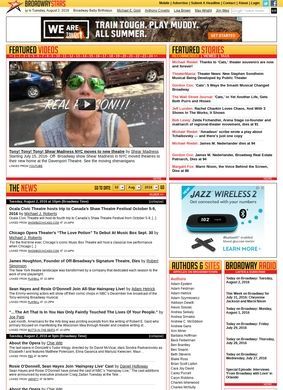
Refresh the page and the headlines have already moved on. BroadwayStars pulls in theater news every five minutes, stacking fresh items from the New York Times, Playbill, BroadwayWorld, Broadway.com, Deadline, TheaterMania, Variety, The Hollywood Reporter, and The Guardian, among others. That cadence is the whole point of the place. Instead of opening a dozen tabs to see what the major theater press is saying about a new production, a reader gets one running feed that gathers reviews, announcements, and feature pieces as they land. The feed updates often enough that checking BroadwayStars twice in a morning will usually surface something different each time.
Theater news beyond Broadway itself
The aggregation is wide, and it does not stop at the Theater District. BroadwayStars sweeps in theatrical community news from around the world, so a regional opening or a piece from a London paper can sit alongside the latest from a Times Square house. That breadth is easy to overlook on a site with "Broadway" in the name, and it is one of the more useful things BroadwayStars offers. Anyone who follows the form beyond the few square blocks of Manhattan gets a wider net than the title suggests. A reader in London or Chicago tracking international touring productions will find the coverage less parochial than the name implies.
Reference features for theater fans
Beyond the headline stream, BroadwayStars carries a set of reference pieces that earn their keep. There is a 2026-2027 season calendar with opening and closing dates, the sort of thing a planner or a fan checks repeatedly over the course of a season. Weekly box office grosses are tracked, giving a running sense of which shows are pulling crowds and which are wobbling. A daily listing of Broadway performer birthdays sits in the mix too, the kind of feature that shows the people running BroadwayStars care about the community and not purely the traffic numbers. Even the Theater District weather gets a slot, a small convenience for anyone heading into the city for an evening show and not wanting to check a separate app.
Video clips and keyword filtering
Video is woven in as well. BroadwayStars hosts curated carousels drawn from YouTube and Playbill, so trailers, interviews, and clips ride alongside the text coverage. For navigation, the feed can be filtered by author, by source, and by keyword, which becomes important once the volume of items piles up. Filtering by source alone turns a firehose into something manageable, letting a reader stick to only the Playbill items or only the reviews from a single outlet without losing the benefit of everything else BroadwayStars is pulling in from elsewhere.
Linking back to original sources
The honest measure of a site that republishes other people's reporting is whether it sends you to the real thing and keeps the lights on reliably. On the first count, BroadwayStars works the way an aggregator should: it surfaces the headline and the source, then points onward to the original press. It is not trying to pass off Variety's reporting as its own, and the named roster of outlets is the kind of lineup a serious theater reader already trusts.
Does the five-minute refresh hold up?
On reliability, the five-minute update promise is the load-bearing claim, and it is the one feature that would most damage the site if it slipped. There is no way to confirm uptime from a single visit, but the structure around it, the calendars, the grosses tracking, the partner sites, points toward something actively maintained, not abandoned. BroadwayStars also lists sister properties, BroadwayWrap.com and WhatsPlayingOnBroadway.com, which hints at an operator running more than one theater project and treating this as part of a small network instead of a side project left to run itself.
Submitting stories as a reader
Participation is built in rather than bolted on. Readers can submit headlines through a dedicated path, and accounts are available for anyone who wants to log in. That submission route is telling: an aggregator that lets its audience flag stories it missed tends to stay more current than one relying on a fixed list of feeds. Whether the community actively uses it is unknowable from outside, but the door is open, and BroadwayStars is better positioned for it than a pure read-only feed would be.
Contact options and site ownership
On the question of who stands behind BroadwayStars, the picture is less clear. A contact path exists on the site, so there is a route to reach whoever runs it. No phone number or postal address appears on the homepage, which is common enough for a content operation of this kind and not something to hold heavily against a free news feed. A form-based route covers the realistic needs of a reader who wants to report a broken link or pitch a story. Still, a little more about the people or the editorial hand behind the aggregation would lift confidence, especially for a site whose value rests entirely on judgment about which sources to trust and surface.
User reviews and scam checks
Outside reputation is where the evidence runs dry. No consumer reviews turned up on Google, Trustpilot, Yelp, Facebook, or the usual rating platforms, so there is no crowd verdict to lean on either way. Scamadviser checked the domain and judged it legitimate and safe off an automated read of forty signals, with no star score attached. That is reassurance about the domain being clean, not a measure of editorial quality, and the two should not be confused. The absence of user reviews is not damning for a tool of this type, since people tend not to rate a news feed the way they rate a restaurant, but it does mean a newcomer takes the experience on trust until they have used it for a while.
Assessing the aggregator overall
The verdict lands somewhere short of a full endorsement, but comfortably on the positive side of useful. BroadwayStars does one job, gathering and organizing theater news fast, and does it with a sensible source list, genuine filtering, and a few reference features that round it out. The gaps are the lack of any visible track record from outside users and a light touch on who runs it. Neither sinks the proposition. The five-minute refresh either proves itself across a week of regular use or it does not, and that is the fairest test a reader can run.