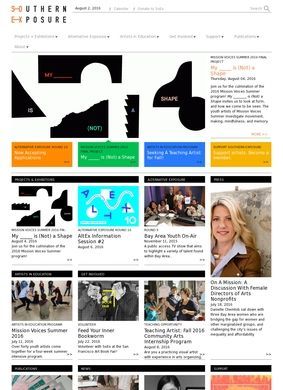
Southern Exposure is a nonprofit visual arts organization in San Francisco that has been running for more than fifty years, built around the idea that the artists themselves come first. The site reflects that orientation pretty directly. Instead of a polished pitch aimed at donors or tourists, what you get is a working hub for exhibitions, grants, youth education, and the everyday machinery of an arts space that still books shows, mounts open calls, and rents out its room.
Exhibition archive and program history
The exhibitions section is the obvious starting point, with current, upcoming, and past programming all kept on the site, including a video archive of work that has already closed. That archive is more useful than it might sound, because a lot of small art venues let old shows vanish the moment they come down, leaving nothing for someone trying to gauge what the place actually puts on its walls. Keeping the back catalogue visible lets a visitor judge the program on its record, not on a single current listing.
Alternative Exposure Grant Program
Where Southern Exposure shows its commitment is the Alternative Exposure Grant Program, a regranting effort now in its twentieth round. It hands out $5,000 project grants to Bay Area artists and collectives, and past rounds have pushed more than $72,000 out the door per cycle across ten to fifteen projects. Individuals and groups can apply, and former grantees are allowed to come back with new ideas. That is meaningful money moving to working artists, and the fact that it has cleared twenty rounds tells you the funding stream is durable, not a one-off gesture. For anyone tracking who supports independent art in the Bay Area, the Alternative Exposure program alone makes Southern Exposure worth following.
Youth education through Artists in Education
Southern Exposure's youth side runs under Artists in Education, and it is broader than the single-workshop offerings a lot of arts nonprofits stop at. There is Mission Voices Summer, one-on-one mentorship, a Youth Advisory Board, a Community Arts Internship Program, plus teaching slots and student opportunities, with school and community partnerships behind them. The depth of a youth program is a fair indicator of whether an arts group means its community language or just prints it, and this one has enough moving parts to suggest the former. It is a structured pipeline that takes years and staff to maintain.
Commercial operations and fundraising events
Beyond programming, Southern Exposure runs a commercial and participatory layer that keeps the place funded and open. There is a publications arm selling limited and unlimited artist editions, a store, and space rental for outside use. Two annual fundraising events anchor the calendar: FLASHLIGHT, a benefit art auction, and the Monster Drawing Rally. Volunteer and internship routes are posted, and the open calls and open submissions give artists who are not already inside the network a way in. Taken together, these pieces describe an organization working on several fronts at once: exhibition venue, grantmaker, educator, and small publisher, without any one of them feeling like an afterthought tacked on for show.
Social media presence and museum listings
On reputation, the picture is partial but not empty. The Facebook page for Southern Exposure SF shows a little over 9,000 likes and around 1,610 check-ins, which points to a genuine local following and a physical space people actually walk into. WhichMuseum lists Southern Exposure among San Francisco museums and carries visitor reviews, so it registers on at least one cultural-listing platform beyond its own channels. No Google, Yelp, or Trustpilot tallies turned up in a search.
The outside verdict here leans on social engagement and a niche museum directory more than on a broad pile of star ratings, and a prospective visitor should know that going in. For a nonprofit gallery that is not unusual, since these places live by mailing lists and openings rather than walk-in trade, but the third-party trail is narrower than it would be for a commercial venue with high foot traffic.
Contact information and visit details
Practical details are handled through a "Contact and Visit" page in the navigation, where the physical address and visiting information sit. The homepage itself does not put a phone number or address up front, so a first-time visitor has to click through to find them. That is a minor friction, not a real barrier, and a labeled visit page does the job a venue most needs to do, telling people where to go and when. For a space that depends on foot traffic to exhibitions, getting that information onto one page is the right call even if it sits one layer down from the front door.
How Southern Exposure presents itself online
The absence of inflation is one of the more honest things about the way Southern Exposure presents itself online. The site does not lean on its half-century of history as a selling point; it leans on the programs currently running and the deadlines currently open. The grant rounds, the summer youth program, the auction, the open submissions: these are dated, concrete, and verifiable, which is more persuasive than any amount of mission-statement language. Visitors can assess the shape of the place without taking anyone's word for it.
Local reputation with limited third-party reviews
Southern Exposure comes across as a long-standing, working arts institution with substance behind its claims: a meaningful grant program, a serious youth pipeline, and an active local audience. The reservations are mild and honest. The practical contact details live a click away from the homepage, and the independently verifiable reputation rests on Facebook engagement and a single museum-listing site rather than a deep bank of public reviews. None of that undermines what Southern Exposure has built over fifty years, but it does mean the picture assembled from outside sources carries less volume than the programs themselves would warrant. The published evidence is enough to assess the place on its own terms.