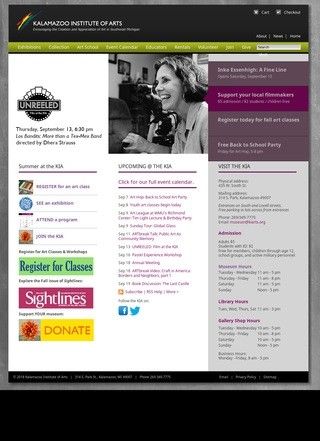
Kalamazoo Institute of Arts Fair is the annual outdoor art fair run by the Kalamazoo Institute of Arts, an art museum and educational center in Kalamazoo, Michigan. The fair sits inside a wider operation that carries the tagline "Art is for Everyone," and that phrase turns out to be a fair description of how the place behaves. The museum keeps a permanent collection open to the public, rotates exhibitions through its galleries, and folds the fair into a calendar that already includes classes, talks, and free evenings. Someone arriving at the site for the fair specifically will find it set against the museum that hosts it, which gives the event more grounding than a standalone festival page usually has.
Permanent collection and rotating exhibitions
The permanent collection anchors everything. Alongside it the museum runs rotating and special exhibitions, with shows such as "For the People, By the People: America at 250" listed among upcoming programming. That mix of a fixed collection plus a steady stream of temporary work is what keeps repeat visits worthwhile, and it is the backdrop against which the Kalamazoo Institute of Arts Fair appears each year. A person checking the site for the fair ends up seeing the rest of the program too, which is probably the point.
Kirk Newman Art School for all ages
Education is the other half of the operation and it gets serious treatment. The Kirk Newman Art School operates under the museum and teaches art classes to children, teens, and adults. That is not a token offering bolted onto a gallery; it is a named school with its own identity, and it explains why the institution leans so hard on access.
Supporting resources for learning
Supporting it are an art library, resources aimed at educators, student exhibitions where class work gets shown, and a children's interactive gallery built for younger visitors who are not going to stand quietly in front of a painting. None of this depends on the Kalamazoo Institute of Arts Fair, but it is the same institution that puts the fair on each year. The range here points to a place that treats teaching as a core function instead of an afterthought.
Free access and low-commitment programs
Access shows up in concrete ways. Free Thursdays open the museum without a charge at the door, giving people who would not otherwise pay their way in a reason to show up. There are artful evening programs and drop-in gallery conversations, the kind of low-commitment formats that let someone wander in and talk about what is on the walls without signing up for anything in advance. For a museum that puts "Art is for Everyone" on its masthead, these are the details that make the slogan mean something rather than sit there as decoration.
Membership, donations, volunteer roles
The participation side is broad. Membership programs, donation drives, volunteer opportunities, and corporate sponsorships all run through the institution, and there is an "Adopt a Work of Art" program for people who want to attach themselves to a specific piece in the collection. That last one is an unusual touch and a smart one, since it gives donors something tangible to point to. Taken together these channels show an organization that expects its community to be involved at several levels, from buying a membership to giving an afternoon as a volunteer.
Event rentals and gallery shop
Beyond the galleries and the school, the institution handles the things that keep a cultural venue running. It rents space for private events, which puts the building to use outside public hours and brings in revenue that supports the rest. There is a gallery shop as well, the usual companion to a museum visit. Neither of these is the reason someone seeks out the Kalamazoo Institute of Arts Fair, but they round out the picture of an organization doing more than hanging pictures on a wall.
Building depth under one roof
What is striking across the whole offering is how much sits under one roof. A collection, changing exhibitions, a teaching school spanning every age group, a library, programs for educators, an interactive space for kids, a shop, rentable rooms, and the fair itself all belong to the same institution. Kalamazoo Institute of Arts Fair benefits from that depth, since the event draws on a permanent organization with staff, a building, and an established calendar instead of being assembled from scratch each summer. A fair attached to a working museum tends to feel more durable than one attached to nothing, and the Kalamazoo Institute of Arts Fair is a clear example of that difference.
One detail says something about the overall posture. The children's interactive gallery and the "Adopt a Work of Art" program target opposite ends of the audience: a kid who needs to touch things and an adult ready to commit financially to a single painting. Holding both in the same program list is a quieter indicator than the tagline, and it lines up with what Kalamazoo Institute of Arts Fair sits beside. This is an institution that has thought about who actually walks through its doors and built something for each of them. The fair is one entry point. The school, the free evenings, the library, and the educator resources are others. Whether the draw is the fair alone or something the museum calendar offers year-round, the infrastructure is there.