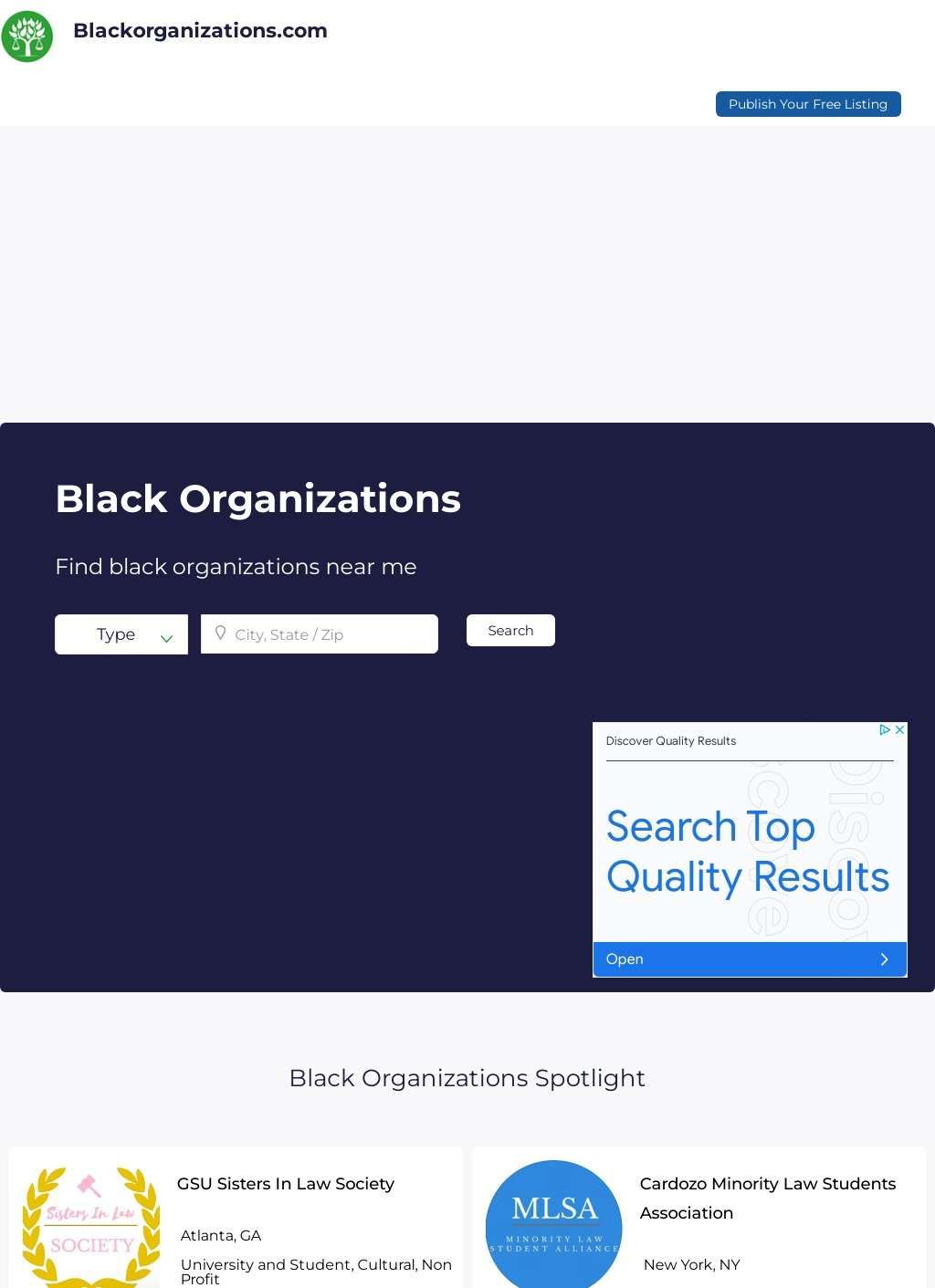
Taxonomy here runs far past what most niche directories bother with. Black Organizations is a searchable index of African American and Black-led or Black-focused organizations worldwide, and whoever drew up the category structure clearly thought hard about how varied this field is in practice. Charities split into animal welfare, arts and culture, education, environmental, health, international aid and religious branches. Alongside them sit separate spines for government bodies and embassies, healthcare and housing services, justice agencies, military and security outfits, human rights and political groups, and a religious column that covers churches, mosques, synagogues and temples as distinct entries rather than a single tag.
Categories for charity and faith groups
That last detail is worth pausing on. Flattening all faith-based groups into one "religious" bucket would erase meaningful differences, and Black Organizations does not do that. Student organizations break out into academic groups, activism, Greek life and sports, a level of detail absent from general-purpose listing sites. Non-profits and cultural bodies sit beside political and advocacy groups, so a researcher hunting for a Black-led environmental charity does not wade through unrelated entries to find it. The category architecture is the clearest sign that Black Organizations was built by people who understood the subject, not assembled by committee with a generic template.
Reach across US cities and abroad
Geographically Black Organizations reaches well beyond a single country. U.S. coverage hits the cities you would expect: Atlanta, Chicago, Los Angeles, New York, Washington D.C., and others where Black civic and cultural life has deep roots. What extends the usefulness is the international layer, with listings tied to Australia, Canada, France and the United Kingdom. The intent is to map the diaspora broadly, covering countries well beyond the United States.
Challenges of building international coverage
International ambition is easy to claim and hard to fill. A French or British visitor will judge Black Organizations on whether their local entries are populated, current, and accurate, and that varies by category in any directory this wide. Many directories begin national and bolt on other countries later as an afterthought, producing lopsided coverage and confusing geography. Here the international scope is baked into the taxonomy from the start, which at least gives overseas listings a proper home rather than a catch-all bucket.
Free listings for grassroots groups
Organizations can submit a free listing to Black Organizations, which is the right call for a directory that wants broad coverage. Free submission lowers the barrier for small grassroots groups, the exact entities most likely to be missing from mainstream indexes, and those are often the listings that make a resource like this worth opening in the first place. A directory that charged every group to appear would skew toward whoever could pay.
Paid referral membership without contracts
Above the free tier sits a paid membership and referral product with its own pricing page. The model is straightforward: qualified referrals sold exclusively once, no long-term contract, no monthly minimums. Selling each referral a single time is a meaningful detail, because the common complaint against lead-selling services is that the same lead gets resold to a dozen competitors. The promise of exclusivity, plus the absence of lock-in contracts, reads as a deliberately low-pressure offer aimed at organizations that want occasional inbound interest without a recurring bill.
Dashboard tools for messaging and notifications
Registered users get a dashboard covering account settings, notifications and messaging. That messaging system is the spine of how Black Organizations expects people to operate: instead of publishing each organization's phone and address openly, contact runs through an internal channel where a logged-in user reaches a listed group directly. A newsletter signup rounds out the regular-user features for anyone who wants to follow new additions without checking back manually.
Trade-offs of routed contact system
The routed-contact approach is a genuine trade-off. It gives the platform a reason to exist beyond a static list, and the messaging layer creates a place for an ongoing relationship between a visitor and the groups they find. It also means there is no phone number, no email, and no street address printed anywhere a logged-out visitor can read it. For a casual visitor who just wants to call a charity, that is a step they may not expect. A security policy page exists, though no general contact page surfaced during browsing.
Login wall filters casual visitors
People skim a directory precisely because they want to grab a detail and act fast, so gating every contact behind a login asks for commitment before the visitor has seen what they get. Some will bounce at that wall. Others, especially organizations evaluating the referral product, may prefer it: the same gate that slows a casual browser also filters out idle clicks and keeps interactions inside a system the operators can moderate.
Whether that exchange is worth it depends on who arrives at Black Organizations. A researcher cataloging the field will find the open taxonomy and city and country filters more than enough to work with, and may never need the messaging at all. A group hunting for partners, or an individual wanting to volunteer, has to buy into the account model to get anywhere, and that is a real cost the design imposes on them.
Behind the confusion with similar names
External coverage gives a visitor almost nothing to weigh. A search for third-party reviews of Black Organizations turned up nothing notable, and the one Better Business Bureau result that appears belongs to a separate Detroit-based entity called "Directory of Black Owned Business and Organizations," a different operation with a similar name. Anyone checking the site's track record should be careful not to conflate the two, because the names are close enough to mislead a quick search.
No body of outside commentary exists to lean on either way, so the structure, the spread of categories, and how populated a given folder turns out to be are what a visitor has to go on. Black Organizations is clearly reaching for something more than a static link list: a working platform with accounts, messaging, a newsletter and a referral business attached. The elaborate category tree is the site's strongest asset. The free-submission path and the single-sale referral terms both point in a sensible direction.
The login-gated contact is the design choice that will divide visitors most, helping the organizations that want managed, trackable inbound interest while frustrating the casual searcher who arrived at Black Organizations expecting a phone number on the page. That tension does not make Black Organizations a poor resource, but it shapes exactly which kind of user will get the most out of it.