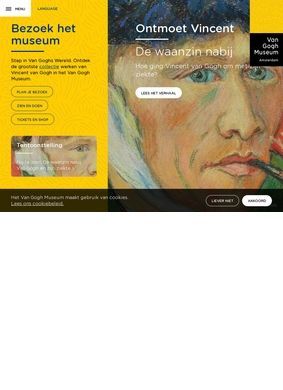
What does the official website of the world's largest collection of Vincent van Gogh's work actually put in front of a person before they visit? Mostly two things: a look at what hangs on the walls, and a way to buy a ticket to go and see it. The van Gogh Museum in Amsterdam runs the site as the front door to its holdings, and those holdings are the reason the place pulls the crowds it does.
The numbers are the headline. Counts cited around the collection vary a little between sources, but the van Gogh Museum holds something on the order of 200 to 205 paintings by Vincent van Gogh, roughly 500 drawings, four of his sketchbooks, and several hundred of his letters. No other institution comes close to the van Gogh Museum on the painter himself. That concentration is the whole proposition, and everything on the site is built to sell a visit to it.
Inside the collection
The permanent collection is what makes the van Gogh Museum more than a gallery with a famous name over the door. Around 200 paintings by a single artist, gathered under one roof, let a visitor follow Vincent van Gogh across his whole short working life instead of catching one canvas here and another in a museum three countries away. That kind of concentration is rare for any painter, and for one this popular it is close to unique.
Seeing this much of one hand at once changes how the work reads. A single van Gogh in a general museum is a trophy on a wall. Two hundred of them in sequence is a biography told in paint, and the van Gogh Museum can walk a visitor from the dark earth tones of the early Dutch years, through the colour that arrived in Paris and Arles, to the frantic late output, all in a single afternoon.
For anyone serious about the painter, this is close to unavoidable. Individual masterpieces hang in New York, Paris and London, but the concentration in Amsterdam, the paintings, the drawings, the sketchbooks and the letters gathered in one place, makes it the reference collection against which those scattered single works get understood.
Paintings, drawings and letters
The paintings are the draw, but the supporting material is what sets the van Gogh Museum apart from a highlights reel. The five hundred or so drawings show the working method behind the finished pictures, the trial and correction that a hanging canvas hides. The letters, several hundred of them, are the part a casual visitor tends to underrate. They are where the painter explains himself in his own words, and few artists left a written record anywhere near this full. Four sketchbooks sit alongside the drawings.
Those letters deserve a second mention. They are much of the reason so much is known about what the painter thought he was doing, and a museum that owns several hundred can build displays around the words as well as the pictures. Few single-artist collections can set a canvas next to the letter written the same week. Taken together, the material lets the van Gogh Museum present a whole life, the working process and the private voice included, which is a real difference from most single-artist displays.
The exact figures shift depending on which source is consulted, and the van Gogh Museum itself frames the collection as the largest of its kind anywhere. On the strength of the paintings alone, that claim is easy to credit.
The rotating exhibitions
Alongside the permanent holdings, the van Gogh Museum runs temporary exhibitions that bring in other artists and other conversations. Past and related programming has featured names as varied as David Hockney, Etel Adnan, Edvard Munch and Anselm Kiefer, which pulls the van Gogh Museum out of a purely nineteenth-century frame and sets Vincent van Gogh in dialogue with painters well outside his own era and country.
The choice of guests says something about how the museum reads its own subject. Setting the work beside a living artist like Hockney, or a near-contemporary such as Munch, is an argument that it still speaks to painters a century and more later. For a repeat visitor, these shows are usually the reason to come back once the permanent collection feels familiar. They also mean the experience on any given day is partly unpredictable, since what hangs on the temporary walls changes through the year.
A first-time visitor comes for the sunflowers and the self-portraits. The rotating program at the van Gogh Museum is aimed more at the person who has already seen those and wants a fresh reason to return.
Getting through the door
Access to the van Gogh Museum runs through the website in a particular way, and it pays to understand it before turning up. Admission is timed-entry and sold online, through a dedicated ticketing part of the site, so a visitor picks a slot in advance instead of queuing at the door on the day and hoping.
That system shapes the whole visit before a single painting comes into view. A timed slot decides when someone can walk in, an audio guide or tour can be added at the same stage, and all of it is handled online rather than at a counter on the day.
Timed entry and the tours
The timed-entry system is now standard for museums with this kind of pull, and it does spread the crowd more evenly across the day. Booking ahead also protects the visit in a quieter way: capping the numbers keeps the famous canvases visible rather than three deep in raised phones, which for a collection this popular is no small thing. The trade-off is that a spontaneous drop-in is off the table. No advance slot, no entry, so someone passing through Amsterdam with a free afternoon cannot simply wander in.
The ticketing sits on its own part of the site, a separate subdomain built to handle the volume, which is a quiet admission of how many people the van Gogh Museum moves through in a day. A timed slot to pick, an audio tour to add, a guided tour to reserve: the logistics wrapped around the art are substantial, and the website carries most of that load before a visitor ever reaches the entrance.
On the visit itself, the van Gogh Museum offers an audio tour and guided tours, the usual way a large collection walks a newcomer through what they are looking at. For an artist whose letters and hard, short life add so much to the meaning of the paintings, a good audio guide is close to essential, and the van Gogh Museum treating it as part of the standard visit is a sensible call. A guided tour covers the same ground with a person on hand to answer questions.
None of this booking machinery is unusual for a museum of this size. It does mean the van Gogh Museum website is doing double duty: part introduction to the collection, part ticket shop, and the two jobs pull in slightly different directions. A page trying to inform a visitor and sell that visitor a timed slot at the same time will always lean toward the sale.
Which leaves the honest question a browser is left with. The site does a clear job of selling a ticket to the van Gogh Museum, and the collection behind that ticket is beyond argument: some 200 paintings, hundreds of drawings and letters, the fullest gathering of Vincent van Gogh anywhere on earth. What is far less clear from the site itself is how much of that collection a person can actually engage with online, from home, without booking a flight to Amsterdam and a timed slot at the counter.
For a visitor standing in the building, the van Gogh Museum is close to unmatched. For everyone reading about it from somewhere else, how much the website hands back beyond a checkout page is the doubt it never quite settles.