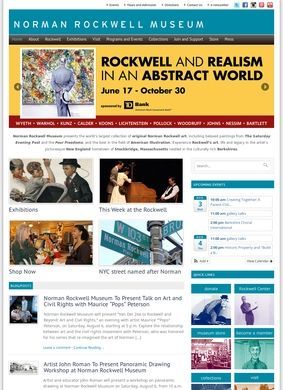
Stockbridge, Massachusetts is a small town, but the Norman Rockwell Museum is not a small institution. It holds the largest collection of original Rockwell work anywhere: paintings, drawings, and a deep archive that goes well past the handful of images most people picture when they hear the name. The site reflects that scope. It is built to serve a working institution that runs exhibitions, education programs, a research center, and a retail operation, and the navigation has to carry all of it without collapsing.
Exhibitions and the Studio
Start with the exhibitions, since that is what most visitors come for. The site separates current, upcoming, virtual, traveling, and past shows, which is more granular than many regional museums bother with. Someone planning a trip can check what is actually on the walls before driving up. There is also a dedicated section for Rockwell's original Studio, which sits on the museum grounds and can be toured by reservation. The site treats the Studio as its own destination rather than burying it in a general visit page, which is the right call: the people who want to stand where the work was made are a real and distinct audience.
Research hub for illustration history
The part that surprised me was the Rockwell Center for American Visual Studies. This is a research hub built around the history of illustration broadly, Rockwell being one focal point among others, and it includes the Frank Schoonover Collection Raisonne, a searchable online collection, archives, image licensing resources, and finding aids. That is academic infrastructure. A scholar, a student, or someone tracking down rights to reproduce an image has real tools here, and the presence of a catalogue raisonne indicates the Norman Rockwell Museum takes its custodial role seriously. Plenty of art institutions claim to be research-minded; far fewer publish finding aids and a searchable archive that a stranger can actually use without emailing someone first.
School programs and visit planning
Education is handled with similar weight. The Norman Rockwell Museum offers K-12 curricula, summer programs, and virtual field trips aimed at school groups, with school-group pricing called out alongside general admission, ticket packages, and group tours. The ticketing structure is laid out clearly enough that a teacher organizing a class visit or a family pricing a day out should not have to guess. Directions and amenities information rounds out the visit-planning side, and the museum does not hide that information behind a booking flow.
Retail, membership, events
Beyond exhibitions and education, the site runs a full retail and events operation. The online shop covers prints, fashion, books and catalogs, home decor, stationery, toys and games, and gift cards. Membership comes in tiers, including individual, the Rockwell Society, and a business level, and the Norman Rockwell Museum hosts weddings and private events. Careers and internship listings sit alongside press resources and an e-newsletter.
Appraisal questions from the public
One detail worth flagging is a "What's My Rockwell Worth?" FAQ that fields appraisal questions. It is a smart way to deflect the flood of inquiries a famous name inevitably attracts from people who inherited a print and want to know what they have. That page tells you the Norman Rockwell Museum understands its own audience: visitors and scholars are one part of it, but so is the broader public that has a vague relationship with the name and needs orienting.
From archive to discovery
What separates the Norman Rockwell Museum site from a typical regional museum homepage is the depth on the research side. The archive and licensing resources are not marketing copy; they are functional tools aimed at people with specific professional or academic needs. The finding aids in particular are the kind of thing that gets built when an institution takes a long view of what the collection is for. A museum can own a great collection and still make it inaccessible; the Norman Rockwell Museum has plainly invested in making the work discoverable.
Virtual field trips extend reach
The education section deserves the same note. Virtual field trips and downloadable K-12 curricula extend the institution's reach well beyond the Berkshires, and the fact that school-group pricing is clearly listed rather than buried in a "call for rates" placeholder is a practical courtesy that overworked teachers notice. The Norman Rockwell Museum is doing the less glamorous work of cataloguing, teaching, and archiving instead of coasting on the painter's fame, and the website reflects that.
Keeping content current
The one open question is freshness. A site this large lives or dies on whether current exhibitions and virtual offerings stay genuinely current, and that is the one thing a single visit cannot confirm. The structure to keep it fresh is plainly there. Whether every corner of a museum site this sprawling gets maintained with the same care, or whether some of those past-exhibition and virtual sections quietly go stale, is a legitimate concern for any institution running this much content in parallel. The Norman Rockwell Museum has built something worth the upkeep; the published evidence gives no reason to doubt they are managing it.