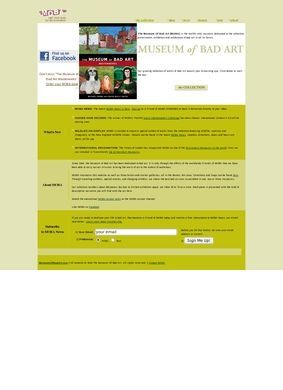
Admission to the Museum of Bad Art (MOBA) costs nothing, and the main gallery sits inside a working brewery in Dorchester, which means a visitor can study a genuinely terrible portrait with a pint in hand. That arrangement is close to the whole pitch. The collection is built around sincere art that went wrong, and it is free to walk through.
Museum of Bad Art bills itself as the world's only institution dedicated to the collection, exhibition, and celebration of work that would never be welcomed into a traditional art museum. The operative word is sincere. A painting qualifies when the artist meant it, tried, and missed: the anatomy collapses, the perspective fights itself, or the colors land somewhere no one intended.
A collection of earnest misfires
What hangs on the walls is not deliberate parody or thrift-store kitsch. Museum of Bad Art draws a firm line between lazy junk and honest failure, and only the second kind gets in. A portrait whose eyes drift in two directions, a landscape whose horizon buckles, a still life that somehow reads as ominous: these are the keepers.
That distinction is also what has pulled in some real academic attention. Wikipedia carries an entry on the collection, and it cites a study in the journal Perspectives on Psychological Science that had viewers rate the artistic quality of Museum of Bad Art pieces against works pulled from the Museum of Modern Art. A wall of bad paintings turns out to double as a usable research instrument, which hints at how carefully the joke is built underneath.
The premise holds because the curators refuse the easy targets. Anything made as a gag, or made cynically, gets turned away at the door.
The audience is deliberately broad. General museumgoers, tourists working through a day in the city, and people who show up strictly for the humor all get the same free walk. That mix shapes how the place has to function, because a picture has to land for someone who wandered over from the bar as readily as for a repeat visitor tracking the newest arrivals. The comedy pulls people in the door, and the sincerity underneath is usually what keeps them looking at the walls longer than they meant to.
Free admission and brewery hours
The flagship Museum of Bad Art gallery in Boston lives inside Dorchester Brewing Co and runs on the brewery's clock: doors open at 11:30 each morning, close earlier at the top of the week, and stretch late on weekend nights. Because the room sits inside a brewery, guests under 21 are turned away during the busy weekend evenings.
None of that changes the price, which is zero. A second gallery in Quebec City, housed inside Aire Publique, is listed as temporarily closed, with its own weekday and weekend hours posted for when it reopens, and free admission there as well.
Membership, donations, and the clip file
Past the galleries, Museum of Bad Art runs a "Become a Friend" membership program and accepts tax-deductible donations through PayPal or Venmo. A newsletter signup rounds out the ways to stay in touch, aimed at people who want word of new acquisitions and events. Nothing here asks for much money, and with the door free, the museum plainly leans on members and small donors to keep the lights on.
It also maintains an "article reviews" page, a running file of the press coverage the collection has attracted over the years. For an institution whose whole identity is a running joke about quality, a tidy archive of clippings is a shrewd move: it lets the joke prove it has traveled. The Facebook page and YouTube channel stay active, and that is where most of the day-to-day updates and new finds show up.
The membership pitch is modest by museum standards. There is no gift-shop-and-cafe machine behind it, no tiered pricing scheme pushed at the exit. A friend program, a couple of digital payment handles, and a newsletter cover the whole apparatus, which fits an operation that gives its art away for free and asks only that people who like it chip in.
Curator talks and educational programming
The programming is thinner but genuine, built around curator talks and educational sessions that use the collection as teaching material. I walked in braced for pure gag, and the framing turned out more considered than that, with the curators treating each acquisition as a small case study in exactly how a picture fails.
That is the one spot where the Museum of Bad Art quietly admits it cares more than the premise lets on.
How the outside listings read
Third-party reputation is scattered across the usual travel and review sites. The Yelp page for the Boston Museum of Bad Art shows 59 reviews and 92 photos, though no star average surfaces in the summary. Tripadvisor is messier, carrying separate pages for current and former homes in Boston, Somerville, and Dedham, with a Travelers' Choice award attached to one of those listings. The spread of pages is partly a quirk of a museum that keeps relocating, and it does make the online footprint harder to read at a glance than a single fixed address would be.
WhichMuseum sums the Museum of Bad Art up flatly as a unique private museum, which lands about right. Contact runs through the site's own contact page and its social accounts: the street addresses and opening hours for both galleries are posted in plain view, but there is no phone number or listed email, so reaching a person means the contact form or a message on Facebook. For a small free museum, that is a reasonable trade.
What the numbers do and do not show
The one hard figure on offer is that Yelp count, and 59 reviews with 92 photos points to steady foot traffic well past a one-time novelty stop. The Tripadvisor award, plus the trail of old location pages, shows the collection has changed addresses more than once and held onto an audience through the moves.
What none of the platforms hand over is a clean star rating, so the read is more about volume of visits than a scored verdict. Admission stays free at both galleries, and the Boston room still keeps a brewery's hours.