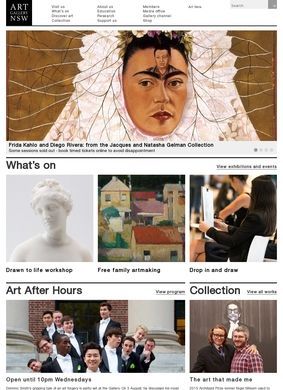
Plenty happens at a state art museum's website before anyone sets foot inside. At artgallery.nsw.gov.au, quite a lot. The Art Gallery Of New South Wales runs its site as a full front door to the institution in Sydney, covering the permanent collection, the changing exhibition program, and the practical business of planning a visit. It is a NSW Government cultural institution, and the site reads like one that expects to be used by very different people on the same afternoon: a tourist checking hours, a doctoral student hunting down a specific painting, a teacher booking a class visit.
Collection database for research
The collection is the spine of the whole thing. The Art Gallery Of New South Wales holds Australian art, a substantial Aboriginal and Torres Strait Islander collection, Asian art, and international works, and the site splits that holding across its two buildings, the original Naala Badu and the newer Naala Nura that came out of the Sydney Modern Project. The online collection database is where the site proves most useful for anyone who cares about the art itself. You can search by artwork or by artist and browse the holdings from a screen, which turns a static museum page into something closer to a research tool. For students and researchers that database is the part worth bookmarking, more so than the polished imagery the site leads with.
Searching artwork by artist or title
Exhibitions are handled with the detail you would want when planning a trip. Current and upcoming shows come with dates and ticketing, and the site is upfront about the pricing logic: general entry is free, while special exhibitions carry an admission charge. That free-plus-paid model matters for planning, since it means a casual visitor and a ticket-holder need different information, and the Art Gallery Of New South Wales gives both without burying one under the other. The annual prizes sit alongside the exhibitions, most prominently the Archibald Prize, which the Art Gallery Of New South Wales hosts and which pulls a national audience every year. The site treats these prizes as recurring events with their own space rather than as footnotes, which is the right call given how much public attention the Archibald draws on its own.
Exhibitions with ticketing information
Visitor information is thorough: opening hours, admission, accessibility notes, directions and parking, and the on-site cafes and gift shop all get covered. The accessibility detail in particular is the kind of thing a lot of institutions treat as an afterthought, and here it is part of the standard visit information. Someone arriving from interstate or overseas can work out how to get there, what it costs, and what to expect once inside, all from the same set of pages. This is a different animal from a generic business directory listing that gives an address and little else; the depth here is closer to a planning guide than a signpost.
Planning your visit with practical details
The programming runs deeper than exhibitions. Learning and education is a genuine section, with school programs, floor talks, workshops, lectures, and artist talks. Kids and family programs get their own attention, and an event calendar ties the moving parts together. The breadth here is more convincing than the headline shows, because a gallery that schedules floor talks and artist talks week to week treats its collection as material to be explained to visitors, going well beyond simply hanging works on a wall. School groups and families are clearly a planned-for audience, not an afterthought bolted on.
Programs beyond the permanent collection
Then there is the institutional layer, where the Art Gallery Of New South Wales behaves like the public body it is. Membership details and benefits are laid out for regulars. The Art Gallery Of New South Wales runs a foundation and philanthropy section for donors, plus venue hire and function space information for anyone wanting to use the building itself. Volunteer and internship opportunities are posted. Media and press releases sit near annual reports and governance documents, the corporate paperwork a state institution is obliged to publish. None of that is glamorous, but its presence tells you the site is a working operational hub and not a marketing shell.
A donor, a member, a researcher, and a school coordinator each have a clear path through the site, and the general public still gets the simple version up front. It would be easy for a museum of this scale to let its site sprawl into an unnavigable index of every department. The Art Gallery Of New South Wales keeps the public-facing material clean while still exposing the deeper functional sections to people who go looking for them.
If there is a limit to what the website conveys, it is the one every gallery site shares: the pages can list the Asian collection or the international holdings, but they cannot substitute for standing in the room. The site is honest about that, steering hard toward the practical (when to come, what is on, what it costs) instead of overselling the experience in prose. For a two-building institution spread across the original space and the Sydney Modern addition, getting a visitor oriented before arrival is half the job, and the Art Gallery Of New South Wales does that part well.
For the collection database alone, the site is worth consulting well beyond trip planning. Researchers can trace an artist across the holdings, and casual browsers can wander the Australian and Aboriginal and Torres Strait Islander collections from anywhere. That searchable depth is what separates a serious museum site from a promotional one, and it is where the Art Gallery Of New South Wales is strongest.
Weigh it against the National Gallery of Victoria's site in Melbourne, the obvious peer for anyone deciding which major Australian gallery to build a visit around. Both run large online collections and busy exhibition calendars, and both serve the same mix of tourists, students, and members. The NGV leans harder into a design-forward presentation, while the Art Gallery Of New South Wales puts its two-building layout, its free general entry, and its prize program, the Archibald above all, at the front. If Sydney is where you are headed, this is the site to plan from, and the collection search gives it lasting value for anyone studying Australian and Asian art no matter where they live. On balance, the Art Gallery Of New South Wales has built a site that does the practical work and respects the people using it.