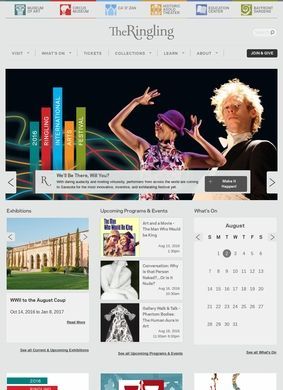
Florida State University runs The Ringling, the state art museum, out of a sprawling estate and museum complex on Sarasota Bay. It grew out of the fortune and personal collection of John Ringling, the circus magnate, and his wife Mable, and the site still carries the shape of that private world turned public. Visitors get a cluster of very different things sharing one set of grounds, and understanding that before a visit changes how much time to set aside.
Museum of Art and European paintings
The core is the Museum of Art, built around the Ringling collection itself. The strength here is European painting, with Old Master works and a notable Baroque holding that includes pieces by Rubens. That gives the place a specific gravity many regional museums cannot match, since a wealthy buyer with the means to acquire serious canvases assembled the collection, instead of it accumulating piecemeal from local donations over decades. Anyone whose interest runs to seventeenth-century European art will find the trip justified on the painting galleries alone.
Ca' d'Zan mansion
Next to the art museum sits Ca' d'Zan, the Ringlings' waterfront mansion, kept as a historic house. It is the domestic counterpart to the collection: the residence where the money that bought the paintings actually lived. Touring a preserved Gilded Age house is a different experience from walking a gallery, closer to social history than to art appreciation, and The Ringling folds both into the same admission territory. That pairing of a mansion and a museum on one estate is unusual, and it is a large part of what makes the destination feel less like a museum stop and more like a half-day excursion.
Grounds and gardens shape the visit
The scale of the property shapes everything about how a visit works. The Ringling occupies acres of bayfront grounds, and the buildings spread across them instead of stacking into one structure. Walking between the art galleries, the mansion, and the circus buildings is part of the experience, and in the Florida heat that alone can dictate how much a visitor manages in a day. The historic gardens are not an afterthought tucked around the edges; they are integral to what The Ringling is, the same landscaped bayfront the family looked out on.
Circus Museum documents American show history
Then there is the circus, where the estate stops resembling any other art institution in the country. The Circus Museum documents the history of the American circus through memorabilia, posters, wagons, and a detailed model circus that reconstructs a touring show in miniature. It is a genuine oddity in the best sense: a fine-art museum that also holds one of the most complete records of a vanished form of popular entertainment.
The connection to John Ringling makes it coherent instead of random, and for families the circus wing is often the part that lands hardest with children who might otherwise fade in the painting galleries. The model circus is the sort of object people remember for years, a hand-built world of tiny performers and animals that rewards close looking, and it draws visitors who would never otherwise seek out a Baroque gallery.
What should you prioritize in one day?
That is the honest tension at the center of the place. The Bayfront gardens, the historic grounds themselves, the Tibbals Learning Center that houses the circus material, and the various indoor collections add up to more than a single unhurried afternoon can absorb. The Ringling lays out visiting information, hours, admission, directions, and parking in a way that expects planning, and the breadth of what is on offer rewards visitors who treat it as a full day out with a pause at the on-site Ca' d'Zan Cafe, rather than a quick detour between other Sarasota stops.
For researchers and readers the estate goes deeper still. The Rosalind Fox Rare Book Library and a separate art library sit on the grounds, alongside a rotating program of special exhibitions that keeps the offering from being purely a fixed permanent collection. This layering is one reason I would push back gently on anyone who files The Ringling under a single label, because it operates simultaneously as an art museum, a historic estate, a circus archive, and a research institution, and the balance among those shifts depending on which door you walk through.
Beyond the collections, The Ringling runs the working apparatus you would expect of a museum of its scale. There are educational programs and guided tours, membership tiers for people who intend to return, group tours for organized parties, and a museum store for the usual post-visit browsing. The estate also rents its grounds and spaces for weddings and corporate events, which tells you something about how photogenic the bayfront setting is and how the institution stretches its historic property to support its own operations.
The audiences The Ringling tries to serve are genuinely varied, and the programming reflects that spread. General tourists passing through the Gulf coast, students working through coursework, researchers after the rare book holdings, members who come back through the seasons, and families steering children toward the model circus are all accounted for in the way the site is organized. The exhibitions and events calendar carries the changing content, while the collections, education, membership, and giving sections handle the standing structure. A press and media section rounds it out for anyone covering the institution.
The educational side deserves its own mention, since it is where the estate justifies the State Art Museum title beyond the collection on the walls. The Tibbals Learning Center anchors the circus scholarship, the two libraries support serious study, and the tour and program schedule gives casual visitors a guided route through material that can otherwise feel scattered across the grounds. For a student sent here on assignment, the depth is real, though it takes some navigating, and The Ringling clearly expects that people will return more than once to reach the bottom of it.
My reservation is less about quality than about coherence of expectation. The Ringling asks a visitor to hold several very different registers in one trip: solemn Old Master galleries, a lavish period mansion, a boisterous circus history, formal gardens, and quiet libraries. That range is exactly what makes it distinctive, and it is also what makes it hard to describe to a friend in a sentence, because the person who comes for Rubens and the person who comes for the miniature big top are having almost unrelated afternoons under the same name.
Whether that breadth reads as generosity or as a lack of focus probably depends on the visitor, and The Ringling does little to resolve the question for its visitors. Someone arriving with two hours and a narrow interest in painting may leave feeling they saw a fraction of a place built for a full day, aware that the mansion, the circus wing, the gardens, and the rare book rooms were all sitting there unvisited. The Ringling is unquestionably worth the trip on the strength of its collection and its unusual pairing of art, house, and circus. What is harder to settle in advance is how much of it any one person can actually take in before the sheer spread of the estate starts working against the attention it deserves.