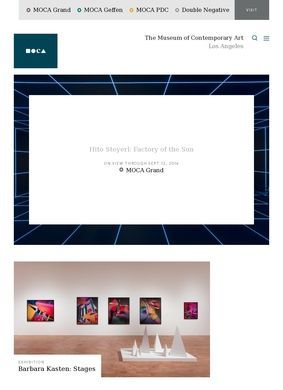
One visitor who lands in downtown Los Angeles wanting to follow the actual lineage of postwar art, not a handful of token canvases tucked into an encyclopedic collection, runs into a familiar wall: most general museums treat the contemporary as a side gallery. The Museum of Contemporary Art was built to answer that exact need. Founded in 1979 and run as a nonprofit, it gives itself over completely to work made from the 1940s forward, and it carries an origin that quietly shapes everything else. It describes itself as the only artist-founded museum in the city, and that is not a marketing flourish. It helps explain why the program keeps returning to artists who test what a museum is supposed to hold rather than artists who merely decorate its walls.
Three venues for different scales of work
The scale is worth understanding before a first trip, because the name covers more than a single building. The Museum of Contemporary Art runs three separate venues. MOCA Grand sits on South Grand Avenue downtown and tends to carry the headline shows. The Geffen Contemporary, in Little Tokyo, is a converted industrial space with the ceiling height and raw volume that large installations and sculpture need. A third space, called WAREHOUSE, rounds out the footprint. Three rooms under one institution means a single ticket-holder can see very different kinds of work in a single stretch of days, and it means the curators are not forced to cram a sprawling sculptural piece and a tight drawing survey into the same square footage.
Current exhibitions and artistic focus
The current slate, running through early August 2026, gives a fair read on how the Museum of Contemporary Art thinks. "The Expanding Field" is the kind of group framing the institution does well, the sort of show that argues a point about a medium rather than just hanging objects in a row. A focused presentation of Michael Asher speaks to the Museum of Contemporary Art's long attachment to conceptual and institution-questioning practice, which fits its artist-founded character almost too neatly. And "Haegue Yang: Star-Crossed Rendezvous" brings a contemporary international voice whose work tends to fill a room with material and movement, exactly the sort of thing the Geffen's volume was made to carry.
Collection database and acquisitions
What I find genuinely useful is that the exhibition program is paired with an online collection database, so the Museum of Contemporary Art is not a black box between shows. A reader can browse the holdings by artist, straight down an A to Z list, and check recent acquisitions to see where the collecting is heading. That second feature is easy to overlook, because acquisitions are the clearest signal of an institution's real priorities. Anyone deciding whether the Museum of Contemporary Art is worth a detour can look at what it has actually been buying and judge for themselves before spending an afternoon on it.
Tours, film programming, lectures
The Museum of Contemporary Art does not stop at hanging objects, either. It runs guided tours across all three venues, which is the difference between drifting past a difficult Asher piece and understanding why it is difficult. For people who want the context spelled out, that guided layer is the most direct way in.
Beyond the tours, the programming spreads into film and talk. The MOCA Artist Film Series gives moving-image work a proper place instead of relegating it to a monitor in a corner, and public lectures are tied to the running exhibitions, so the talks track what a visitor can see that same week instead of floating off into generic art theory. The two strands reinforce each other: see the show, then hear someone unpack it.
Education programs for teachers and teens
Education is handled as a real department, not a token gesture. The Museum of Contemporary Art builds programs for teachers, for teens, and for general audiences, three groups with very different needs that too many institutions lump together. A teacher planning a unit, a sixteen-year-old testing whether contemporary art is for them, and a curious adult with no background each get a different door in. That kind of segmentation is a quiet sign that the Museum of Contemporary Art takes its public role as seriously as its exhibition calendar.
For people who cannot get to Grand Avenue, the Museum of Contemporary Art keeps a digital arm. MOCA Stream carries online video content, which extends the lectures and artist material to anyone outside Los Angeles or anyone weighing a visit from a distance. It is not a replacement for standing in front of the work, and the Museum of Contemporary Art does not pretend it is, but it lets a far-off reader sample the institution's voice before booking a flight. A newsletter signup keeps regulars ahead of what is opening next, and the museum maintains an active presence on Instagram, Facebook, YouTube, and TikTok, which is where most of the day-to-day exhibition news actually surfaces now.
A few practical notes round out the picture. Tickets run through a dedicated third-party ticketing portal, separate from the main site, which is standard practice and worth knowing so a first-time visitor does not hunt for a checkout that lives elsewhere. The museum shop sits on its own site as well, mocastore.org, and it sells exhibition catalogues alongside general merchandise.
The catalogues are the part worth flagging for anyone who cares about the work past the visit itself, since a serious contemporary show often produces the only durable scholarly record of itself in its catalogue, and a strong museum store is where that record stays available after the walls are repainted for the next exhibition. On Google the Museum of Contemporary Art carries several thousand ratings and lands reliably above 4 stars; TripAdvisor shows a similar volume, with most complaints circling parking and the multi-venue layout, not the programming itself.
Put together, the Museum of Contemporary Art reads as an institution that knows precisely what it is for. The narrow remit, art from the 1940s on, keeps it from diluting into a general survey. The three venues give different kinds of work the space they each demand. The collection database and the acquisitions feed make the holdings legible between shows. And the layered programming, tours plus the Artist Film Series plus exhibition-linked lectures plus a genuine education department, means the place rewards a return visit instead of a single pass. The artist-founded origin is more than a founding footnote; it shows up in choices like a full Michael Asher presentation, the sort of conceptually demanding artist a more cautious museum might avoid.
If there is a caveat for a newcomer, it is the one that comes with any institution this committed to the contemporary: the work will not always be comfortable or immediately legible, and someone expecting Impressionist crowd-pleasers will be in the wrong building. That is a feature, not a flaw, and the museum is honest about its lane. The Museum of Contemporary Art is for the person who wants postwar and present-day art taken seriously, not softened.
The clearest practical step for an out-of-town art traveler is to start on the Museum of Contemporary Art's collection pages and read the current "Expanding Field," Michael Asher, and Haegue Yang descriptions to see whether the running shows land, then book through the ticketing portal and put the Geffen Contemporary on the same itinerary as MOCA Grand so a single trip covers both registers of the program. Teachers should go a step further and contact the education department directly about teacher offerings before the school term, since that is where the Museum of Contemporary Art quietly does some of its strongest work.