Somewhere between booking the flight and clearing passport control, most first-time visitors to Amsterdam run into the same problem: the national collection of the Netherlands is enormous, an afternoon is short, and nobody wants to spend it lost in corridors hunting for the one painting they crossed a continent to see.
The website built by Rijksmuseum Amsterdam is aimed squarely at that problem. Its Visit and Tickets section sets out what is on before a visit, and a searchable Collections database lets a visitor pin down a single work, a single painter, or an entire theme without setting foot in the building.
The collection is the reason to come, and the site of Rijksmuseum Amsterdam treats it that way. The holdings run through the great Dutch painters, Rembrandt, Vermeer and Van Gogh among them, and the online catalogue tracks the galleries closely enough that planning a route through them takes minutes. The first time I went looking for a single Vermeer, the collection search turned it up in seconds, with the room and the surrounding context already attached.
That is the real use of the database. Less browsing, more triage.
A visitor with two hours can decide in advance what those two hours are worth, and arrive with a shortlist instead of a floor plan and a vague sense of dread. For a collection this size, that planning layer is the difference between a satisfying visit and an exhausting one, and Rijksmuseum Amsterdam clearly understands which of the two it wants people to have.
The Collections database rewards attention on its own terms. It is open to anyone with a connection, which means a student in another country can study the holdings without a plane ticket, and a researcher can trace a single painter across the catalogue at two in the morning. For an institution that exists in part to preserve and to share, putting the collection online in a form people can genuinely search is the quiet half of the public mission, and it is done well.
Three names carry most of the traffic. Rembrandt, Vermeer and Van Gogh are the draw, and the site does not pretend otherwise; the planning tools funnel a first-time visitor toward them without apology. That honesty about what people actually cross the city for is part of why the catalogue works. It meets the visitor where they are, then widens the view once they are through the door.
The Visit and Tickets section is where that practical planning happens. Booking ahead is the norm for a collection that draws crowds, and having the exhibition information and ticketing sit in one place means a visitor settles the logistics in a single sitting. It is unglamorous work, and it is exactly what turns a daunting institution into a manageable morning.
The permanent masterworks are only half of it. The programme rotates, and recent exhibitions at Rijksmuseum Amsterdam have set photography by Ed van der Elsken alongside the illustrated work of Fiep Westendorp, two very different registers of Dutch visual culture sharing the same institution. This is where a museum shows whether it is a mausoleum for old paint or a living place, and pairing Ed van der Elsken's photographs with Fiep Westendorp's illustrations points firmly at the latter.
A collection anchored by the old masters that also gives wall space to twentieth-century photography and to illustration is a collection arguing that Dutch art did not stop with the old guard.
Tying the threads together is the Stories section, the thematic writing where Rijksmuseum Amsterdam turns objects into narrative. It carries essays and background that give a painting, a photographer or a whole period some frame before a visitor stands in front of the work. For anyone reading up ahead of a trip, Stories does genuine work, and it reads as scholarship pitched at a general audience, the kind that informs without ever talking down.
The whole site carries support across more than ten languages, a detail that fits an institution whose audience is genuinely global. A visitor from Tokyo or Sao Paulo gets the same planning tools as a teacher in Utrecht, and Rijksmuseum Amsterdam treats that international traffic as ordinary, with the catalogue and the practical information reaching every one of those visitors equally. It calls itself het museum van Nederland, and the multilingual apparatus is the museum making good on the national part of that claim for an audience that turns up from everywhere.
There is a Gift Shop at Rijksmuseum Amsterdam as well, carrying merchandise and, more usefully, the museum's own publications. These are the catalogues and books that go deeper than a postcard, the useful end of a museum shop for a visitor who would rather leave with a book than a fridge magnet. A serious publication programme signals an institution that treats its collection as material to be studied, and it gives a visitor a way to carry the museum home in print.
Beyond the masterpieces
The galleries and the rotating exhibitions are the headline, but Rijksmuseum Amsterdam spreads well past them. A national museum funded through the Dutch Ministry of Education, Culture and Science carries a public brief, and the site reflects that brief in the room it gives to education, access and support. Accessibility Services get their own section, arranged for visitors who need them, so that a wheelchair user or someone with sensory needs can plan with the same confidence as anyone else.
The structure of the site follows from that public role. A family, a school group and a solo researcher each get a path in, and none of them reads as an afterthought to the tourist trade. It is the kind of breadth a publicly funded institution is supposed to deliver, and at Rijksmuseum Amsterdam the breadth holds up as substance rather than decoration. None of it reads like an entry in a business directory, which is the right instinct for an institution answerable to a ministry rather than a shareholder.
The accessibility material sits within easy reach, not three clicks deep where good intentions often go to hide; a visitor who needs it will find it right away.
Programs for families and schools
The Educational Programs are built for families with children, for school and group visits, and for teachers organising a class trip. During the summer programs, admission is free for under-eighteens, which drops the barrier for precisely the audience a national museum should want coming through the door young.
Rijksmuseum Amsterdam treats children as real visitors, with material aimed at them instead of a token corner near the exit. Teachers get their own planning route, so a class trip can be organised around a curriculum instead of improvised at the ticket desk. Get a child in front of a Rembrandt at eight years old, and the museum has done something a school textbook cannot.
Newsletters, membership and the Vrienden
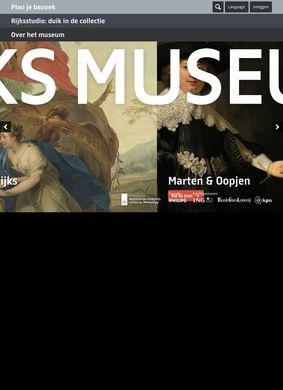
For people who come back, the site offers a newsletter, donation options, and the Vrienden membership programme, the supporters' scheme that keeps visitors tied to the place between trips. The newsletter and the donation options are the low-commitment ways in, useful for someone who wants to keep an eye on what Rijksmuseum Amsterdam is showing without signing anything. The museum also names its corporate partners, among them KPN, the Vriendenloterij and ING, the sort of backing that funds acquisitions and keeps a national collection growing year to year.
Joining as a Vriend is pitched as belonging to the place, and for a resident who returns often that framing genuinely lands.
Put together, the site is a national collection made navigable before arrival: a searchable catalogue, rotating exhibitions running from Ed van der Elsken to Fiep Westendorp, reading in the Stories section, and programmes that reach a child and a scholar with the same seriousness. The Van Gogh, the Vermeer and the Rembrandt are still what fills the halls. Everything the Rijksmuseum Amsterdam site does is arranged around getting people to them.