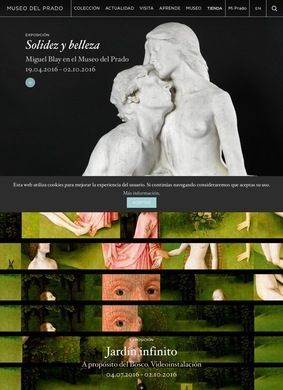
Spain's national art museum occupies a long neoclassical building on the Paseo del Prado in Madrid, and its website is the front door to one of the deepest collections of European painting anywhere. The numbers set the scale: roughly 8,000 paintings, around 700 sculptures, some 4,800 prints and over 8,000 drawings, plus thousands of decorative arts objects. What the site does well is treat that scale as something to be searched and read rather than simply listed. The permanent collection sits behind a digital catalog you can dig through properly, which turns a building full of masterpieces into something a person can plan around before ever buying a ticket. This is a listing in a business directory, so the entry point is the museum's own web presence, and that presence is worth examining on its own terms.
Masterpieces behind the numbers
The holdings are the reason anyone arrives at Museo Nacional del Prado, and the site is honest about which works pull the most attention. Velazquez is represented by Las Meninas, the painting most visitors come for. Goya appears twice over, through The Third of May and the unsettling Black Paintings, two very different sides of the same artist. Add Bosch's Garden of Earthly Delights, El Greco, Titian, Rubens, Raphael and Rembrandt, and the catalog stops reading like a museum inventory and starts reading like a survey of several centuries of how Europe painted itself, its rulers and its nightmares. Few institutions can put that many first-rank names in one place, and the Museo Nacional del Prado website does not pretend otherwise.
Searching the permanent collection
For a collection this size, browsing matters as much as the art itself, and the searchable digital catalog that Museo Nacional del Prado maintains for its permanent collection is the part worth returning to. You can look up a specific work, read about it, and see where it sits within the wider holdings, which is genuinely useful whether you are preparing a visit or simply following a thread from one painter to another. The span runs from the 12th century to the early 20th, so the catalog reads less like a snapshot of one school and more like a long, continuous record of how tastes and techniques shifted across generations.
Reaching scholars and remote visitors
Virtual tours extend the reach of Museo Nacional del Prado for people who cannot get to Madrid, and they pair naturally with the catalog entries. The library and archive also have their own section, a quiet acknowledgment that this is a research institution as much as a place to walk through. Students and scholars find material there that a purely tourist-facing site would skip entirely, and the depth of those resources puts Museo Nacional del Prado in a different category from museums that publish only visitor-facing content.
Temporary exhibitions get their own coverage, with details on what is currently showing and what is coming. Since these shows rotate, the information keeps the site from feeling like a static brochure for the permanent rooms alone. It is a small but meaningful difference when you are trying to decide whether a particular trip to Madrid lines up with something worth seeing beyond the standing collection.
Planning a visit
Online ticketing covers general admission with timed-entry slots, which is how Museo Nacional del Prado manages the crowds that a collection of this fame draws. General admission runs at fifteen euros, with free entry in the final two hours on weekday and Saturday evenings, and free admission for anyone under eighteen. Those free windows change how a budget-conscious visitor or a family might time a trip, and the fact that they are spelled out clearly on the site removes a common source of confusion.
Comparing membership and education programs
Guided tour bookings and audioguide rental sit alongside the ticketing, so a visitor can decide in advance how much structure they want once inside. Beyond the single visit, Museo Nacional del Prado lays out membership and the Friends of the Prado Foundation programs for people who want a continuing relationship with the institution. Educational resources for schools and families give teachers and parents a starting point, and accessibility services are documented for visitors who need them. None of this is flashy, but it does not need to be. A school group, a member returning for the fifth time, and a tourist with two hours to spare can all find what they came for in the same set of pages, which is a fair test of how well the site has thought about its different audiences.
Taken together, the Museo Nacional del Prado site does two jobs well. It opens the collection to anyone curious enough to search it, and it removes friction from getting through the door. The catalog rewards slow exploration, the exhibition pages stay current, and the ticketing and membership tools cover the practical side without burying any of it. Museo Nacional del Prado has the rare advantage of a collection that needs no argument made for it, and the website mostly gets out of the way and lets the works speak for themselves.