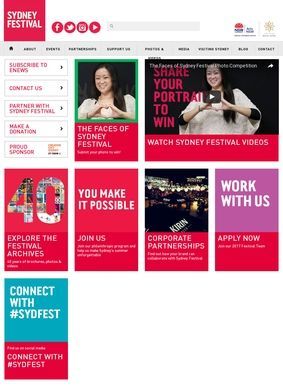
Each January, Sydney Festival takes over the city for several weeks with a program that spans music, theatre, dance, circus, visual arts, and family shows. The website is where attendees plan their time: it lists every event, links to ticketing, and carries the practical detail you need to work out a schedule. For first-timers, the site is structured to make that initial pass through the program manageable.
Program listings and ticketing
The program page does the core job well. Each show gets its own entry with description, scheduling, and venue information before the link out to an authorised ticket seller. That handoff to a partner platform is worth knowing about in advance, because the purchase step happens off-site, outside Sydney Festival's own pages. It is a common arrangement for large-scale events and not a flaw, but it does mean the smoothness of the checkout depends on whichever external seller handles a given show.
How ticket purchases work
What makes Sydney Festival more than a standard listings site is the mix of what is on offer. Ticketed performances and free events sit alongside each other in the same program, and the site does not hide the free strand behind filters or footnotes. For someone assembling a week of events on a tight budget, that is genuinely useful. The festival's scale means the program reads less like a single bill and more like a city-wide season you piece together yourself, choosing across neighbourhoods instead of turning up at one address.
Free events alongside paid performances
Sydney Festival gives First Nations programming its own named strand called Blak Out. It is positioned as a substantive thread through the lineup, not a gesture tucked away in a sidebar, and grouping it makes the work easy to follow if that is the part of the program you want to build around. The placement reflects the weight the festival puts behind it.
Blak Out as a named programming strand
Beyond the performances, Sydney Festival carries the operational layers a long-running cultural institution accumulates. Accessibility information is on the site, covering what attendees can expect at various venues, with specifics on physical access and audio support that determine whether a particular show is workable for you or someone you are bringing. Volunteer opportunities are listed for people who want to be involved from the inside. A Work With Us section handles employment, and separate pages cover philanthropic giving, sponsorship, and the government and corporate partnerships that fund the event. None of that is why a casual visitor lands on the site, but it shows an organisation that runs year-round, not a pop-up that surfaces for a fortnight and goes quiet.
Accessibility details across venues
The digital archive deserves attention. Past editions are documented at a dedicated subdomain, which turns Sydney Festival's web presence into something more than a calendar for the current year. You can trace what the festival has presented over decades, and for researchers, returning attendees, or anyone curious about how the programming has shifted over time, that record has real use. It is an unusual asset for a festival site to maintain seriously, and Sydney Festival keeps it current and navigable.
Inside the digital archive
The festival is based at The Rocks in Sydney, which fits an event that spreads across multiple precincts of the city during its run. One site coordinating many venues across a few weeks is the practical proposition: the Sydney Festival website holds the full picture so you are not cross-referencing separate venue calendars to build an itinerary.
From The Rocks to multiple precincts
Outside reputation is limited in a specific way. A search for third-party reviews of Sydney Festival as an organisation turns up event coverage and press mentions rather than aggregated ratings on platforms like Trustpilot or Google Reviews. That is fairly normal for a public cultural institution of this standing, where audience word of mouth tends to stay in arts journalism and social media rather than review aggregators. The absence of a star rating on a consumer platform does not reflect on the event's track record, which spans several decades of continuous operation.
Limited third-party review presence
Sydney Festival runs a tight, functional site for what it needs to do. The program depth is real, the free events are properly surfaced, the Blak Out strand is given room to breathe, and the archive gives the festival a longer memory than comparable events typically bother to maintain online. The ticketing handoff adds one extra step, but that is the only friction. If you are planning time in Sydney in January, Sydney Festival's site is where the scheduling work actually gets done, and it is put together well enough that you rarely need to look elsewhere to fill in the gaps.