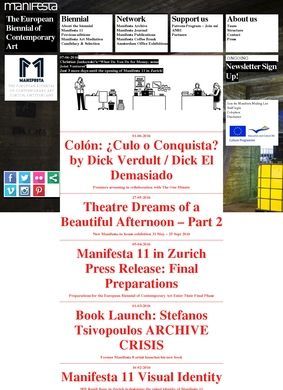
Every two years the whole exhibition picks up and moves to a different European city, which is the trait that sets the Manifesta Biennial apart from almost anything else in contemporary art. There is no permanent venue, no home gallery, no fixed skyline behind it. Founded in the early 1990s and run by the Amsterdam-based Manifesta Foundation, it treats each host region as both subject and material, and the website is built to carry that restlessness and not iron it flat.
A biennial without a permanent home
The practical upshot is that the site reads partly as a current programme and partly as an archive of places. Past editions give you the range quickly: Manifesta 10 took over the Hermitage in St. Petersburg in 2014, Manifesta 14 landed in Pristina, Kosovo, and Manifesta 15 spread across the wider Barcelona Metropolitana in 2024, including industrial relics such as the Three Chimneys complex in Sant Adria de Besos. Those are not neutral choices of address. Putting contemporary work inside a former power plant, or inside one of the most tradition-bound museums in Europe, is the argument the biennial keeps making about where art belongs.
What the programme includes
Content-wise the Manifesta Biennial offering goes well past hanging objects on walls. The programme covers exhibitions, artist commissions made for the specific site, research workshops, and curatorial formats that are openly experimental, sometimes uneven, occasionally more interesting as a method than as a finished show. Thematically it tends to circle hard subjects: European colonial and post-colonial history, the relationship between Europe and North Africa, the long aftermath of communist and post-communist transitions.
Post-1989 Europe as organizing principle
The post-1989 framing is the most genuinely useful thread here, because it ties the nomadic structure to an actual idea instead of treating each move as a fresh marketing reset. A book, "The Manifesta Decade," gathers the first ten years and the exhibition-making paradigms that came out of them. If you find this organisation by searching a business directory or arts database, expect to land on a site that rewards patience rather than quick browsing.
Who uses this resource
Artists and curators arrive at Manifesta Biennial for the commissions and the open curatorial models. Researchers and educators get the workshops and the documentation of how site-specific projects were actually assembled, which is the sort of material that rarely survives once a temporary show closes. There is a thread of European cultural policy running through it too, so people who track how culture gets funded and positioned across the continent have reasons to read carefully.
General visitors are not shut out, but they should know what they are walking into. This is a curated proposition with a point of view, and the work it presents can be demanding. Someone hoping for a comfortable gallery afternoon and someone tracking debates about Europe and its borders will both find something, though they will take very different things away. The Foundation also describes an expanding artistic network and ongoing experimentation with local communities alongside international artists, with the clear intent that engagement outlasts the run dates of any single edition.
What keeps drawing attention back is how unusual the format is as a thing to sustain. Most institutions accrue weight by staying put and building a collection. The Manifesta Biennial does the opposite on purpose, dismantling and rebuilding its own context every cycle, absorbing whatever a new host region throws at it. That makes the project harder to summarise and, honestly, harder to judge from a distance, because each edition is its own animal with its own local politics. The website is the one stable place where the whole sequence sits together and you can follow the line from one host to the next.
Visiting during and between editions
For anyone consulting this entry, the value depends a lot on timing. Between editions the material leans archival, which suits researchers and curators more than casual visitors looking for something to do this weekend. During an active edition it becomes the practical hub for venues, commissions, and the programme on the ground in whatever city is hosting. That swing between archive and live event is worth understanding before you decide how much of it applies to your situation.
How credibility builds for nomadic institutions
Outside reputation is sparse. A search of major review platforms turns up very little, which is typical for a nomadic arts foundation rather than a venue with a fixed address and a regular clientele. The Manifesta Biennial is the kind of entity whose credibility accumulates through critical coverage and institutional partnerships, not public star ratings, and the archive on the site itself is where that record lives.
Does this biennial suit your research or visit?
Taken across its editions, the Manifesta Biennial offers considerably more substance than a one-off art fair. As a record of how a serious nomadic biennial works, and as a way into the recurring questions the Manifesta Biennial asks about Europe, the site has genuine depth. The experimental formats mean some curatorial output will land better than others, and the site's usefulness rises and falls with the exhibition calendar. The post-communist and post-colonial research threads give it intellectual weight that persists between editions, and for anyone whose interest runs to contemporary art with a policy or cultural-history edge, this is a destination worth following across its moves.