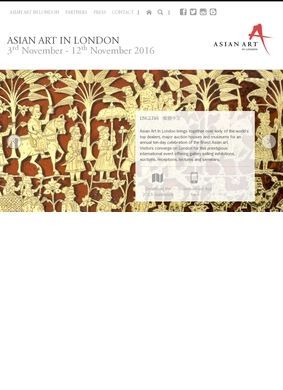
Running since 1998, Asian Art in London is the coordinating body behind a fortnight each autumn when galleries and dealers across the city act as a single event. The 2026 edition runs 29 October to 10 November across participating venues that specialize in Asian art. There is no ticketed hall, no central building, no single door to walk through. The website does that job, which puts more weight on it than a typical event organizer would have to carry.
Participants directory and planning tools
The Participants directory is where the site earns its keep. It lists the galleries and dealers taking part, which is the practical map anyone planning a route through the events would actually use. Alongside it sits an Events Calendar covering related talks, auctions, and exhibitions, so Asian Art in London is trying to cover the wider gravitational pull of the fortnight, beyond its core participants. A downloadable Guidebook in PDF form rounds out the planning tools. That choice tells you something about the audience: people who want a printed or offline reference they can carry between Mayfair galleries and a Bloomsbury auction room, rather than refreshing a phone in a doorway.
Entry point for new collectors
A few touches show the organizers thinking beyond trade insiders. The "Under 5,000" artworks category is the clearest example, pitched at buyers who want a genuine entry point into collecting without an auction-house budget. It suggests Asian Art in London is not purely courting established collectors with deep pockets. There is also a Press resources section with releases and a dedicated press lounge login, plus a Participant Log In portal for registered members. Asian Art in London is built in layers: a public face for visitors, and gated areas for the people who supply the inventory and the coverage.
Inside the gated member areas
The structure is sensible and the content fits the brief of a coordinating body, not a sales platform. What keeps coming back is how much rests on the Participants directory and the Guidebook being accurate and current, because a stale listing in a multi-venue event is worse than no listing at all. It sends someone to a closed door. How fresh those pages are at any given moment is a question a visitor should answer before plotting a day around them. The framing Asian Art in London uses for itself, that London is the international center for Asian art expertise, is the sort of claim a fortnight like this is well placed to back up, given the concentration of specialist dealers it pulls together.
Press coverage and institutional credibility
Outside coverage gives Asian Art in London real weight. Apollo Magazine covered the 20th edition and reported strong collector and dealer appetite for classical Asian art. That is editorial attention from a publication that knows the field, not paid placement, and it is worth more than any self-description on the homepage. For an event whose credibility depends on serious dealers choosing to return year after year, that kind of trade-press notice is the right currency.
Public ratings across review platforms
Public ratings are another picture entirely. The Yelp listing for Asian Art in London sits unclaimed with no rating. The Facebook page carries two reviews and no overall score. On 10times.com Asian Art in London scores 3 out of 5 from two people, with 114 marking themselves interested, which says more about awareness than quality. No Google, Trustpilot, or Tripadvisor presence turned up. None of that is damning for an annual trade-driven event, where the meaningful verdict comes from gallery participation and press coverage, not from walk-in star ratings, but anyone expecting a wall of crowd reviews should set that expectation aside.
Contact details and accessibility gaps
Contact is the one area where the site undersells itself. The homepage shows no phone number and no physical address. There is a contact form at the contact-us page, which is a working route, though it asks visitors to take something on trust before reaching anyone directly. A Facebook presence fills part of that gap with a phone number, an email, and an address on John Street, but those details are not carried over to the main site where most visitors will look first. For an organization that coordinates dozens of venues and fields questions from collectors, press, and prospective participants, surfacing a number and address on the site itself would be a small fix with a large payoff.
The layered access tells you who Asian Art in London is really built for. Casual visitors get the calendar, the directory, and the guidebook. Participants and press get their own logins. That split is the natural shape of an event run by and for a trade, and it explains why the public-facing reputation footprint is modest while the institutional standing, vouched for by Apollo and by more than two decades of continuity, is the stronger half.
Asian Art in London puts its Participants list front and center, and for an event with no single address, the list is the event. Whether the autumn programme suits a given visitor comes down to who is taking part, and that is exactly what the site is built to answer. The phone number, if needed, is on the Facebook page and not the homepage. The Guidebook download is the thing to grab first when planning a route. Asian Art in London has built something coherent for a genuinely unusual kind of event, and the gaps are fixable ones.