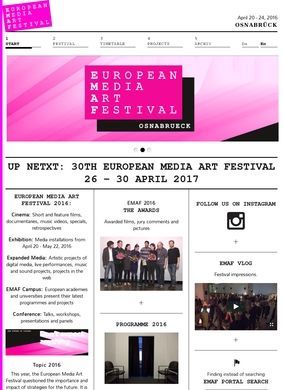
Each spring, a media festival in the German city of Osnabrueck puts a specific slate in front of its audience. The European Media Art Festival answers with experimental short and feature films, digital art, animation, and multimedia work, arranged into a competitive film program that runs alongside exhibitions, live performances, and hybrid formats that resist any single label. It is one of the older events of its kind in Europe, and the range of what it shows is wide without feeling scattered. Screenings share the schedule with gallery-style installations and stage pieces, so a visitor can move between a darkened cinema and an exhibition floor in the same afternoon.
Film, installation, performance
The event grew out of a Media Studies workshop at the University of Osnabrueck, which led to the founding of the Experimental Film Workshop association that still runs it today. That academic root shows in the programming. The European Media Art Festival treats moving images and installation as material worth studying, not simply displaying, and the selection carries that seriousness without turning dry or forbidding for a general audience. Four decades of continuity behind an event like this is uncommon, and it gives the curators a long memory of what the medium has already tried.
EMAF Campus platform for art schools
One section that says a lot about what the European Media Art Festival values is EMAF Campus, which hands forum space to selected German and European art academies. Putting students and emerging practitioners on a platform next to established artists is a deliberate choice, and it keeps the lineup from settling into the same handful of names every year. Art schools get a real stage here, not a token slot at the margins, and that turns the festival into something closer to a working meeting point for the field than a finished shop window. It also means the program reflects what the next wave of media artists is making now, which is harder to get from a lineup built only around confirmed reputations.
International submissions and selection process
Artists based elsewhere can put their work forward through a separate entry and accreditation platform, hosted apart from the main site instead of tucked into a form on the homepage. International media artists submit through that channel, and the scale of the response is not modest. Figures cited from a past edition of the European Media Art Festival point to as many as 2,500 entries in a single year, with up to 250 works surviving into the final selection. That ratio means the curators are turning a great deal away, which is usually a good sign about the standard of what makes it in. A festival that can afford to be that selective tends to reward the trip.
Audience reach and attendance
The audience side keeps pace with the submissions. One past count puts attendance somewhere near 14,000 participants, and for a specialist media art event in a mid-sized city that is a genuine crowd, not a small circle of insiders talking among themselves. Numbers like that suggest the European Media Art Festival pulls in curious locals and day visitors alongside the artists and academics who have a professional reason to be in the room.
Panels, workshops, hands-on sessions
Beyond the screenings, the European Media Art Festival programs public discussion and hands-on sessions that give the week some intellectual backbone. Recent editions have run panels on weighty subjects, artistic freedom and the responsibility of institutions among them, and workshops that get practical. One example is an augmented-reality session tied to Museum Day, staged with the Alternative Monument collective, which is the sort of concrete collaboration that reads as real activity instead of a line on a program.
Extended exhibition timeline at Kunsthalle
The exhibition strand also reaches well past the festival week. A recent show at Kunsthalle Osnabrueck stays open for roughly a month after the films wrap up, so the visual-art component is not crammed into the same few days as everything else. The festival gives its exhibitions their own timeline instead of forcing every strand into one crowded window, and that works in its favour. It means someone who cannot make the core dates still has a way to see a substantial part of what was on.
Who is all this for? Artists, curators, distributors, gallery staff, researchers, students, and filmmakers each have a plain reason to pay attention, and so does a general audience willing to sit with work that experiments and occasionally frustrates. The breadth of that list is part of why the European Media Art Festival holds together: a distributor scouting new voices and a student on a class trip are looking at the same program from very different angles, and the schedule seems built to serve both. The site works in both German and English and keeps a steady run of news posts, which helps an international visitor plan ahead and track what is coming without relying on second-hand listings.
Editorial standing and contact information
On outside standing, the picture is more descriptive than numerical. Wikipedia calls the European Media Art Festival the largest event of its kind, and festivalfinder.eu describes it as one of the most influential forums for contemporary media art. Those are editorial assessments, the kind that come from writers and cultural bodies rather than ticket buyers, and they read as credible given the source. On the consumer side there is less to weigh. The festival's Facebook page carries around 9,300 likes and a few hundred check-ins from people who marked that they had been there, but no aggregate star score sits on top of it.
A search turned up no Google, Trustpilot, Yelp, or Tripadvisor rating, which is common for a cultural event that lives more in press coverage and academic circles than on review platforms. No entry in a general business directory came up either, which tracks for an organisation built around submissions and accreditation, not walk-in customers.
Contact takes some digging, and that is the one practical snag. The European Media Art Festival keeps an About page and a regular flow of news, but a phone number, an email, or a postal address does not surface on the pages a first-time visitor tends to land on. For an event that actively invites submissions and accreditation, slightly more visible contact routing would smooth the path for newcomers who are not already inside the network. A missing email alone is no fault when a submission platform and an About page cover the main routes in, but the phone and postal details being this buried is a small miss for an organisation of this reach.
Weighing it all together, the European Media Art Festival comes across as a long-running, tightly curated event with an academic spine, a real appetite for new and emerging work, and programming that stretches past the core dates. The submission numbers point to a selective standard, the editorial praise is credible, and the only real friction is finding a direct line to the organisers. The next edition will be the fortieth, scheduled again for late April, and the Experimental Film Workshop association already lists it on the site next to the current news feed.