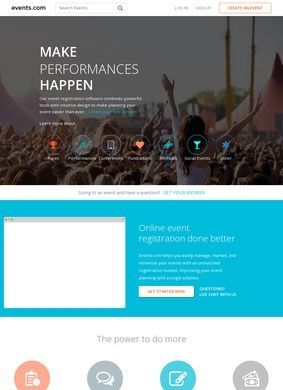
A race organizer with three months until a regional mountain biking event needs to sell tickets, collect waivers, push the event in front of people who have never heard of it, and then run a working check-in line on the day without chaos at the gate. Stitching that together from four separate tools is where a lot of small events lose money and patience. Events.com sets out to be the one place where all of that lives, and the spread of what it covers is the first thing worth taking seriously.
Platform features for organizers
The platform splits cleanly into two audiences. Organizers get ticket sales and registration management, promotion tools for getting an event seen, sponsorship management, and the on-site execution side: check-in and the gear to run a real entrance line. After the gates close, the Insights side handles analytics and reporting, so an organizer can see how a sale moved and where attendees came from.
Virtual events and live production
Virtual and hybrid hosting is built in for events that need an online component bolted onto the physical one. There is also a heavier offering, Events.com Live, a full-service live production arm for organizers who would rather hand off the running of the thing than learn another dashboard. That last piece is a real differentiator. Most ticketing tools stop at the software boundary and leave physical staging to someone else; Events.com keeps a production service in-house, so the same company selling the tickets can also wire up the stage and the entrance flow.
Attendee tools on Events.com Discover
On the other side are the people buying tickets. Events.com Discover is the discovery layer, a way to browse what is happening, and the Experience portal lets an attendee manage the tickets they have already bought: find them, transfer them, sort out the practical mess that comes with going to a show. It is a sensible split, because the two sides of an event have nothing in common operationally, and trying to serve a ticket buyer through an organizer interface tends to produce something that helps neither.
Event categories and mobile-first design
The featured categories give a fair sense of who the platform is chasing. Mountain biking and motor sports sit next to music festivals, car shows, food festivals, and comedy nights. That is a deliberately physical, in-person, sometimes outdoorsy mix, and it tells you Events.com is aiming at the gate-and-crowd end of the market more than the webinar end.
The scale claim is broad, from a local fundraiser up to a large festival, and the platform leans on being mobile-first to back it up. For an event audience checking schedules and pulling up tickets on a phone in a parking lot, that emphasis is the right one. Whether a tool actually serves both a 200-person charity 5K and a multi-day festival equally well is something only volume use proves, but the architecture is at least pointed at both ends. That span is the hardest for any platform to cover honestly, since the needs at those two extremes barely overlap.
One detail in the history complicates an otherwise tidy picture. Events.com acquired BrownPaperTickets at some point and absorbed its organizer base, which is how platforms in this space tend to grow: buy the userbase, fold it in. The trouble is what came with it. Reviews surfacing on GetApp and Capterra carry verified users, and a notable strand of the negative sentiment points straight at the BrownPaperTickets transition, specifically organizers reporting funds owed to them that went unpaid.
For a ticketing platform, money owed to organizers is close to the worst category of complaint there is, because the entire value proposition is that the platform holds attendee money and pays it out cleanly. An acquisition that leaves an inherited organizer base short is the kind of wound that lingers in search results long after the underlying problem is fixed, and it colors how a cautious organizer reads everything else Events.com offers.
Checking reputation across review sites
That sentiment does not appear to be the whole story, and the wider reputation picture is mixed across sources. Trustpilot carries 82 reviews, though the snippet did not surface an aggregate score, so the count is more useful than any star claim would be. G2 shows only 4 reviews, too few to lean on.
On the employer side, Glassdoor reports 3.6 out of 5 for work-life balance and 3.7 for culture, with 65 percent of staff saying they would recommend the place to a friend, and Indeed adds 122 employee reviews with sentiment described as mixed. TrustRadius simply did not have enough reviews to score. None of those numbers is damning on its own, and the employee figures are middling-to-decent rather than alarming, but the spread does not point at a platform with a single, settled reputation. Anyone weighing Events.com as a vendor should read those acquisition complaints directly, because payout reliability is the part that cannot be patched over with good features.
Contact information and headquarters
Where the platform leaves little doubt is reachability. Contact is genuinely easy to find, which is not a given in this category. Two phone numbers are published, a local San Diego area line and a toll-free number, plus a listed email at the hello address. There is also a full help center on its own subdomain and a separate contact and FAQ page. Headquarters sits in La Jolla, California, a real fixed address rather than a vague "based in the US" line. For a company that handles other people's ticket money, having a staffed phone line and a help center is the baseline you would want, and Events.com clears it.
Events.com does not appear in any general business directory for event services, which is worth noting because organizers sometimes cross-reference listings when vetting a new vendor. The contact surface described above is a more reliable indicator of operational presence.
So the Events.com offering reads as broad and coherent. An organizer can plausibly run the whole arc on one platform: list, sell, promote, find sponsors, check people in at the gate, and read the numbers afterward, with a production team available for hire if the do-it-yourself path is too much. Attendees get a discovery front door and a portal to manage what they bought. The promotion tools and the sponsorship side are the parts that small organizers most often skip and most need, and folding them into the same place as ticketing is a genuinely useful idea. Sponsorship money at the smaller end of the market tends to get handled over email and spreadsheets, so a structured way to manage it inside the platform that already holds the event has real value for an organizer running a tight budget.
Payout reliability as the critical concern
The doubt is not about the features. It is about trust at the one moment that defines a ticketing platform, the moment the show ends and the organizer expects to be paid. The BrownPaperTickets payout complaints are specific, they name the exact failure mode that should never happen, and the public ratings around the company are scattered enough that they neither confirm nor clear the concern. A polished dashboard and a toll-free number do not resolve that. The published evidence is good enough to take Events.com seriously and not good enough to hand over a festival's revenue without doing more homework first.
Business address
Events.com
611 Mission St,
San Francisco,
CA
94105
United States