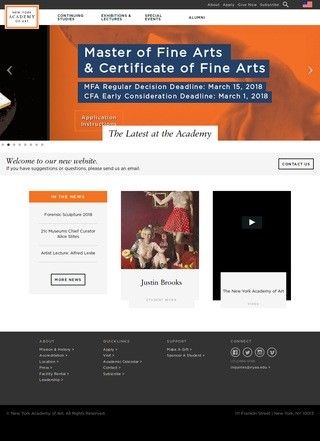
Where does a painter go to study the human figure at a graduate level and still come away with an accredited degree? New York Academy of Art is one of the few answers in the city. It grants a Master of Fine Arts in drawing, painting, and sculpture, built around figure-based study and traditional technique inside a contemporary art school, the sort of atelier grounding many university programs quietly dropped decades ago.
Degrees built on the figure
The core of New York Academy of Art is the MFA, and the school does not hide what kind of MFA it is. The training is representational and skills-first. A student learns to draw a body before deconstructing the idea of one, which is a deliberate stance in a field that often runs the other way. That priority shapes everything downstream, from how the studios are run to who the faculty are, and a prospective applicant should know it going in so the emphasis is a choice rather than a surprise.
Two optional tracks sit on top of the degree for students who want to push the technical side further, and the school layers in professional preparation so that graduates leave with more than a portfolio.
The MFA and its tracks
The MFA covers drawing, painting, and sculpture, and a candidate can add an Anatomy Track or a Printmaking Track for advanced technical work. Anatomy here is treated as a real discipline, the study of how a body is built so it can be drawn convincingly from any angle.
Thesis critiques, faculty master classes, and professional practice courses carry the degree past pure studio time into the harder business of being a working artist. This is where New York Academy of Art is most itself: serious about craft, and unembarrassed about tradition in a way few graduate programs still are.
Certificate and summer routes
Not everyone wants, or needs, a full MFA. New York Academy of Art also grants a Certificate of Fine Arts through its continuing studies division, and it runs a Summer Undergraduate Residency Program for college students testing whether this kind of intensive figurative training suits them. The summer route is the low-commitment door into New York Academy of Art, and a sensible one for an undergraduate unsure about a two-year graduate move.
It lets someone find out in a season what a degree would ask of them for years. The residency runs on the same figurative principles as the MFA, so what a student samples over the summer is an honest preview of the full program, not a watered-down version pitched to beginners.
Learning outside the degree
A large part of what New York Academy of Art offers never touches the MFA at all. The Continuing Studies division runs classes and workshops, online and in person, from short intensives to concentrated one-on-one instruction with an individual teacher.
Behind that teaching sits a set of facilities that amount to more than classroom space, and that physical plant is part of what a prospective student is paying for.
The Continuing Studies division
Academy Everywhere is the self-paced online offering, which lets someone absorb the New York Academy of Art approach without moving to the city or quitting a job.
The in-person workshops range from single sessions to intensive multi-week programs, and the personal-instruction option pairs a student closely with a teacher for concentrated feedback. For a working adult who cannot enroll full time, this division is the practical entry point, and it carries the same figurative emphasis as the degree tracks.
Shops, library, and workspaces
Physical resources include a professional printshop, a woodshop, community workspaces, and a library stocked with learning materials. A sculptor needs the woodshop, a printmaker needs the press, and both need room to spread out; New York Academy of Art provides the shared space to do it. The library backs the studio work with references and research materials, which matters a good deal for a school this committed to historical technique, where a student is often looking hard at how earlier artists solved the same problem.
Access to a well-equipped printshop and woodshop under one roof is the sort of thing an independent artist would otherwise spend years and considerable money assembling, and at New York Academy of Art it comes with the enrollment. Community workspaces fill the gap between formal class time and working alone at home, which is where a lot of the real progress in an art education actually happens.
The public and professional side
New York Academy of Art runs a full slate of public programming: exhibitions, lectures, artist conversations, drawing parties, and the annual Tribeca Ball, a fundraiser that pulls the wider art world through the doors. These events make the place somewhere to visit as much as somewhere to enroll, and they give students a standing audience for their work. The Tribeca Ball in particular puts student and alumni work in front of collectors and press who would otherwise never see it, which is a practical benefit dressed up as a party.
On the career end, New York Academy of Art provides career services, student life programming, an Alumni Association for networking, and artist residencies and fellowships, and it sells merchandise and student artwork as well. The alumni network is the quiet asset here. A figurative-art career leans heavily on who has seen and remembers your work, and New York Academy of Art keeps that channel open long after graduation, which is worth as much as any single course to a young artist trying to get established.
New York Academy of Art suits a representational painter or sculptor who wants rigorous figure training and finds most university programs too conceptual. A sensible next step is sitting in on a Continuing Studies workshop or applying to the Summer Undergraduate Residency ahead of the full MFA, and asking directly about the Anatomy Track if that is the real draw.