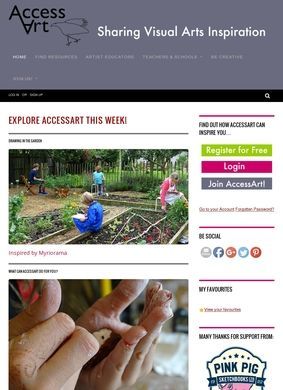
AccessArt is a UK registered charity (no. 1105049) and a subject association for art and design education, run out of Cambridge. The number that frames everything else here is the resource count: more than 1,500 visual arts teaching materials, ranging across lesson plans, pedagogy guides, recorded CPD, and full creative projects. That is not a sampler. It is a working library, and the site treats it as one.
Primary art curriculum for ages 3 to 16
The spine of the offering is the AccessArt Primary Art Curriculum. It is built for ages 3 to 16, with teaching pathways laid out as structured sequences instead of loose worksheets you stitch together yourself. For a primary teacher who is not an art specialist, which describes a large share of the people delivering art in UK primary schools, that structure is genuinely useful. You are handed an order of work, not a folder of ideas. Secondary teachers are catered for too, and the material extends up through the older age bands instead of thinning out the moment it leaves Key Stage 2.
Professional development and live training
Beyond the core curriculum, the spread of programmes is wide for a charity of this size. There is Teaching Art Well, an eight-module professional development course aimed at deepening how teachers teach the subject day to day. There are live Zoom CPD events, which are worth having because they let educators ask questions in real time instead of working alone from a PDF. There is AccessArt Art Week 2026, a scheduled piece of programming that gives schools a fixed point to plan around.
Connecting educators through the AccessArt Map
And there is the AccessArt Map, a tool for connecting educators to one another, which is a quietly sensible thing to build given how isolated a single art coordinator in a small school can be. Taken together, these are not bolt-ons. They form a year-round support system around the curriculum, with the recorded CPD acting as the bridge for teachers who cannot make a live session.
Reaching beyond the classroom
The audience list is broad without feeling unfocused. Primary and secondary classroom teachers are the obvious centre, but the site also names SEND educators, artist educators, hospital educators, home educators, and lifelong learners. That hospital and home-education reach is worth pausing on, because the material has clearly been thought about outside the standard classroom, where the usual scheme-of-work assumptions do not hold. AccessArt does not appear to treat those groups as an afterthought tacked onto a primary-school product.
Pricing is handled with the same broad reach in mind. The free tier is genuine, and the paid tiers presumably open the deeper curriculum sequences and the full course material. For a state school running art on a shoestring, that gradient is practical: a teacher can prove the value before a budget conversation ever happens, and a department can scale up its access when funds allow. AccessArt has clearly designed the membership so that cost is not the barrier between a teacher and the first usable resource.
Support for students with persistent absenteeism
One programme stands apart from the rest: AccessArt Treehouse, described as support for students dealing with persistent absenteeism. Art as a route back for children who have disengaged from school is a specific, difficult problem, and the existence of a named strand built around it, instead of a vague promise, tells you something about how the organisation thinks. It is the kind of provision that does not generate much traffic but does generate genuine usefulness for the families and staff who need it. Charities often pad their offering with broad initiatives that sound good in a grant report; this one is narrow and aimed at a real gap.
The breadth of the catalogue is matched by the way it is organised. With over 1,500 individual resources on file, a poorly indexed site would bury the good material, but the curriculum pathways give the collection a backbone so that a teacher planning a term has somewhere obvious to start. AccessArt clearly expects to be used as a tool of the working week, not browsed once and forgotten, and the structure reflects that intention.
Membership numbers back up the claim that teachers find the place worth returning to. AccessArt reports more than 24,000 members, a figure that for a niche subject association is substantial, and it points to the resources doing real work in real schools rather than gathering dust behind a sign-up wall.
The pedagogy framing is consistent throughout. This is not a clip-art-and-templates operation. The CPD recordings and the guides address how to teach drawing, making, and looking, which is harder to do well than handing out activities to fill a Friday afternoon. A teacher who works through the Teaching Art Well course is being asked to change practice over eight modules, not simply download a one-off lesson and move on. That ambition is part of why AccessArt reads as a serious educational resource and not a download farm.
Membership and credibility markers
On credibility, the picture is mixed in an honest way. The charity registration number, 1105049, is cited openly, and a Cambridge address sits on the site. What is missing is a prominent phone number on the homepage, so anyone who wants to speak to a person rather than fill in a form has to dig for it. For an education charity that lives largely online, the form-first approach is defensible, and the visible registration number paired with a real street address does most of the trust work a phone line would. The charity status is a meaningful marker here, since it means the accounts and the registration are matters of public record.
Outside opinion is sparse relative to what the membership figure might lead you to expect. Schoolzone.co.uk carries a single teacher review, from an art coordinator at a Plymouth primary academy, praising the creative activities. That is one voice, positive but solitary. The AccessArt Facebook page holds 7,734 likes and an associated community group, which points to an active following even if a like is a soft measure. The bigger gap is the absence of aggregated star ratings on the usual consumer platforms. Searches on Google, Trustpilot, and Yelp turn up no scored profile for this organisation, and a plain search for "Access Art" reviews mostly surfaces unrelated American outfits such as Access Art Inc. and Access Art Therapy, which muddies the water for anyone trying to vet it quickly.
That scarcity of public reviews should be read in context. Schools and teachers tend not to leave Trustpilot ratings for curriculum suppliers the way shoppers rate a retailer, so a near-empty review profile here is closer to normal than alarming. The 24,000 membership figure and the steady programming calendar are the more meaningful indicators of whether AccessArt lands, even if neither is independently audited on the page.
The proportion of the thing is what holds the attention. A small Cambridge charity has assembled a curriculum spanning thirteen years of schooling, a professional development course, live training, a community map, and a dedicated strand for absent children, and it gives a usable slice of all that away for nothing.
The sort of resource a head of art or a generalist primary teacher would bookmark and return to across a whole school year, and the free tier means testing that against a real classroom costs nothing but an afternoon. A cautious newcomer has to accept one thing going in: the proof sits mostly in the membership and the material itself, since the open web has surprisingly little independent verdict to offer on AccessArt. The address in Cambridge, the registration number, and the 24,000-strong membership are the markers left to weigh, and they sit on the page in plain sight.