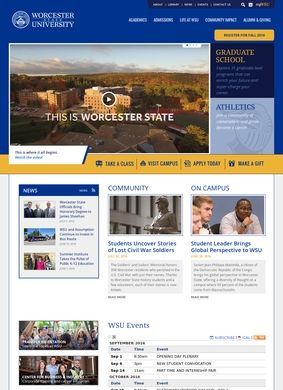
What loads behind this listing is not a crafts center. The address worcester.edu opens onto Worcester State University, a public liberal arts and sciences institution at 486 Chandler Street in Worcester, Massachusetts. Someone searching for the Worcester Center for Crafts lands instead at a degree-granting university with roughly 4,734 undergraduates and a full campus. That mismatch is the first thing worth flagging, because nothing on the page matches the name the listing carries. The Worcester Center for Crafts is a real place with its own web presence; the URL here simply points to the wrong institution.
Academic programs at Worcester State University
Set the naming problem aside and the destination itself is substantial. Worcester State University runs undergraduate programs across a wide spread of fields: nursing, psychology, business administration, chemistry, biotechnology, communication sciences and disorders, and speech-language pathology, among others. Thirty-two graduate programs sit on top of that, plus online and continuing education tracks for people who cannot study on a fixed daytime schedule. The academic picture is filled in with real numbers. Ninety-two percent of full-time faculty hold doctorates, and 53.2 percent of students are the first in their family to attend college. That second figure says something specific about who this place was built to serve.
Tuition covered under the valueplus program
The financial side is the part that will catch most eyes. Through the ValuePlus program, Massachusetts residents and Pell-eligible students can attend with zero tuition and fees starting fall 2025. That is a concrete commitment, not a vague gesture toward affordability, and it shifts the calculation for a lot of in-state families. Paired with the first-generation enrollment figure, it reads as a deliberate institutional posture: keep the door open to students who might otherwise rule out a four-year degree on cost alone.
Support services for first-generation students
The supporting structure looks genuinely built out. The site points to career services, counseling, student accessibility services, a wellness center, a library, housing and dining, and study abroad. Those are the services that decide whether a first-generation student actually finishes. For students who arrive without a family roadmap for college life, the counseling and accessibility pieces do as much practical work as the course catalog. A student who hits an administrative wall or a mental-health rough patch in a first semester needs those offices in place, and the site treats them as core features instead of burying them behind the admissions pitch. None of that is what a person looking for the Worcester Center for Crafts came to read, but it does describe the destination accurately.
Dual majors and career outcomes
Two features stand out beyond the standard major list. MajorPlus lets a student pursue a dual major, and the university leans on experiential learning, the placements and projects that put coursework into a real setting before graduation. Worcester State University reports an average first-year salary of $50,991 for graduates and says 98 percent are employed or enrolled in further study within three months of finishing. I tend to read placement figures with a raised eyebrow, since institutions choose how to count them, but pairing a salary number with an outcome rate is more useful than either figure alone. These are the sort of numbers a four-year university publishes; the Worcester Center for Crafts, a small craft-education organization, would not report enrollment cohorts or graduate salaries on this scale at all.
Breadth of degree fields offered
The breadth of fields is genuine. A prospective student weighing nursing against biotechnology, or business against the communication sciences, can research both on the same site without bouncing between separate program micro-pages. That coherence is easy to overlook and harder to build than it sounds, and it makes the university a workable research stop even for someone still deciding what to study. Anyone who turns up via a business directory listing and lands here by accident will find a well-organized institutional site rather than a dead end, though they will still need to find the Worcester Center for Crafts separately.
Weighing the site as a research stop
Where this leaves the listing is a harder question. As a guide to Worcester State University, the page is informative and clearly organized, and the institution has the standing you would expect from an established public university. The case for treating it as a resource worth time is straightforward on its own terms.
Mismatch between the listing and the destination
The trouble is that those terms are not the ones the entry promises. A person searching for the Worcester Center for Crafts gets a full-scale university instead, and a person who genuinely wants Worcester State has to arrive through a label naming something else entirely. The Worcester Center for Crafts is a ceramics and craft education center; Worcester State University is a four-year public institution. The two have no obvious connection, and the listing conflates them. Until the entry for Worcester Center for Crafts is pointed at the right web address, the value of what loads here is undercut by the simple fact that it is not what was asked for.