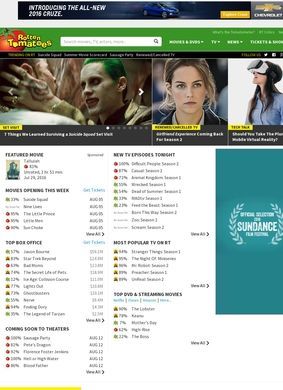
Anyone who has spent five minutes looking up a film online has almost certainly landed on Rotten Tomatoes. The site started as a niche aggregator of professional critic scores and turned into something close to a cultural reflex: before buying a ticket or pressing play, millions of people check that percentage at the top of the Rotten Tomatoes page. Whether that percentage deserves the trust it gets is a more interesting question than the homepage suggests.
Two scores behind the Tomatometer
The core product is the Tomatometer, a single number built from binary votes. Each critic review is logged as fresh or rotten, and the percentage reflects how many came down on the positive side. That is it. A movie everyone found watchable but unexceptional can outscore a genuinely strange film that some critics adored and others walked out on. The Tomatometer captures breadth of approval, not depth of feeling, and Rotten Tomatoes is upfront about that if you read the fine print. Most people do not. Sitting beside the Tomatometer is the Audience Score, which draws from verified user ratings and frequently contradicts the critic percentage by a wide margin. The gap between the two numbers is often more informative than either figure alone.
Certified fresh status verification
Critic accreditation has published submission criteria, which puts Rotten Tomatoes ahead of aggregators that run opaque processes. The Certified Fresh badge is awarded to titles that sustain a high Tomatometer over a meaningful number of reviews, adding a layer of signal beyond the raw score. The Audience Score has had its own friction over the years. Coordinated review-bombing hit some releases hard enough that the platform introduced verified ratings to blunt the effect. No open system is immune to gaming, but the change reduced the most obvious manipulation, and reading both scores together gives a more honest picture than either alone.
Where to stream and watch
Beyond the scores, Rotten Tomatoes has built out a reasonably full viewing companion. Search a title and you can see current streaming availability across Netflix, Prime Video, Apple TV+, and Paramount+, alongside theatrical showtimes via a Fandango integration and rental or purchase options through Fandango at Home. The catalogue reaches back through decades of releases and extends to streaming-only titles, so coverage is not confined to whatever opened last weekend. Free streaming collections are also surfaced for people browsing without a subscription to every platform.
Guides, lists and podcast content
The editorial layer is heavier than a pure score aggregator would need. Rotten Tomatoes runs curated "What to Watch" guides and ranked lists that take real angles (best A24 films, best LGBTQ+ releases, that sort of thing), box office weekend reports, trailers, and video interviews. Awards coverage appears during the relevant stretches of the calendar year. There is a Rotten Tomatoes podcast called "Seen on the Screen." All of this points to a platform trying to function as a destination, rather than a number you glance at before opening a streaming app. Whether that expanded editorial identity holds up is a separate question, but the content is genuinely there and updated regularly.
Ownership tied to Fandango
The commercial structure deserves a mention. Rotten Tomatoes is owned by Fandango, itself part of Versant Media, and virtually every action the site nudges you toward (buying a ticket, renting a film, subscribing to a service) routes through Fandango's own commerce layer. That does not contaminate the critic scores, which come from external reviewers, but it does mean the site has a direct financial stake in turning a browse into a transaction. The "where to watch" buttons are convenient and they are also a sales funnel. A regular user is better off holding both of those facts at once rather than treating the experience as neutral.
Is the reputation deserved?
Rotten Tomatoes does not appear in any general business directory of entertainment platforms, and it hardly needs to. Its search visibility on its own terms is effectively total. The Rotten Tomatoes outside reputation is well-documented: review counts in the thousands on the major consumer platforms, consistent complaints about the Tomatometer being misread by audiences and occasionally by press, and some ongoing discussion in film criticism circles about whether the fresh/rotten binary has reshaped how critics frame their conclusions. The legitimate grievances are methodological, not about Rotten Tomatoes being unreliable in a basic sense.
Practical uses in one place
For practical use, Rotten Tomatoes covers a lot of ground in one place. Checking whether something is worth watching, finding where it streams, and seeing what it costs to rent are all handled without leaving the page. The streaming-availability data alone removes the tedious loop of opening four apps to find out which one carries a given title. The ranked lists are useful for filling an evening without a specific film in mind, and the box office reporting satisfies an industry-curiosity interest that goes well beyond personal viewing choices.
Reading the score as a starting point
The harder assessment is not whether Rotten Tomatoes is useful (it clearly is) but whether the headline figure it has trained an enormous audience to treat as authoritative is being read with enough nuance. The Tomatometer flattens a range of critical opinion into one percentage. The Audience Score sits beside it with its own methodological caveats. The platform that presents both profits when you act on them. None of that makes Rotten Tomatoes a poor resource. It does mean the score at the top of the page is a starting point, not a conclusion, and the site's reach is precisely what makes that easy to overlook.