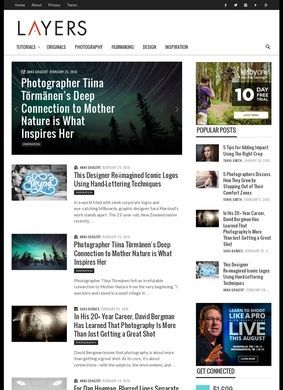
Seventy-four pages of gear reviews is a number that tells you something before you read a single one of them. That is the size of the archive sitting on Layers, an online publication that has been writing about Adobe software since 2005, when a group describing themselves as Adobe geeks and design fanatics started putting tutorials online. The depth of that back catalogue is the first thing worth knowing, because a site can claim to cover photography and design without ever building anything that lasts. Layers kept going long enough to fill seventy-four pages with product write-ups alone, and that volume changes how you read everything else on it.
Adobe Creative Suite tutorials
The core of what Layers offers is instruction in the Adobe Creative Suite. Photoshop, Lightroom, Illustrator, InDesign, and Acrobat all get their own tutorials, and these are pitched as in-depth pieces, not the two-paragraph how-tos that pad out most software blogs. Around that spine, Layers adds photography and filmmaking technique, gear reviews, design inspiration, and news. The audience is named plainly: photographers, filmmakers, graphic designers, and digital artists. That is a wide tent, but it holds together because almost everyone in those four groups touches the same Adobe tools daily, so a single tutorial on masking or color grading is useful to a working photographer and a motion designer in the same breath.
Photography, filmmaking, design inspiration
What lifts Layers above a personal blog is the surrounding ecosystem. Beyond the written tutorials, the site offers or links to live webcasts, online classes, and conferences. That points to a publication treating teaching as the product, not as a side effect of selling something else. The affiliation with KelbyOne matters here. KelbyOne is an established education platform built around Photoshop and Lightroom courses, and the connection gives Layers a credibility that an independent tutorial mill cannot borrow. Scott Kelby's own blog references Layers as a reputable Adobe creative resource, which is a meaningful endorsement given Kelby's standing in that exact corner of the industry. When the people who train the trainers point at you approvingly, that is more persuasive than a wall of star ratings.
Education platform connections
Layers also crossed over into print and into books. A magazine subscription, print or digital, has been listed on DiscountMags.com, so this was never purely a web operation. Amazon carries at least two books drawn from the magazine's content, including one titled The Best of Layers Magazine and an InDesign tip-of-the-day compilation. The existence of those volumes says the editorial output was strong enough that someone thought it could be curated, bound, and sold. That is a higher bar than publishing posts and hoping they get read. It is worth being honest about the limits of that signal, though: the Amazon listing for the derived book shows one rating and no customer reviews, so the commercial footprint of the books themselves is faint. The books prove the content existed in volume; they do not prove anyone bought them in numbers.
Print publications and books
On reputation, the picture outside the Adobe education world is quiet. A search turns up no Google, Trustpilot, Yelp, or BBB ratings, none of the aggregated scores that a consumer brand accumulates over time. For a content publication that is less damning than it would be for a shop or a service firm. People rarely leave Trustpilot reviews of a tutorials website; they bookmark it, share an article, come back when they get stuck on a feathered selection. The absence of platform ratings is normal for this kind of site, and reading it as a red flag would be a mistake. The single strong external signal, the Kelby reference, is the right kind of endorsement for the niche, even if it is one voice rather than a crowd.
External ratings and endorsements
Contact is where the honest caution belongs. The Layers homepage shows no phone number and no physical address. The routes a visitor gets are an Advertise with Us page and the usual social links to Facebook, Twitter, Instagram, and YouTube. There is a Tampa, Florida phone number, (813) 433-5010, but it surfaces only on a third-party data listing, not on the Layers site itself. For a reader who simply wants to learn Lightroom that costs nothing.
Contact options for readers, advertisers
For an advertiser or anyone wanting to reach an editor directly, the only formal channel is the advertising page, and that is less than you would expect from a publication with this much history behind it. A contact form or a clearly labeled editorial email would close the gap, and the absence is a fair mark against Layers even while the social presence gives a workaround.
Best suited for Adobe users
The thing to weigh is what kind of resource you need. Layers is built around a single technology stack and serves it deeply, which is its strength and its boundary at once. If your work runs through Adobe applications and you value tutorials written by people who have been doing this since the mid-2000s, the depth here is real and the KelbyOne lineage is reassuring. The seventy-four pages of reviews mean that when you go looking for an opinion on a lens or a tablet, the odds are decent that Layers has already covered it. The instructional content sits alongside news and inspiration, so Layers functions as a place to keep current as well as a place to learn a specific technique, and that combination is harder to assemble than it looks.
There are honest limits to set against that. A reader who wants coverage of design tools outside the Adobe universe will find Layers too narrow, because the whole identity is wrapped around Creative Suite. The buried contact details and the quiet third-party reputation mean you are trusting the content on its own merits and on the strength of an industry endorsement, not on a visible crowd of satisfied readers. Some of the webcast and conference material may reflect a specific era of the publication, and a visitor should check whether the live offerings are current before planning around them. None of that undermines the tutorials, which are the reason to visit Layers, but it does shape the expectations you should bring.
Taken together, Layers is a specialist resource that knows exactly what it is. The writing depth, the book spin-offs, the KelbyOne tie, and the Kelby endorsement form a consistent story about a publication that built standing in the Adobe training world over many years. The absent contact surface and the lack of aggregated ratings are real caveats, not deal-breakers, for a site whose value lives in its archive rather than in a customer-service relationship. If you work in the Adobe ecosystem and need a deep, searchable library of technique-focused writing, Layers has the volume and the editorial track record to make that search worthwhile.