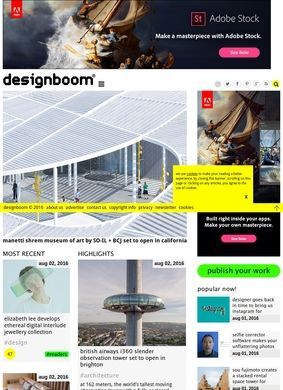
Readers hit a wall the moment a new pavilion goes up at the Venice Architecture Biennale or a furniture brand drops something strange and beautiful at Milan Design Week: finding somewhere to see the thing properly photographed, with a few paragraphs that explain what it is and why anyone bothered to make it, is harder than it should be. Design Boom has been answering that exact question since 1999, and the back catalogue tells the story better than any pitch could. Over 50,000 articles sit behind the homepage, the result of a publication that kept showing up to every major design moment for a couple of decades and filed a report each time.
Magazine sections and archive depth
Design Boom calls itself the first and most popular digital magazine for architecture, design, art and technology. The "first" part is a historical claim impossible to verify from the page alone, but the breadth on offer makes the "popular" part easy to believe. Content splits into clear sections: architecture, design, art, technology, video, and interviews. That last one does more than round out the list, because an interview section kept up for this long becomes a kind of oral record of who was making what and thinking how, year after year. The archive alone would justify a visit even if nothing new were ever published again.
How the editorial selection works
What you get on a typical visit is a stream of editorial articles, the occasional editor's letter, and themed chapters that group pieces around an idea, including one carrying the title "Crafting the Future." Design Boom reads like a publication where editors are still making choices, not an algorithm filling a grid. Coverage leans toward the big international set pieces, the Milan and Venice events especially, but the day-to-day flow goes wider than that: product launches, buildings, art installations, the occasional piece of technology that crosses into design territory.
Free access with advertising support
Reading it costs nothing. Design Boom is free and runs on advertising, which is the honest old bargain of online publishing and worth knowing before arriving with expectations of a paywall or a sign-up gate. By the numbers that circulate from outside sources, the audience is large: roughly 3.5 million readers globally, with around 390,000 people taking the newsletter. Those figures come from third parties, not a counter watched in real time, so treat them as ballpark, but they line up with a publication of this vintage and reach.
Industry recognition from TIME and Webby Awards
One detail says something about how seriously the operation takes itself. Design Boom registers as a media company, an SRL, which is the structure of a working business with staff and obligations, not a hobby blog that grew. TIME magazine named it among the Top 100 design influencers, and honorable mentions from the Webby Awards are on the record too. Recognition like that does not guarantee the writing is good, but it does confirm that people inside the field have been paying attention for a while.
Competitions, courses, directory, events
The magazine is the front door, and behind it sits a surprising amount of working machinery for the design community. Design Boom runs a competitions and submissions area where calls for entries and design competitions get listed, genuinely useful if you are a practitioner hunting for the next brief to enter. A courses section points toward learning. A design directory groups firms and makers. An events calendar tracks what is happening and when.
Reader submissions and video content
Two more pieces round it out: a readers submit portal and a shop. The submit portal is the interesting one, because it turns a portion of the audience into contributors and keeps the editorial pipeline fed from outside the staff room. Add the video section, and the picture is less of a magazine and more of a small ecosystem built around the same subject matter, where you can read about a competition, find a course, look up a studio, and check when the next biennale opens without leaving the site.
Who benefits most from the platform?
Whether you need all of that depends entirely on who you are. A casual reader who wants to look at good buildings and clever objects will live in the article feed and never touch the directory. A working designer, an architecture student, a brand scouting for talent: those are the people who get real value from the scaffolding around the magazine. Design Boom serves both without making either feel like an afterthought, which is harder to pull off than it looks and most publications do not bother trying.
Ratings across multiple review platforms
Outside ratings run mixed but lean positive. Knoji shows 4.0 out of 5 across 48 reviews, realreviews.io sits at 4.2 from 9 ratings, and the Design Boom Facebook page reports 90 percent recommending it from 327 reviews, a meaningful sample. There is a lone one-star entry on Skeptic Files, a single review that sits far apart from everything else and looks like an outlier. Across the platforms with real volume, the verdict is steady approval, which tracks with a publication that has held an audience this long.
Reaching the team works the way you would expect for a media company. A "Contact Us" link lives in the footer alongside About Us, Advertising, Newsletter and Careers, and a public email, contact@designboom.com, turns up on the Facebook page. There is no phone number or street address published, which is unremarkable for a digital publication that mostly fields email from readers, advertisers and people submitting work. The Advertising and Careers links quietly confirm Design Boom is a staffed operation with a commercial model, not a one-person feed running on enthusiasm.
Design Boom has a clearer identity after twenty-five years than many publications manage in five. For anyone who follows architecture and design at the level of serious curiosity, the depth of the archive, the breadth of the live coverage and the free access make it worth returning to regularly. The awards and the audience numbers point in the same direction, and they have been pointing that way long enough to count as something more than a good run of luck. The single critical outlier is in the record, but it sits against 48 platform ratings and 327 Facebook recommendations, and on that count the record is not close.