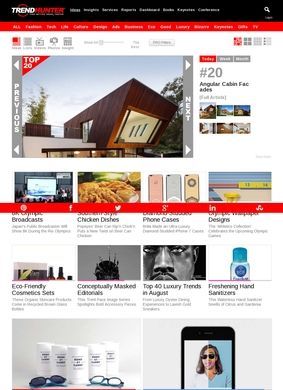
Sixty million people a month land on a site built to tell you what is about to be cool. That headline number is Trend Hunter's own claim, and whether or not the figure is exact, the scale of what runs through the platform is the first thing that registers. Based in Toronto, Trend Hunter positions itself as the largest trend-spotting operation around, and the front of the site backs that up with a constant churn of articles sorted into Design, Fashion, Tech, Lifestyle, Business and a dozen other buckets. The volume is genuine. New entries keep arriving, drawn from a crowd of contributors and shaped by editors, so the design category alone feels less like a magazine and more like a feed that never stops refilling.
Paid research products for corporate teams
The reading material is the public face, but it is not really what the company sells. Underneath the free article stream sits a stack of paid products aimed at corporate innovation teams, strategists and marketers. Trend Hunter's reports come in two flavours: ready-made studies covering areas like design, gadgets, art and pop culture, and custom research commissioned for a specific client question. There is a rapid consumer-research tool called Survey Fast, a forecasting product named Horizon, and longer consulting engagements for companies that want a team to dig into a problem with them. The design coverage that pulls casual readers in doubles as a sample of the methodology those clients are paying for, which is a tidy arrangement that few comparable platforms bother to close properly.
Events and training offerings
Beyond the research itself, the offering branches into events and education. Future Festival is the flagship conference, the kind of annual gathering a brand sends its strategy people to. FuturistU is a training and learning platform, and Masterclass-style content teaches the mechanics of trend-driven innovation to anyone who wants to build the skill internally. Trend Hunter also runs a speaker bureau of its own in-house futurists, so a corporate booking can pull a keynote and a workshop from the same source. It is a wide spread for one organisation, and the navigation keeps it manageable by collapsing everything into three top-level doors: Solutions, Events and About.
Does the broad product range create confusion?
That breadth raises a fair question about focus. A platform doing free editorial, syndicated reports, custom consulting, a conference circuit, a training academy and a speaking roster is wearing a lot of hats. The thread tying them together is trend intelligence, and most of the pieces feed each other in a sensible way: the articles supply raw signal for the reports, the reports inform the keynotes, the keynotes sell the training. Still, a buyer arriving with a narrow need, say a single custom study, has to wade past a fair bit of adjacent product before reaching it. The site is organised well enough that this is a minor friction more than a real obstacle, but it is worth flagging for anyone who prefers a leaner sales experience.
Employee satisfaction versus client feedback
The picture here is lopsided in an interesting way. The strongest signal comes from the employee side: Glassdoor carries 63 reviews with an overall rating near 3.9 out of 5 and roughly seven in ten staff saying they would recommend the place to a friend. Indeed's Canadian listing adds more employee feedback, though the count there is not clear. For a company whose product is human judgement about culture and design, a consistently positive workforce sentiment has real consequence, because the people writing the trend pieces are the asset. Take the editorial quality away and Trend Hunter is just a publishing platform with a conference attached.
Inside the sparse customer review landscape
On the client-facing side, the picture is sparser. Trustpilot shows only two reviews, far too few to draw anything from, and a 4.9 figure on Smart.reviews comes with no clear source or volume behind it. No large body of independent client testimony turned up anywhere obvious. That absence is less damning than it would be for a restaurant or a shop. Trend Hunter sells to innovation departments and marketing teams, and that kind of business-to-business relationship rarely generates public star ratings. Big clients sign contracts and stay quiet about it. A prospective buyer would do better judging the company on the published research it can freely sample than on a Trustpilot score that barely exists.
Contact process requires extra navigation steps
Contact is the one place where the polish slips slightly. The landing page does not put a phone number or email address in front of you, and reaching a person means working through the About or Solutions sections, where the path is almost certainly a form. For a company courting enterprise budgets, a form-first approach is normal and even expected. But the lack of a clearly posted phone line on the homepage means a visitor in a hurry has to hunt a bit, and a more prominent inquiry route would cost Trend Hunter nothing while reassuring a serious buyer faster.
What you get from Trend Hunter depends heavily on which door you walk through. A curious reader gets an endless, well-sorted stream of design and culture stories for free, refreshed faster than almost anything comparable. A corporate team gets a research-and-consulting partner with a real archive of signal behind it, plus events and training if they want to build the capability in-house. The Toronto base, the published methodology and the steady editorial output give the operation a substance that a lot of trend blogs lack once you look past the homepage.
The reservations are modest: a product list broad enough to blur at the edges, customer testimony too sparse to lean on, and contact details that hide one click too deep. None of those undercut the core value, which is a genuinely large and genuinely active intelligence engine that has been running long enough to have a recognisable name in its field. Trend Hunter's free side alone justifies a bookmark for anyone curious about what is coming next in design or culture. Whether the paid tier delivers the specific, decision-ready research a corporate team needs is a different question, and the published sample material is the most honest place to go looking for that answer.