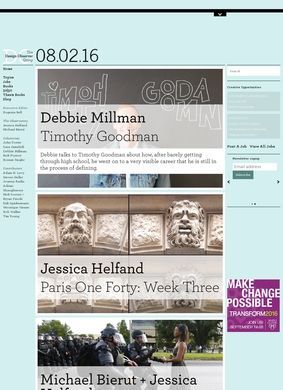
Two designers, Jessica Helfand and Michael Bierut, started this publication back in 2003, and the thing that strikes you first is how little it has drifted from its purpose since. Design Observer is a place to read serious writing about design rather than a portfolio shop or a tool vendor. The essays, articles, reviews and peer-reviewed pieces are organized into channels with names like Theory + Criticism, The Built World, Civic Life, Innovation and Sustainability, which tells you the editors think about design as something that touches cities, schools and public life, logos and grids included but far from the whole story.
Writing organized by design discipline
If you spend an afternoon clicking through, the breadth is real and not padded. Arts + Culture sits next to Business and Education; Design Impact gets its own space. The writing leans toward criticism and commentary, which means you get arguments and opinions rather than press releases dressed up as features. For a working designer who wants to read something with a spine to it, that distinction is the whole point.
Audio programming across multiple shows
The audio side is genuinely deep. "Design Matters" is the long-running flagship, and around it sit "Draw the Line," "DB | BD," "Design As," "The Futures Archive," "She the People," "Connect 4" and "Insights per Minute." That is a lot of programming for one editorial outfit to sustain, and the range of formats shows a willingness to experiment with how design conversation actually sounds instead of recording the same interview week after week.
Newsletters tracking AI and equity in design
On the written-update side there are three newsletters: The Observatory Newsletter, AI Observer, and Equity Observer. The AI and equity framing is worth noting because it shows Design Observer tracking where design is being pulled now, into machine systems and into questions of who design serves. A YouTube channel and a jobs board round things out; the jobs board gives a designer a practical reason to keep the site bookmarked beyond the reading.
Navigation challenges on a prolific site
The volume of channels and shows can feel like a lot to navigate on a first visit, and a newcomer might not know where to start. That is a fair criticism of any publication this prolific, though it is the good kind of problem, too much to read instead of too little.
Recognition through awards and academic ties
On the credibility side, Design Observer has been nominated for seven Webby Awards, five of those for Best Culture Blog and two for Best Writing. Awards for a culture blog and for writing specifically are the relevant ones for a publication that lives or dies on the quality of its prose, so the nominations land as meaningful, not decorative. Yale University's Office of Career Strategy points students toward it, and there is a Wikipedia entry, both of which are the sort of third-party acknowledgement that is difficult to game.
How does Design Observer build credibility?
Consumer review platforms are a different story, and an unsurprising one. There are no Google, Trustpilot or Yelp ratings to cite, which is exactly what you would expect for an editorial site, people do not leave star ratings on essay collections the way they rate plumbers. Listing Design Observer in a business directory yields similarly sparse results: on LinkedIn the publication reports 4,802 followers, a modest number for a niche design audience, and Crunchbase lists it as an established online platform. None of this is a mass-market footprint, and it should not be read as one; the reach is professional and specialist by design.
Contact information and physical location
Finding the people behind Design Observer is reasonably straightforward. There is a contact page at the expected address, and a mailing address on Parsonage Street is listed, so the operation has a physical anchor and is not hiding behind a form alone. No phone number turns up on the homepage, which is normal for a publication that runs on email and editorial submissions. Anyone with a pitch, a correction or a partnership question has a clear route in.
Editorial independence as reader draw
The editorial independence is what keeps bringing readers back. Design Observer is not a brand magazine funded to flatter an industry; it reads like writers and editors who care about argument, and that tone is consistent across the channels, the podcasts and the newsletters. The peer-reviewed pieces in particular show the site wants some of its work held to an academic standard, which is rare for something that also publishes quick blog posts and topical commentary in the same breath.
Start with the "Design Matters" archive or one essay in Theory + Criticism, see whether the voice suits you, then sign up for whichever of the three newsletters matches what you work on. Students sent here by a careers office will find the same depth a practicing critic would, and that consistency is the best argument for putting Design Observer on a short list of design publications worth following.