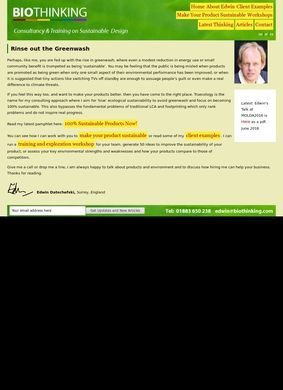
Behind Greener by Design sits Biothinking, a one-person sustainability consultancy run by Edwin Datschefski out of Surrey, England. The pitch is narrow: help businesses and product teams design things that are genuinely ecological, with a low environmental cost built into the whole product instead of a green coat of paint over the same item. Where a lot of environmental consulting hedges, this site stakes out a clear position, aiming for 100 percent sustainable product design and treating anything short of that as the starting point for work, not the finish line.
Truecology method and service offerings
The method has a name, "Truecology," and a few concrete promises hang off it. The headline one is the generation of 50 sustainability improvement ideas for a single product during an engagement, which is a refreshingly specific number to put on the table. Alongside that sits an environmental assessment that looks at a product's strengths and weaknesses and lines it up against competitors, plus training and exploration workshops aimed at business teams. None of this is vague mission-statement language. You can read what Greener by Design proposes and know roughly what you would be paying for, which is more than many consultancy pages manage.
Sustainability improvement ideas
What stands out about the framing is that it picks a fight with greenwashing rather than tiptoeing around it. The argument running through Greener by Design is that swapping a logo to green or adding a recycled-content line does little, and that real ecological design means rethinking the product itself. For a product team that already suspects its sustainability claims are hollow, that is a useful perspective to bring into the room. The 50-ideas format also implies a working session that ends with a concrete list a team can act on.
Single practitioner framework
The flip side is that this rests almost entirely on one practitioner's framework and reputation. Datschefski has written and spoken on this subject for years, and the consultancy is essentially him. That can be a strength, since you know exactly who you are dealing with, but it also means there is no team page, no roster of past clients, and no case studies to thumb through. A business weighing a Greener by Design workshop has to take the approach largely on the strength of how it is described.
Editorial content and product gallery
Beyond the consulting offer, the site carries a surprising amount of editorial material, and this is where it builds genuine credibility. There are articles working through what a sustainable chair, a sustainable bicycle, a solar factory or greener white goods would look like, treating familiar objects as design problems. There is also a sustainability quiz, a set of inspirational quotes, a slideshow, and the standout piece: a gallery of roughly 800 eco-products that Greener by Design has assembled. That collection is genuinely useful as a reference, a curated set that takes real effort to assemble and is hard to find elsewhere.
Design examples across product categories
Taken together, this content does double duty. It demonstrates the thinking behind the consultancy in public, and it gives a curious visitor something to do even if they never hire anyone. A product designer browsing for examples of what good looks like would find plenty here, and the breadth of the gallery points to someone who has spent a long time paying attention to this field.
Material age and update frequency
It is worth being honest about the era this material seems to come from, though. The subject matter and the framing feel rooted in an earlier wave of sustainable design writing, and there is no clear sign of recent updates. The core ideas remain sound, but a visitor expecting current data or freshly added work may come away wanting.
Contact information gaps
The weak point is contact. The landing page shows no phone number, no email address, and nothing to act on, leaning instead on a loose "give me a call or drop me a line" line with nothing attached to it. For a sole consultant that informality is understandable, and it does not by itself mean the practice is inactive. But a prospective client ready to make an enquiry is left without a direct line, and as it stands the route to a conversation with Greener by Design is harder to find than the rest of the site would lead one to expect.
Absence of third-party reviews
Searching for external opinion turns up a landscaping company in New Rochelle, New York that happens to share the Greener by Design name, so there is no body of third-party reviews attached to this consultancy to weigh either way. That absence does not disqualify it; it just means the site has to stand on its own content, and for the most part it does.
Evaluating the consultancy today
Greener by Design works well as a source of ideas and a clearly argued position against shallow environmentalism. The eco-products gallery alone justifies a visit for anyone working in product design. As a consultancy to engage today, the picture is softer: the offer is specific and the philosophy is consistent, but missing contact details, a single-practitioner setup, and no external validation leave a serious enquirer with more homework than they should need.