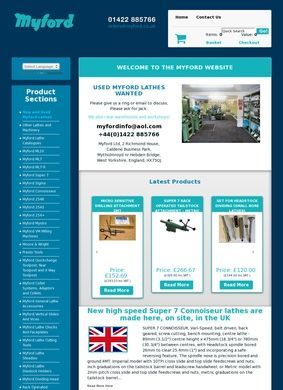
Who keeps a decades-old British lathe turning once the workshop that first built it has gone quiet? For a certain kind of machinist, the name that surfaces is Myford. Trading online as Myford Tools, the company manufactures and sells metalworking lathes, and it stocks the spares and accessories that keep older machines cutting long after they left the assembly bench. That second half of the trade, the parts side, is what pulls most people to the site well before they weigh up buying a whole machine.
Machines and parts for the home and trade workshop
At its plainest, Myford is an engineering business: lathes and the components that surround them. The Facebook page files it under Engineering Service and describes the operation as British engineering at its best, which is the kind of line a firm writes about itself, so it lands as a statement of intent more than independent proof.
What the product pages show is a working catalogue for people who cut metal, whether that is a retired toolmaker in a home shed or a small professional shop turning out short production runs. The tone is functional. It is aimed at hands that already know what a cross-slide is.
The audience is narrow and Myford plainly knows it. Hobbyist machinists and working engineers want the same two things from a supplier of this sort: a dependable machine, and a steady source for the small parts that wear, seize, or simply go missing over years of use. A lathe is a long-lived tool.
People buy one and expect to run it for a lifetime, sometimes passing it down, which means the company selling it gets judged less on the first sale than on whether it can still supply a spindle part or a change gear a decade later. The Myford catalogue is built around exactly that expectation, and that is the sharper half of the proposition.
Two model names anchor what shows up in a search: the Super 7 and the Sigma. One is the bench lathe singled out in a customer comment; the other the machine whose spares fill their own dedicated section. Between them they sketch a company that sells machines and then commits to keeping them running, which is the part that should weigh most with anyone spending real money on a tool they mean to own for good.
The Super 7 and the lathes themselves
The machine that comes through most clearly is the Myford Super 7, a lathe named directly in one of the customer comments carried on the homepage. That comment calls it brilliant and really well made, and it singles out the delivery and setup for praise. Delivery and setup are exactly the anxieties a first-time lathe buyer has, since these are heavy, precise machines that do not travel well, so it is genuinely useful to hear even from a single voice.
It is worth being precise about where that praise sits, though. This is a quote the company chose to display through a review widget embedded on its own page, not a verdict a shopper turned up independently somewhere neutral. As self-selected testimony it tells you the Super 7 has at least one satisfied owner who was happy with how it arrived and was installed.
The comment cannot stand in for a broad track record, and an honest reading keeps it in that box: one voice, chosen by the seller, saying a good thing.
Sigma spares and the details that matter
Dig into the range and the parts logic shows itself. There is a Myford Sigma Spares section, an archive of components for the Sigma lathe, sitting beside items as small as a Myford headstock nameplate. A Myford warning sticker is listed as well.
Those last two sound almost comically minor until you are the person restoring a tired machine and wanting the original plate and the correct label back where they belong. That is the culture this business serves. Restorers and long-term owners care about originality down to the transfer on the guard, and a supplier that keeps such things stocked understands them.
It is a deliberately narrow range, closer to a marque specialist than a general tool shop, and it signals a business that expects to be a repeat destination, not a one-time checkout. That narrowness is the whole appeal for the people it is meant for.
What holds up, and what a buyer cannot check
Judging the operation from outside the workshop turned out harder than it should be, for a blunt reason: the site would not open. Every attempt to load it came back blocked with an HTTP 403 refusal, so none of the on-page detail could be confirmed at first hand, not the full catalogue, not the ordering steps, not the returns terms. For a business like Myford that sells physical goods and takes orders online, a front door that turns visitors away is a real mark against it, whatever sits behind the error.
It also means a first impression, for anyone arriving cold from a search result, of a shop that will not let them in.
Contact, at least, is not a dead end. The block meant none of it could be checked on the site itself, but the Myford Facebook page lists a phone number, an email for orders and a physical address, so a determined buyer still has a way in. That is enough to place an order or ask a question when the main site is being difficult, though few first-time visitors will think to detour through social media to find a phone number.
A site that turned visitors away
The block matters more here than it would for a walk-in shop, because the spares trade depends on people across the country and further afield finding the exact component and ordering it there and then. If the page is unreachable at the moment they arrive, that is custom lost and, worse, confidence lost. The cause may be nothing sinister, a misconfigured firewall or heavy-handed bot protection rather than a site gone dark, since search snippets clearly show live product pages sitting behind the wall.
My own read is that this looks fixable and probably temporary. A first-time visitor to Myford hitting a flat refusal has no way to know that, though, and plenty will simply move to the next result and never come back. For a supplier like Myford whose edge is being the place that still has the part, an unreliable door is close to the worst failing there is.
One outside rating, and little beyond it
Independent evidence on reputation amounts to almost nothing. Trustpilot lists Myford with a single review and a score of 3.7, which is close to meaningless as evidence: one person's experience, with nothing to average it against and no telling how representative it is. Past that lone entry and the self-hosted quote on the homepage, no reviews for Myford surfaced on the other major platforms searched.
For a manufacturer with a recognisable name in its field, that quiet is a little surprising, and it leaves a prospective customer with very little third-party evidence to lean on. The lathes may well be first-rate in daily use. The public record just does not say so yet in any volume, and a careful buyer should note the gap.
So the picture is mixed, and at least it is honest about itself. Myford sells a real, focused product to a real audience, backs it with a spares archive that suggests it takes long-term ownership seriously, and keeps a reachable set of contact details behind the scenes. Set against that are two things a shopper cannot wave away: a homepage that blocked every visit, and an outside record amounting to a single Trustpilot line plus a comment Myford selected for its own page.
What a would-be buyer is left holding is one homepage quote about a well-packed Myford Super 7, that lone Trustpilot score, and a Sigma parts archive visible only through search snippets until the front door decides to open again.