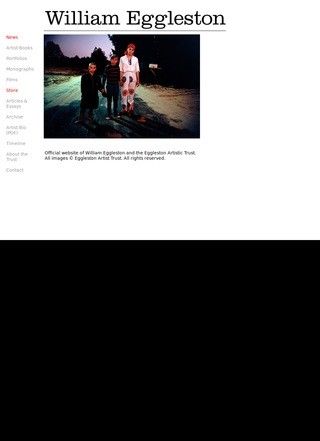
Egglestontrust.com is run by the Eggleston Artistic Trust out of Memphis as the official home for the estate, archive, and image rights of William Eggleston, the American photographer born in 1939 who did more than almost anyone to carry color into serious gallery walls. His 1976 solo exhibition at the Museum of Modern Art is the moment most often cited as the turning point, when color photography stopped being dismissed as the stuff of postcards and advertising and started being collected as art. A site sitting behind that legacy has a clear job to do: hold the pictures, control how they are reproduced, and steer the licensing and publishing that keep the work moving through galleries, books, and museums.
A caveat belongs up front. On repeated attempts the site would not serve its actual contents through standard tools: one pass returned little more than a tracking pixel and a "Do Not Sell or Share My Personal Information" link, and a fallback request came back with a server error. That leaves the real structure unverified, whether there is a plate gallery, a bibliography, a licensing request form, or a press section, because none of it loaded. Anyone planning a visit should know the front door was stuck on the days it was tested.
Archive and intellectual property
What can be stated with confidence comes from outside the site. The trust holds the Eggleston archive, and that archive has already produced real finds, among them a box of his earliest black-and-white pictures that was published later as the book "Before Color." That detail says something about the scope of what the organization keeps: the material from before the switch that made his name, sitting next to the saturated frames everyone recognizes. Beyond the photographs, the trust is the body that manages reproduction and intellectual property, the practical machinery that decides how and where the images appear. Independent accounts treat this archive as the authoritative holding, the place where the key prints and negatives are kept and from which new projects like that rediscovered early work emerge.
Publishing record and critical reception
The publishing record is where the reputation genuinely shows up, and it is deep. Eggleston's catalogue runs to roughly thirty works, from "William Eggleston's Guide" to "William Eggleston: Election Eve" to "William Eggleston in the Real World." Readers on Goodreads give his output an average near 4.24 across more than six thousand ratings and a couple of hundred written reviews. Amazon carries customer feedback on individual volumes, and independent photography blogs have handed "William Eggleston's Guide" a straight five out of five. His exhibitions draw press coverage as well, from the London Evening Standard to Haber's Art Reviews and other dedicated art-review outlets.
Behind the reputation gap
One distinction needs stating. Those ratings and reviews attach to the photographs and the printed books, not to egglestontrust.com or to the trust as an organization. A search for the trust itself in a business directory or on a review platform turns up nothing beyond the domain record; nothing assesses the website itself or the estate's stewardship of its role. So a strong public reputation clearly exists around William Eggleston the artist, while the online presence carrying his name stays largely unexamined by outside voices.
Contact and access issues
Reaching the organization is another blank, for the same reason. With the pages refusing to render, no phone number, address, contact tab, or form could be confirmed one way or the other. It may all sit there behind a working load; it simply could not be checked. A body that handles licensing and reproduction rights needs an easy path for a curator, publisher, or rights researcher to reach it, more so than a plain portfolio would, and that blank, whether it reflects an actual gap or just a fetch failure, is worth noting.
The legacy versus the website
Weighing it up is a slightly strange exercise, because I am judging a thoroughly documented legacy through a door that would not open. The case for William Eggleston himself is overwhelming: a photographer whose color work reset the medium, whose books sell and get read and rated, whose shows still pull serious critics decades on. There is almost nothing to weigh for this particular site, not because of any visible weakness but because it never appeared at all. Two different questions, and only one of them has a confident answer at the moment.
From archive to reliable access
This is plainly the address that ought to hold what a scholar, collector, or admirer needs on William Eggleston, and the name behind it settles any doubt about legitimacy. The open question is practical rather than reputational: an archive that will not surrender its contents on repeated attempts is not doing the one job a site like this exists for, no matter how solid the legacy behind it is. Until it loads reliably, the books and museum shows remain the surer route to the material itself.