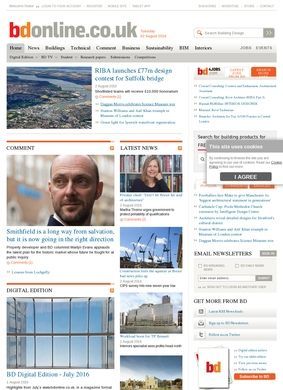
Anyone who has followed the WA100, the annual ranking of the world's hundred largest architecture practices, has run into Building Design at some point, and that award alone tells you a lot about what this site is for. It is a working reference for the UK architecture profession, published under the BD name as part of Assemble Media Group, the same stable that puts out The Architects' Journal. The homepage is dense with working news: planning rulings, practice hires and departures, competition results, project completions. Anyone who follows the industry will recognise the register straight away, and Building Design has clearly built its front page for readers who already know the terrain.
News and professional analysis
Journalism is the main thing on offer here. Building Design covers breaking stories from across British architecture and construction, then layers opinion and analysis on top. The comment and Briefing sections carry professional argument about policy, regulation, and the direction the profession is heading, which is the sort of material practitioners read to keep pace with what their peers and the people who write the rules are thinking. It is not a picture gallery pretending to be a publication. The writing does the work.
Organizing projects by sector and specification
Project coverage is organised the way an architect actually thinks about buildings. You can move through completed schemes by sector: cultural, civic, education, healthcare, housing, offices, retail, infrastructure. Someone researching a new hospital wing wants precedent from other healthcare projects, not a scroll through everything ever built, and the sector split gets them there faster. Alongside the sector view sits a technical strand arranged by specification: building services, envelope, materials, retrofit, interiors. Retrofit in particular has become a serious professional concern as the industry confronts existing stock and carbon, and giving it its own lane reflects where the discipline has moved.
Awards that carry standing in the field
Building Design puts real weight behind industry recognition. It administers the Architect of the Year Awards and the Building Awards, both long-running programmes that carry genuine standing among UK firms, and it publishes the WA100 rankings that get cited well beyond these pages. There is also the Davidson Prize, which sits at the more experimental, ideas-driven end of the spectrum. Running credible awards is a substantial editorial and logistical undertaking, and it is one of the things that separates an established title from a website that simply aggregates news. When a practice cites a placing in one of these programmes, the standing of Building Design is doing quiet work behind that claim.
CPD modules and career resources
The site also functions as a professional-development resource. It publishes CPD modules, the Continuing Professional Development material that architects in the UK are expected to accumulate, along with webinars, conferences, and sponsored educational content. For a working architect, that turns the platform from something you read in spare minutes into something that counts toward a professional obligation. The CPD strand and the awards strand reinforce each other: both keep the audience returning for reasons beyond the daily news cycle.
Careers get their own dedicated channel through BD4Jobs, a board aimed squarely at architecture and design roles, not a generic business directory padded with listings from every trade. Pairing a jobs board with the editorial side is a sensible fit, since the readership is exactly the pool that employers in this field want to reach. An events calendar rounds out the practical tools, pointing readers toward conferences, award ceremonies, and design-week activity that the publication also covers in its reporting.
From daily reporting to design-week coverage
Design-week coverage and special reports are worth calling out on their own. These are the moments when Building Design shifts from steady daily reporting to concentrated, themed output: a run of pieces around a major festival, or a deep report on a single topic. That rhythm of routine news punctuated by set-piece coverage is how serious trade titles hold an audience over a long stretch, and it is clearly deliberate here. It also gives Building Design a way to go deep on a subject without pulling reporters off the daily beat, which is a practical editorial trick more than a flourish.
Access is tiered. A good deal of the news is open, but Building Design operates a subscription model with premium and paywalled content behind sign-in, plus user registration for those who want to follow the site more closely. That is standard practice for a trade publication that funds original journalism, and it is honest about it: the sign-in and subscription routes are plainly presented rather than buried under a wall of prompts. On-site search lets a reader dig into the archive, which for a title with this much history is a meaningful part of the value. Years of project write-ups and comment become a body of reference, a store of professional record that stays useful long after the day it was published.
What holds all of this together is focus. Building Design does not try to be a general construction portal or a lifestyle-adjacent design magazine. Its readership is architects, designers, and the construction professionals who work alongside them, and nearly every section maps back to that audience: the sector-by-sector projects, the specification-led technical guidance, the CPD, the jobs, the awards. A general reader would still find the news readable, but the depth is pitched at people who need it for their work. That precision is a strength. It means the coverage can assume a level of knowledge and get to the substance quickly.
There are limits worth naming so the picture stays fair. The subscription paywall means a casual visitor will hit locked articles, and the sheer volume of news and section navigation can feel like a lot on a first visit before the structure clicks into place. Neither is a fault so much as a consequence of what the platform is: a comprehensive professional resource rather than a quick-read blog. Someone who wants the full benefit will need to register, and probably subscribe, to reach the premium analysis and the CPD library.
Measured against what it sets out to do, the platform delivers. Building Design combines current reporting, considered opinion, sector-sorted project references, technical guidance, a respected set of awards, a CPD programme, and a jobs board, and it keeps every one of those tied to the same professional audience. Sister-title lineage aside, it stands on its own record: the WA100 and the Architect of the Year Awards are cited across the field precisely because the title behind them has earned that authority over a long run. The archive alone, reachable through search, gives a working architect a reason to keep the site bookmarked.
The case for UK architecture and the surrounding construction trades is straightforward. Building Design gathers the news, the analysis, the technical reference, the career tools, and the industry recognition programmes into one place, and it does each of them with enough seriousness that they hold up individually. The paywall is the price of that quality of journalism, and whether it is worth paying depends on how central this profession is to a reader's work. The material is here, organised with real understanding of how architects think and read, and the WA100 and the Architect of the Year Awards give the title a reach well beyond its own pages.