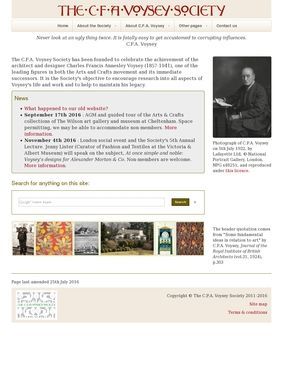
Founded in 2012, the CFA Voysey Society has chosen a narrow remit and gone deep instead of wide. The subject is Charles Francis Annesley Voysey, an architect and designer who lived from 1857 to 1941 and left a recognisable mark on the Arts and Crafts movement in Britain. The site reads as a working tool for people who already care about that period, not a soft introduction to it.
Buildings index and biographical resources
The buildings index is the part of the CFA Voysey Society site I kept coming back to. Voysey designed houses with a recognisable hand, white roughcast walls, long horizontal lines, sloping buttresses, and a cataloguing effort that tracks where those buildings are and what state they are in does real scholarly work. Paired with a biographical resource section, it turns the website into something closer to a reference than a promotional page. A researcher chasing a specific commission, or a conservation officer trying to confirm an attribution, has a starting point here that would otherwise mean trawling scattered archives. The buildings index also catalogues works that have been altered or lost, which is the kind of record that quietly disappears when no one keeps it.
The Orchard journal reaches members worldwide
An annual journal called The Orchard, posted to members anywhere in the world, sits at the centre of what the CFA Voysey Society publishes. A peer journal built around new research into one architect, arriving by post internationally, is a quiet sign that the membership is spread well beyond Britain. A tighter subject does not usually support that kind of reach, and it is worth noting because it hints at how seriously the field takes this particular organisation.
Research grants administered with academic partners
Research grants are the most concrete commitment. The CFA Voysey Society awards them to individuals and institutions studying Voysey, and it administers the scheme in partnership with the Society of Architectural Historians. That partnership gives the grants a recognised academic frame and connects the CFA Voysey Society to the wider study of architectural history instead of keeping it contained. For a postgraduate or an independent scholar, a grant tied to a named architect is rare enough to be worth knowing about, and the involvement of a national body adds credibility to a funding application.
Site visits to Voysey-designed houses
The events programme is the other half of the offer, and it is unusually specific for 2026. There is a Voysey House visit and a Bedford Park tour on 30 June, a W.D. Caroe visit to WM College on 12 September, a summer event and Annual General Meeting at Broad Leys in Windermere on 19 September, and the fifteenth annual lecture, given by Dr Steven Brindle, on 20 November. Site visits to actual Voysey-designed buildings are the sort of access that is hard to arrange independently, since many of these houses are private. Walking tours, lectures, and the AGM round out a calendar that gives members a reason to stay involved across the year, well beyond paying a subscription and reading the journal.
Inside Broad Leys on Windermere
The Broad Leys venue deserves a note of its own. Holding the summer event and AGM at a Voysey building on Windermere is a neat piece of programming, putting the membership inside the very subject they study. The appeal of Voysey is not abstract; it lives in particular rooms and particular views, and an AGM in such a setting is a stronger draw than a hired conference room ever would be.
Annual lecture series demonstrates institutional continuity
The fifteenth annual lecture is a telling number. A society that has run a flagship lecture every year since shortly after its founding, and that lines up a named historian like Dr Steven Brindle to give it, has built a habit of continuity. The 2026 calendar carries dates, places, and people rather than vague intentions, and that specificity is the clearest evidence that the CFA Voysey Society is active. For anyone assessing a niche organisation at a distance, that is the first thing to confirm.
Three strands of membership value
Taken together, the offer breaks into three strands: funded research, published research, and the chance to see the work in person. The CFA Voysey Society holds the three together rather than leaning on any one. The grants produce scholarship, the journal carries it, and the visits keep the membership connected to the physical record. Few single-architect societies manage all three with this much detail on the page.
Scope limited to historical study, not practice
It is worth being clear about scope. This is not a resource for someone shopping for an architect or a design service. The CFA Voysey Society is educational and historical, aimed at people who want to understand a body of work that is already complete and partly listed for protection. Anyone arriving expecting practitioner services will be in the wrong place, and the site does not pretend otherwise. The audience is members, architectural historians, and researchers, and the content is pitched at exactly that level.
There is a wider value here too, beyond the membership. Arts and Crafts architecture is studied across schools of design and conservation, and a single point that gathers grants, a peer journal, a buildings index, and a biography into one place reduces a lot of friction for students entering the field. The CFA Voysey Society effectively curates the Voysey corpus, a service to scholarship even for people who never join. Within a business directory listing under architecture, the CFA Voysey Society is one of the few entries that points to primary scholarly material instead of commercial work.
If there is a limitation, it is the natural ceiling of the subject. One architect, however significant, is a finite topic, and the CFA Voysey Society has clearly accepted that by going deep on cataloguing, grants, and recurring events instead of stretching the remit. That focus reads as a strength, because it means the work is thorough where it counts.
There is no significant body of third-party reviews for the CFA Voysey Society on general platforms, which is typical for learned societies of this kind. The evidence available is what the organisation publishes about itself: a named grant programme, a peer journal running since 2012, a specific events calendar, and a buildings index that does not exist anywhere else in the same form. Taken on that basis, the CFA Voysey Society repays the attention of anyone serious about this corner of British architecture. The grant scheme run with the Society of Architectural Historians is the detail worth chasing first; check open deadlines before drafting a proposal.