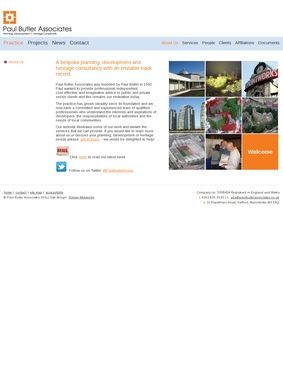
Manchester United FC sitting on the client list alongside Bruntwood, Renaker, DeTrafford and Salix Homes is a spread that runs from a globally known football club to social housing providers, and it tells you a fair amount about the kind of work Paul Butler Associates: Planning, Development & Heritage Consultants handles day to day. Paul Butler Associates: Planning, Development & Heritage Consultants is a Salford practice, founded in 1992, that advises on planning and the heritage side of the built environment. The named projects give those claims substance: Express Building One in Manchester and Windswood in Bowdon both sit in the listed-building bracket, not the new-build-on-a-greenfield one.
Strategic planning advice and applications
Strip away the client roster and what Paul Butler Associates: Planning, Development & Heritage Consultants sells is advice at the points where a development meets the planning system. Strategic planning advice comes first, the early-stage steering that decides whether a scheme is worth pursuing and how to frame it.
Then planning applications themselves, public consultation, and the documents that go with a submission: planning statements, heritage statements, and environmental impact assessment work. There is a separate strand for heritage and archaeological advice, which is where the listed-building experience is most directly relevant. A practice can claim conservation expertise easily enough; naming the buildings it has worked on is a different thing entirely, and the Express Building and Windswood references do that job. The service descriptions at Paul Butler Associates: Planning, Development & Heritage Consultants are written in the right register for an audience that will be reading closely, not skimming for a headline.
Heritage expertise in listed buildings
Plenty of consultancies do planning. Plenty of others specialise in heritage. Putting both inside a single firm means a developer dealing with a listed structure or a conservation area does not have to coordinate two separate sets of advisers who may not agree with each other. For a city-centre scheme in Manchester, where a high proportion of sites carry some historic constraint, having the heritage judgement and the planning strategy come from the same desk is a practical advantage, not a marketing line. This is where Paul Butler Associates: Planning, Development & Heritage Consultants differs from a firm that bolts heritage on as an occasional extra.
Residential, commercial and public sector work
Sector coverage is broad without being vague. Residential is split sensibly into city-centre living and social housing, which are genuinely different markets with different drivers, and the presence of Salix Homes on the client list lines up with the social-housing claim. The firm also lists commercial work, heritage conservation, and community and leisure facilities. The client base reaches into the public sector too, with local authorities and regeneration agencies named, so the same team that advises a private developer also sits on the other side of the table for public bodies.
Paul Butler Associates: Planning, Development & Heritage Consultants works across the UK, though the centre of gravity is clearly the North West and Manchester in particular. This is a B2B consultancy, and the site reads accordingly. The audience is developers, landowners, housing associations and councils who already know what a planning statement is, and Paul Butler Associates: Planning, Development & Heritage Consultants does not waste words trying to be something broader than it is.
Professional credentials and verification
Credibility for a firm like this is not built on star ratings, and there are none to report: a search turned up no Google reviews, no Trustpilot, no consumer rating platform of any kind. For a planning consultancy that is unsurprising. The relevant markers are professional ones, and a few do show up. Paul Butler Associates: Planning, Development & Heritage Consultants appears in the IHBC database, the Institute of Historic Building Conservation, which is a meaningful reference point for heritage work specifically. It also turns up in Housing Design Awards records. In this field those citations tell a prospective client more than a five-star aggregate from the public would, and they sit comfortably with the longevity the firm has built since 1992.
The administrative basics check out. The company is registered in England and Wales under number 3398456, which puts a verifiable entity behind the trading name, and the LinkedIn presence, while modest at 261 followers, is active. Taken together it is a picture of a long-established, professionally networked practice with the formal record to back up the longevity. A phone number, email, and physical address on Blackfriars Road in Manchester are all findable without effort, and the registration number means anyone can confirm exactly who they are dealing with. This business directory entry collects those essentials in one place.
The absence of outside voices is the main limit on what the listing can tell you. The professional citations establish standing within the heritage and design community, but they are not the same as hearing from a developer who took a contentious application through committee with Paul Butler Associates: Planning, Development & Heritage Consultants in the room. That kind of testimony did not surface in the search. It is not a red flag, given how this corner of the industry tends to run on word of mouth and repeat instruction rather than online reviews, but it does mean a prospective client is leaning on the named projects and the client list to judge the work. That is a reasonable thing to do when the names are this specific.
Heritage specialism as the core distinction
The depth of the heritage specialism is what separates Paul Butler Associates: Planning, Development & Heritage Consultants from a general planning shop. That depth is the firm's clearest distinguishing feature, and Paul Butler Associates: Planning, Development & Heritage Consultants has been building it for over thirty years. Listed building consent and work on historically significant structures is a niche that punishes the underprepared, because the regulatory tests are stiffer and the consultees more numerous. Express Building One is exactly the sort of project that demonstrates the capability rather than asserting it. A developer with a sensitive site, an old industrial building due for conversion, or a structure in a conservation area will find relevant experience already on the table.
For straightforward residential or commercial schemes with no historic complication, Paul Butler Associates: Planning, Development & Heritage Consultants is still a credible choice, but the distinctive value is less pronounced. Plenty of consultancies can shepherd an uncontroversial application through. The heritage and archaeological strand is where this practice has something specific to offer. Public consultation sits alongside it too, and for the larger regeneration and city-centre schemes community engagement is part of getting permission, not an afterthought.
The overall picture is of a substantial, well-rooted Manchester consultancy with a genuine heritage edge and a client base that few firms of its size could match. The registration and professional references are verifiable, the named projects are specific, and the work spans more than three decades. Paul Butler Associates: Planning, Development & Heritage Consultants presents itself as a serious firm for serious work, and the published evidence supports that.