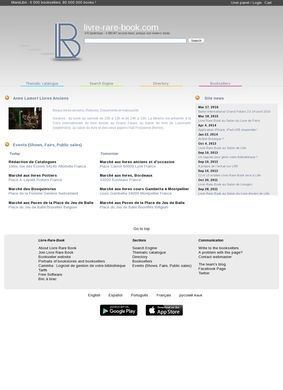
Someone hunting for a specific 1742 edition, a signed first printing, or just a battered second-hand copy of a French novel that fell out of print decades ago has a familiar problem: where do you even look? General marketplaces bury antiquarian stock under mountains of new paperbacks, and individual dealer sites are scattered across the country with no shared search. Livre Rare Book exists to solve exactly that. It pulls together roughly five million books from professional booksellers into one French-language catalogue, so a collector can search across the whole trade at once instead of emailing shops one at a time.
Browse categories for collectors
The depth of the browse categories tells you who this is built for. Autographs, comics, incunabula (the early printed books from the first decades of movable type), engravings, history, literature, maps, music, photography, posters, and travel material all get their own entry points. That is the spread you want when the thing you are chasing might be a hand-coloured map, a piece of sheet music, or a poster instead of a bound book. Livre Rare Book treats all of these as collectable objects in their own right, which matches how the antiquarian trade actually works.
Searching across five million titles
For anyone who registers, the tools go beyond simple browsing. You can save searches, keep wishlists, message sellers directly, and track orders. The saved-search feature is particularly well-suited to this corner of the market, because the book you want may not be listed today but could surface next month when a dealer in Brussels or Geneva catalogues a new acquisition. A standing search that pings you is more useful on Livre Rare Book than on almost any general platform, given how sparsely any single rare title is distributed across active stock at any moment.
Saved searches and wishlists for registered users
Livre Rare Book carries a few things that push it past being a plain listings engine. There is an event calendar covering book fairs and markets across France, Belgium, and Switzerland, which is genuinely handy for collectors who still prefer to handle stock in person before buying. A bookseller directory sits alongside it, so you can work back from a dealer you trust to everything they have on offer. The geographic focus is squarely Francophone Europe, and the platform does not pretend otherwise, which I find more honest than the usual claim of borderless global reach.
Events and dealer directory
On the professional side, the company runs subscription plans that let booksellers list and manage inventory, plus a library management software product called Caminha for handling a stock catalogue. There is a separate seller portal at a sitelibraire subdomain and a blog at a blabla subdomain, along with iOS and Android apps for searching on the move. None of this is window dressing. It points to a business that serves both ends of the transaction, the buyer browsing and the dealer keeping books organised and visible.
Subscription plans for booksellers
That dual structure shapes the buying experience in a concrete way. When the inventory comes from working booksellers who pay to be there and rely on their own reputations, the descriptions and condition notes tend to be written by people who know the difference between a foxed page and a fatal one. Livre Rare Book is the connective tissue, not the seller, and a buyer should read each listing as the word of the individual dealer behind it.
Dealer descriptions shape buyer trust
Contact arrangements fit that model. Livre Rare Book publishes a webmaster contact form for site issues and a dedicated address for reaching booksellers, which is the route most useful when you have a question about a particular copy. A company address in Lyon is on record. No public phone number turned up on the homepage, so anyone who wants to speak rather than write will need to go through the form or the seller email first. For a marketplace whose real conversations happen between buyer and individual dealer, that is a reasonable setup, though a visible phone line would round it out.
Contact methods and language limits
Outside opinion is positive but limited in volume, which is normal for a specialist platform that most general review sites never touch. Knoji shows 3.7 out of 5 across six reviews, and a single Yelp review sits at 4.0. The trust-checking services lean favourable: Scamdoc reports a 97 percent trust score and Scamadviser rates it highly, with no user complaints logged. No Trustpilot or Google review presence turned up for the main site. Six data points cannot settle much, so treat the rating as encouraging rather than decisive, and let the trust scores carry the reassurance that the operation is legitimate and long-standing.
How do ratings and trust scores measure up?
The honest limitation is the language. Livre Rare Book is French throughout, so a buyer without functional French will lean hard on browser translation and may find seller correspondence slower going. That narrows the audience, but it also reflects where the stock and the dealers actually are. The trade-off favours coverage of a market that English-language sites simply do not reach as deeply, and for the right user that is not a compromise at all.
French-language focus narrows but deepens reach
What you get is a serious aggregator for the antiquarian and second-hand French book trade, with buyer tools, dealer infrastructure, and in-person event listings to back it up. The five-million-title scale means the long-shot search is worth running on Livre Rare Book when it would be hopeless elsewhere. Register, set a saved search for the exact edition you want, and use the bookseller email to ask a dealer directly about condition before placing an order. Dealers across Francophone Europe weighing where to list stock have a second reason to look: the subscription plans and the Caminha cataloguing tool are worth asking about to see whether the fit is right for the shop.