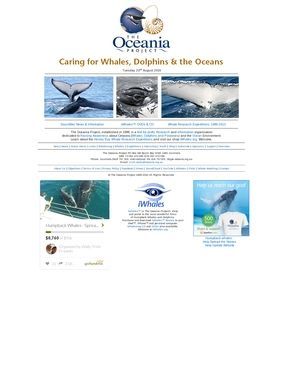
What does a whale-research charity actually give a visitor who is not a marine biologist? The Oceania Project answers it with more specifics than a typical conservation site, because it runs real fieldwork and then opens the doors around it. It is a not-for-profit research and information organisation founded by the marine scientists Trish and Wally Franklin, dedicated to raising awareness about cetacea, the whales, dolphins and porpoises, along with the wider ocean environment.
The center of gravity is fieldwork in Hervey Bay, on the Queensland coast, where the group has run whale research expeditions season after season. Everything else on the site radiates out from that fieldwork: the education, the produced media, the advocacy, and the several ways an ordinary person can get close to the work. The Oceania Project doesn't operate at scale, but it operates with a clear focus, and that focus is its strength.
From fieldwork to a wider audience
The Oceania Project does two jobs that feed each other. It gathers observations of whales in the wild, and it turns that material into something the public can use. Founded and led by working scientists, the organisation keeps a foot in genuine research while pointing most of its output at people who will never crew an expedition. That combination is what gives the site its texture, and it explains why the pages range from expedition logistics to school-friendly explainers.
The whole thing is framed around a single conviction, that people protect what they understand, and The Oceania Project spends most of its energy on the understanding part.
Whale research expeditions to Hervey Bay
The expeditions are the flagship. The Oceania Project has run annual whale research seasons in Hervey Bay across several consecutive years, and the site keeps a calendar of past and upcoming seasons so a prospective participant can plan well ahead. Hervey Bay is a well-known gathering point for humpbacks on their migration, which is why the fieldwork sits there and not somewhere more convenient.
The whale-watching side is certified through Eco-Certified Ecotourism Australia, so the trips carry an outside environmental accreditation instead of the group simply vouching for its own standards. For a visitor weighing a boat trip that claims a conservation purpose, that certification is the concrete detail that separates The Oceania Project from an ordinary tourist cruise. A participant is joining a season of observation, not a sightseeing loop, and the educational material on whale migration published across the site sets up what they will be looking at before they ever board.
There is a research payoff too. Season after season of watching the same population builds a record, and The Oceania Project frames its expeditions as data-gathering as much as encounter, which is a meaningfully different proposition from a day charter. Anyone who has been on a standard whale-watch knows the drill: a couple of hours, a few tail slaps, a photo, done. What the founders built is closer to citizen science, where the point of being on the water is contributing observations that carry across years, and the site is careful to describe the seasons in those terms.
SoundNet, iWhales and the resource shelf
Away from the water, the site runs a set of named programs, and this is where The Oceania Project starts to look like a small publisher as well as a research group. SoundNet is its news and information portal, a running feed covering the organisation and the wider ocean-conservation world. iWhales is the media arm, an online portal backed by DVDs and CDs about cetaceans; the disc formats date it a little, but they do mean there is produced, edited material behind the site instead of blog posts alone.
That distinction counts for a small charity, because it shows the group has invested in finished work a teacher or a parent can actually put in front of a class or a child.
Around those two sit the smaller resources. There is a whalesong archive, a links directory that points outward to related work, a News feed and Action Alerts for people who want to follow campaigns, educational pages on whale migration, and a merchandise shop that helps fund the operation. None of these is large on its own.
Taken together, though, they give The Oceania Project more surface than a single-issue campaign page, and they let a visitor pick a depth: a two-minute news read, a migration explainer, an internship application, or a browse through the whalesong recordings. That last archive is a niche holding a casual search would never surface, and it is the sort of thing that keeps a curious visitor on the site longer than planned.
Recordings of whalesong are exactly the material a small research group is placed to gather and a big commercial operator would never bother with, and their presence signals where the group's real interests lie.
Internships, contact and outside reputation
The Oceania Project runs internship programs for students and youth education initiatives, and this is where the research and the public-facing sides genuinely meet. A marine-science student can move from reading the site to working alongside the expeditions, and that pathway is spelled out plainly instead of merely hinted at. For a small charity, keeping a real internship track running is a meaningful signal that the research is active and staffed, not a historical footnote. The youth education work sits on the same shelf, aimed at reaching people early, before habits about the ocean have hardened.
Between the internships, the school-facing material and the expeditions themselves, the group has built a ladder that a genuinely interested person can climb, from a first curious click to a season crewing the boat, and that progression is spelled out clearly enough that a student could map their own route through it.
Contact is easy, and that counts for a group asking people to travel and volunteer. The site lists a postal address in Hervey Bay, Australian and international phone numbers, a Skype handle, and a named contact email tied to co-founder Wally Franklin. Reaching a specific, named person near the top of a small non-profit is reassuring in a way a faceless inbox is not. The registration reinforces it: The Oceania Project is a registered Australian charity with the national regulator, which puts its non-profit status on a public record anyone can check.
Outside reviews are the weak spot. A search for third-party ratings of The Oceania Project mostly turns up a completely unrelated commercial cruise line with a similar name, whose Yelp, Cruise Critic and Trustpilot scores belong to that other company and say nothing about this charity. For The Oceania Project itself, no notable third-party reviews surfaced at all.
That absence is common for a small research non-profit, where the handful of people who crew an expedition tend not to leave star ratings afterward. It does mean a newcomer cannot lean on a crowd verdict, and has to judge the group on its own materials, its named founders and its charity registration. There is a mild risk buried in the name confusion, too: a person searching casually could stumble onto the cruise line's reviews and assume they apply here, forming a false impression in either direction.
Reading the address and the charity details closely is the only sure way to confirm which organisation is actually in view.
That is a fair trade for what the organisation is. The Oceania Project is transparent about who runs it, easy to reach, externally certified on the ecotourism side, and openly registered as a charity, which together do a lot of the work a pile of reviews would otherwise do.
The missing outside reviews are a genuine gap, though the fieldwork, the ecotourism certification and the named, reachable founders give a first-time visitor plenty to weigh without needing a pile of star ratings first. What sets The Oceania Project apart is how little of that weighing is left to guesswork: the address checks out, the accreditation comes from outside the organisation, and the person answering the phone or the email has a name and a body of published research attached to it.